

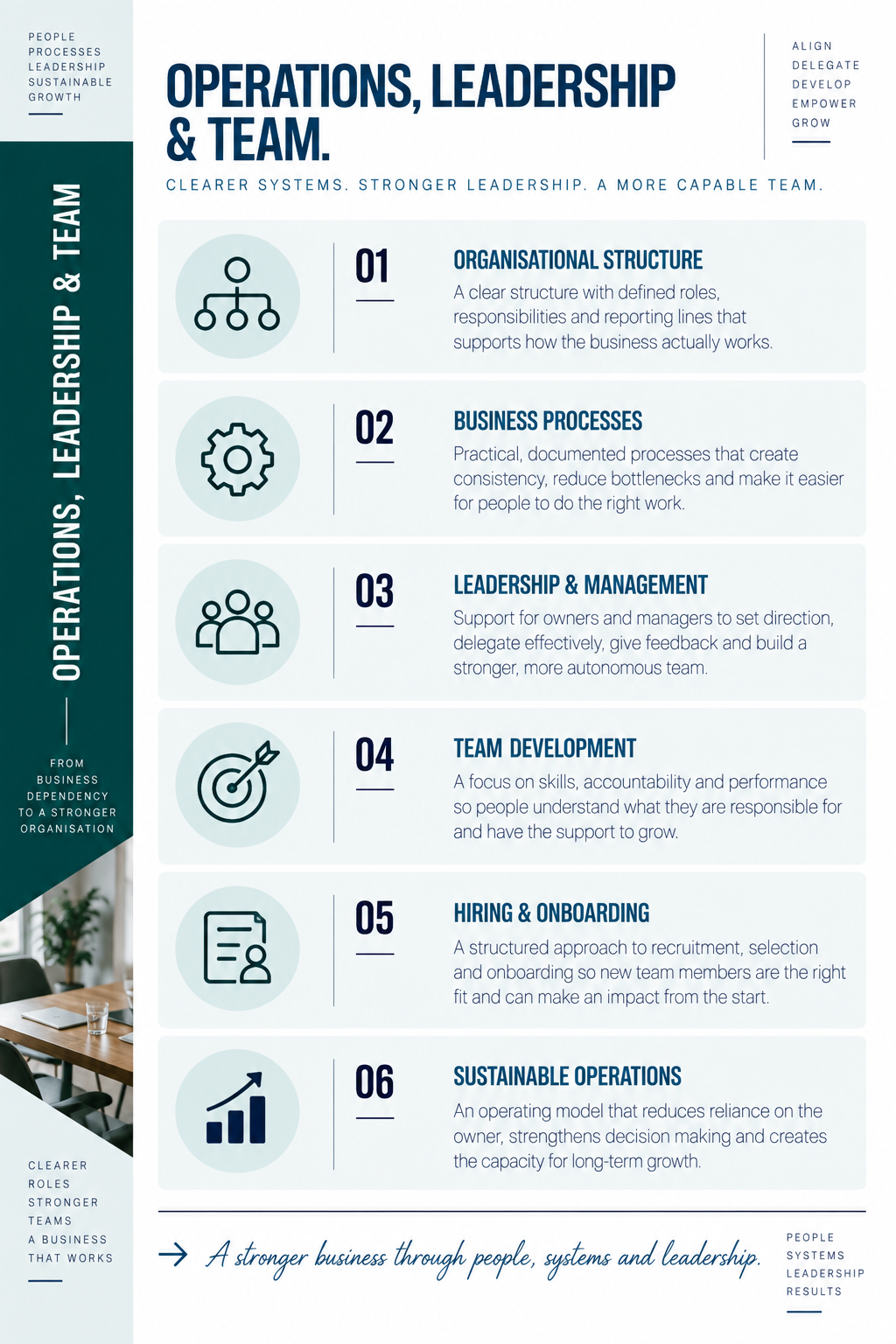
Operations, Leadership & Team.
As a business grows, the challenge is rarely just needing more people. More employees, managers, departments, customers and daily decisions make the business more complex. When roles remain unclear, processes live mainly in the owner’s head and people keep returning for decisions, growth can create more pressure instead of more freedom. We work across business operations, leadership and team management to understand where responsibility is unclear, where decisions get stuck and why the business still depends too heavily on particular people.
We build the business systems around how work actually needs to happen, then develop the people responsible for making those systems work.
That can include organisational structure, roles and responsibilities, business processes, delegation, decision making, management routines, task setting, feedback, hiring, onboarding and team development, brought together as one practical operating structure rather than a collection of disconnected policies and procedures. But structure alone is not enough. We also work with owners and managers on business leadership: how responsibility is delegated, how expectations are set, how performance is managed and how people develop the judgement and confidence to make appropriate decisions without constantly returning to the owner.
The result is not simply a cleaner organisational chart. It is a business where responsibilities are clearer, managers can lead, employees understand the results they own and fewer everyday decisions depend on the owner.
Build a company that works through clear operations, accountable leadership and a capable team, not constant owner intervention.
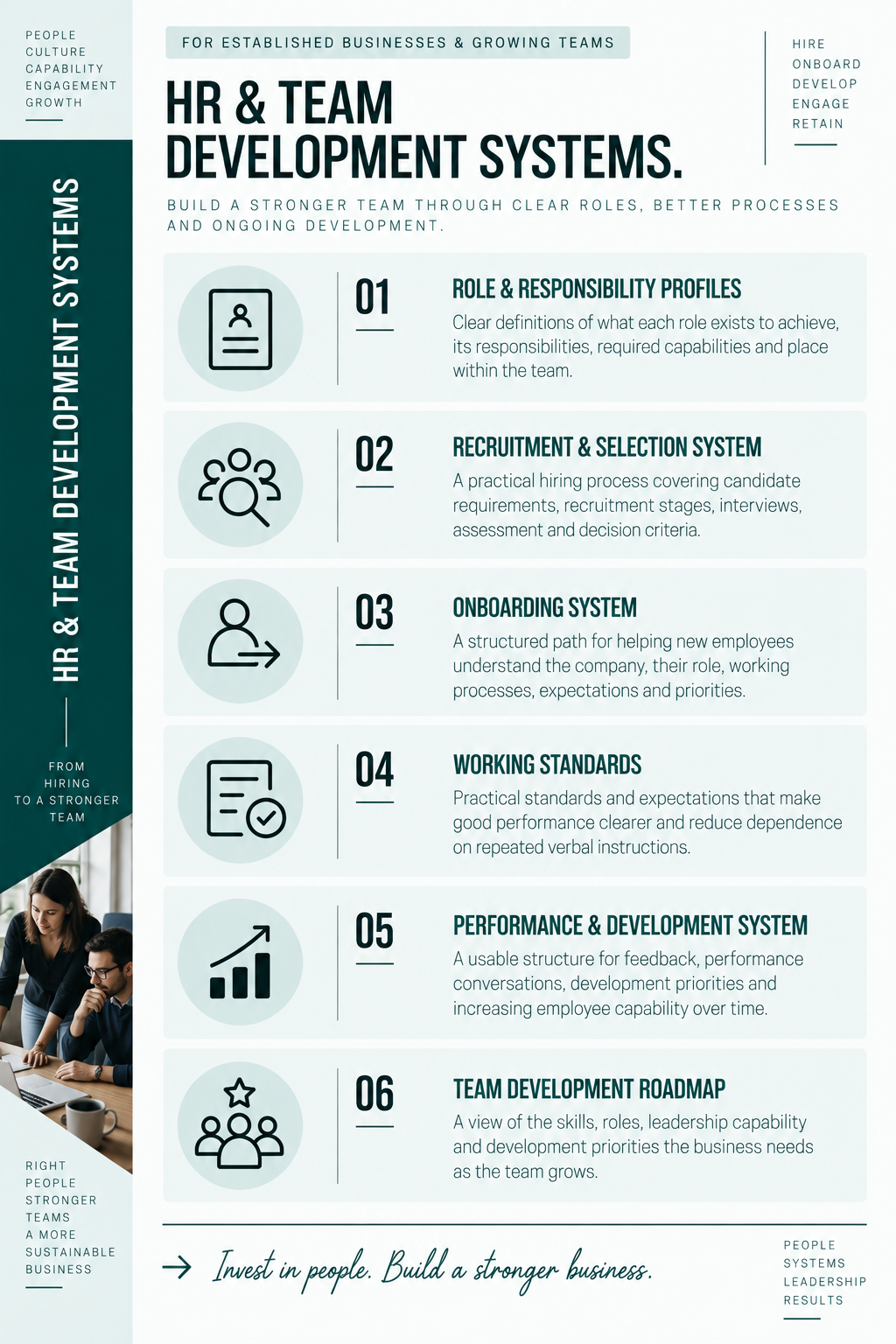
HR & TEAM DEVELOPMENT SYSTEMS
Build a hiring and team development system that helps you find the right people, bring them into the business properly and develop them without everything depending on the owner.
Hiring problems often start long before a job advert is written. A business knows it needs another person, but the role is unclear, expectations exist mainly in the owner’s head and recruitment begins because somebody is urgently needed rather than because the business understands exactly what needs to be done.
We start with the role itself. What result should this person be responsible for, what work sits behind that result, what skills and behaviours are required and how the role fits into the wider team.
From there, we can build the practical HR system around the employee journey: recruitment and selection, interviews and assessment, onboarding, role expectations, working standards, feedback, performance conversations and ongoing development. The goal is not more HR paperwork. It is a more consistent way to bring people into the business, help them understand what good performance looks like and give managers a practical structure for developing them over time.
We look at:
This work starts with understanding how the company actually operates and what it needs from each role. Without that, recruitment becomes a search for a vaguely defined “good person”, onboarding becomes information transfer and performance problems become difficult to diagnose. We build the HR and team development system around the company’s real structure, management capacity and growth plans. Existing employees can be included where useful, particularly when roles are changing or people are moving into greater responsibility.
Weekly sessions allow us to implement the system while the business is using it, rather than producing a set of HR documents that sit unused.

£5,700 · 6 – 10 weeks · Weekly team sessions
WHAT YOU TAKE BACK
WHAT YOU DO WITH IT
Use the system whenever you hire, onboard, manage or develop people.
Instead of starting each recruitment process from scratch, managers know what the role requires and what they are assessing candidates against. New employees have a clearer route into the business and understand their responsibilities, working standards and expected results sooner.
Performance and development also become easier to manage because conversations can be based on defined responsibilities and observable expectations rather than vague impressions about whether somebody is “doing well”.
As the company grows, the same structure can be adapted for new roles, new managers and changing responsibilities without requiring the owner to personally explain and supervise every part of the employee journey.
Hiring becomes more deliberate. Onboarding becomes more consistent. Team development becomes part of how the business operates rather than something addressed only when there is a problem.
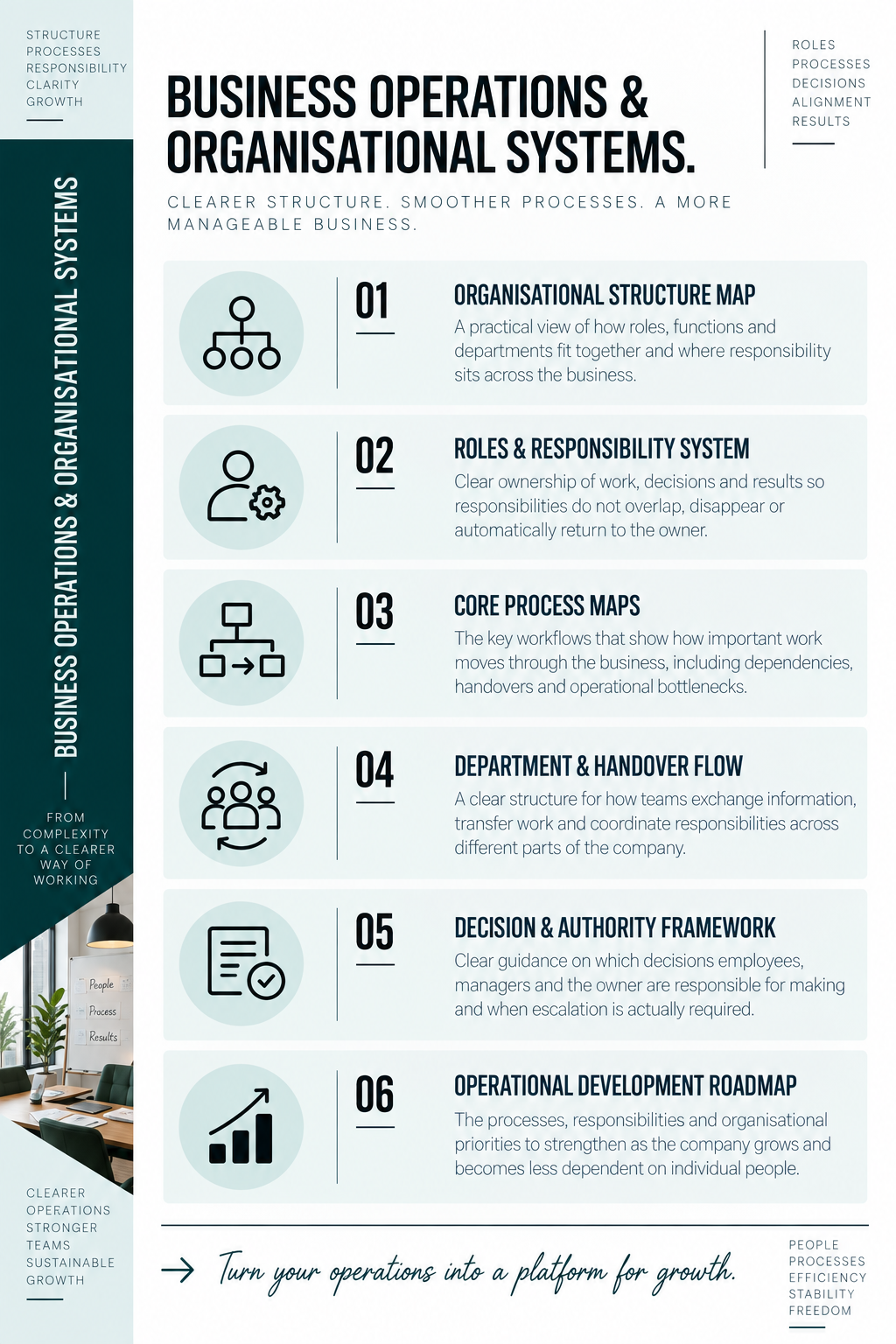
BUSINESS OPERATIONS & ORGANISATIONAL SYSTEMS
As a business grows, operational problems rarely appear all at once. They show up in everyday work. Two people think the same task belongs to each other. A process works only because one experienced employee remembers every step. Departments solve their own part of a problem without seeing what happens next. Decisions wait for the owner because nobody is sure who has the authority to make them.
The business may have good people and established ways of working, but much of its operational structure still exists through habit, individual knowledge and constant coordination.
We look at how the business actually operates, then build the organisational systems around the work that needs to happen.
That means defining roles and responsibilities, mapping business processes, clarifying how work and information move between people and departments, identifying operational bottlenecks and establishing where different decisions should be made.
We are not trying to document every action or turn the company into a collection of procedures. The purpose is to create enough structure for people to work independently while keeping responsibilities, standards and management visibility clear. The result is a more manageable business where fewer tasks fall between people, fewer decisions automatically return to the owner and growth does not have to depend on a handful of employees holding everything together.
We start with how the business works in reality, not with an ideal organisational chart. That means understanding who currently does what, how important processes actually move, where responsibilities overlap or disappear, which decisions repeatedly reach the owner and where individual employees are compensating for weaknesses in the system.
From there, we build the operational structure around the business itself. Processes are documented where documentation is useful. Responsibilities are clarified where ambiguity creates problems. Management controls are introduced where visibility is needed.
Weekly sessions allow us to test the system against real work as it develops. Owners, managers and relevant team members can bring current problems into the sessions, so responsibilities, processes and decision rules can be refined before they become embedded in the business.
£6,700 · 4 – 8 weeks · Weekly team sessions
WHAT YOU TAKE BACK
WHAT YOU DO WITH IT
Use the system as the practical operating structure behind everyday work.
Employees can see what they own, where their responsibility begins and ends and how their work connects with other people. Managers have a clearer basis for assigning work, identifying problems and holding people accountable without controlling every individual action.
Processes become easier to teach, repeat and improve because critical knowledge is no longer held only in somebody’s head. When a new employee joins or a new department is created, the company has an existing structure into which that person or function can be integrated.
Weekly sessions help move the work from diagrams into daily behaviour. We can see where responsibilities remain unclear, where a process fails in practice and where the team still defaults to asking the owner for decisions that should sit elsewhere.
As the company grows, the structure can be expanded without rebuilding the business from scratch.
The business stops operating through constant coordination and individual heroics and starts operating through clearer processes, responsibilities and decision making.
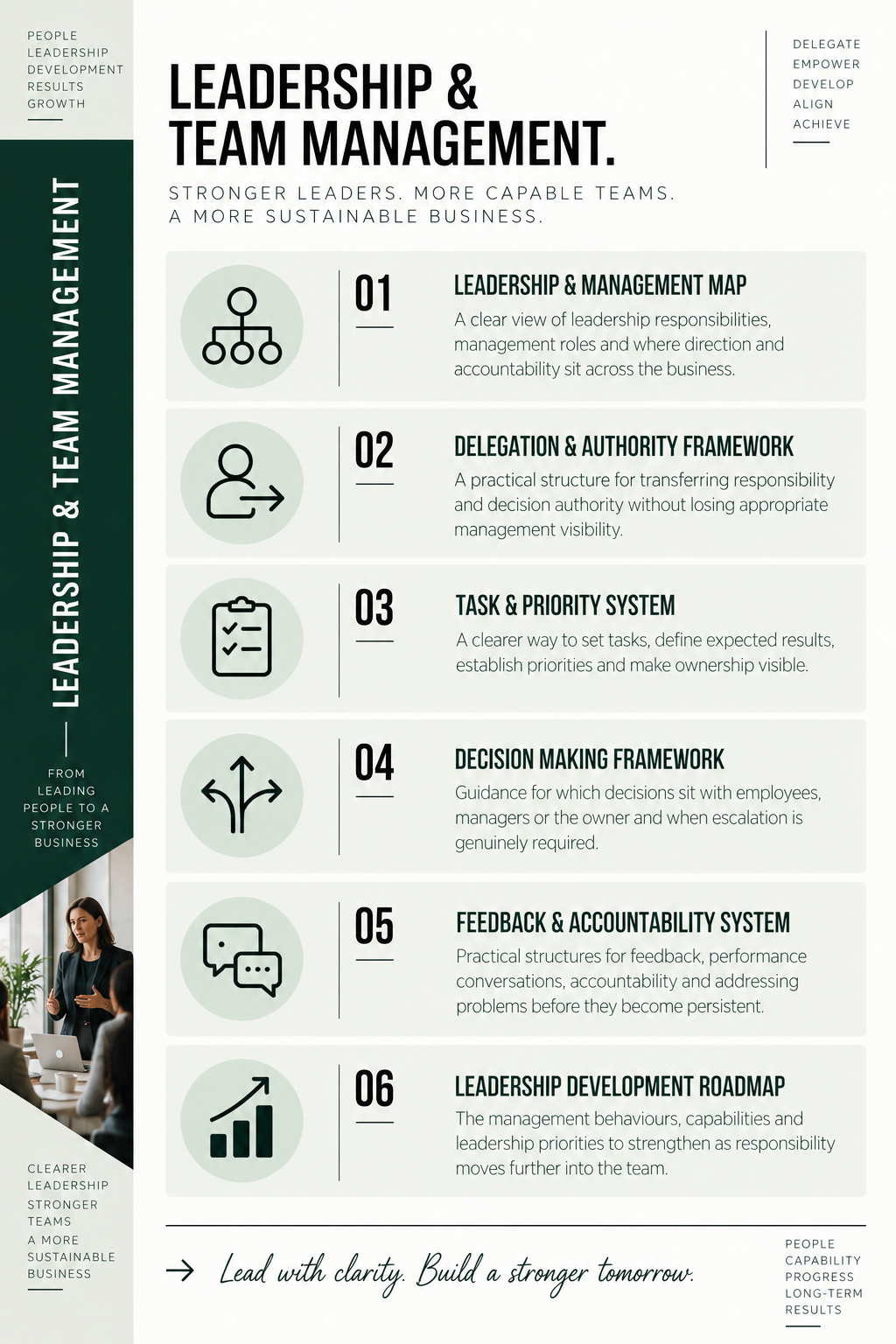
LEADERSHIP & TEAM MANAGEMENT
As a business grows, leadership becomes less about personally solving problems and more about creating the conditions in which other people can solve them well.
But many owners and managers remain the point through which priorities, decisions, approvals and difficult situations continue to pass. Tasks are delegated, but responsibility comes back. Employees wait for confirmation. Managers coordinate activity but hesitate to make decisions. The owner remains involved because stepping away feels more risky than staying in control.
We work with business owners and managers to strengthen how they lead, delegate, set priorities, make decisions and manage performance.
The work is practical and connected to the situations they are dealing with inside the business. We look at how tasks are set, how responsibility is transferred, where decisions should sit, how managers communicate expectations and feedback, and where management habits are unintentionally creating dependency or unnecessary control. This is not about becoming a more authoritative manager or introducing another layer of supervision. It is about developing leaders who can provide direction, create accountability and give people enough responsibility to become more capable and independent.
The result is a stronger leadership structure, clearer management across the business and a team that can take greater responsibility without every important decision returning to the owner.
This programme works with real management situations rather than abstract leadership theory. Current tasks, difficult conversations, delegation problems, team performance and decisions become practical material for developing stronger management habits.
Weekly working sessions with the owner and relevant managers are built into the programme. They allow new approaches to be applied between sessions, reviewed against what actually happened and adjusted until they become part of everyday management.
£5,700 · 4 – 8 weeks · Weekly leadership sessions
WHAT YOU GET
WHAT YOU DO WITH IT
Use the system to change how responsibility moves through the business.
Owners can step away from decisions that no longer require their involvement while maintaining visibility over the results that matter. Managers have a clearer understanding of what they are responsible for, what authority they have and how to lead their people without simply passing problems upwards.
Tasks become easier to manage because ownership, priorities and expected outcomes are clearer. Feedback becomes part of normal management rather than something saved for when a problem has already become serious.
As managers become more capable and employees take greater responsibility, the business becomes less dependent on constant intervention from the top.
The goal is not to help owners control their teams better. It is to build leadership strong enough that constant control is needed less.