

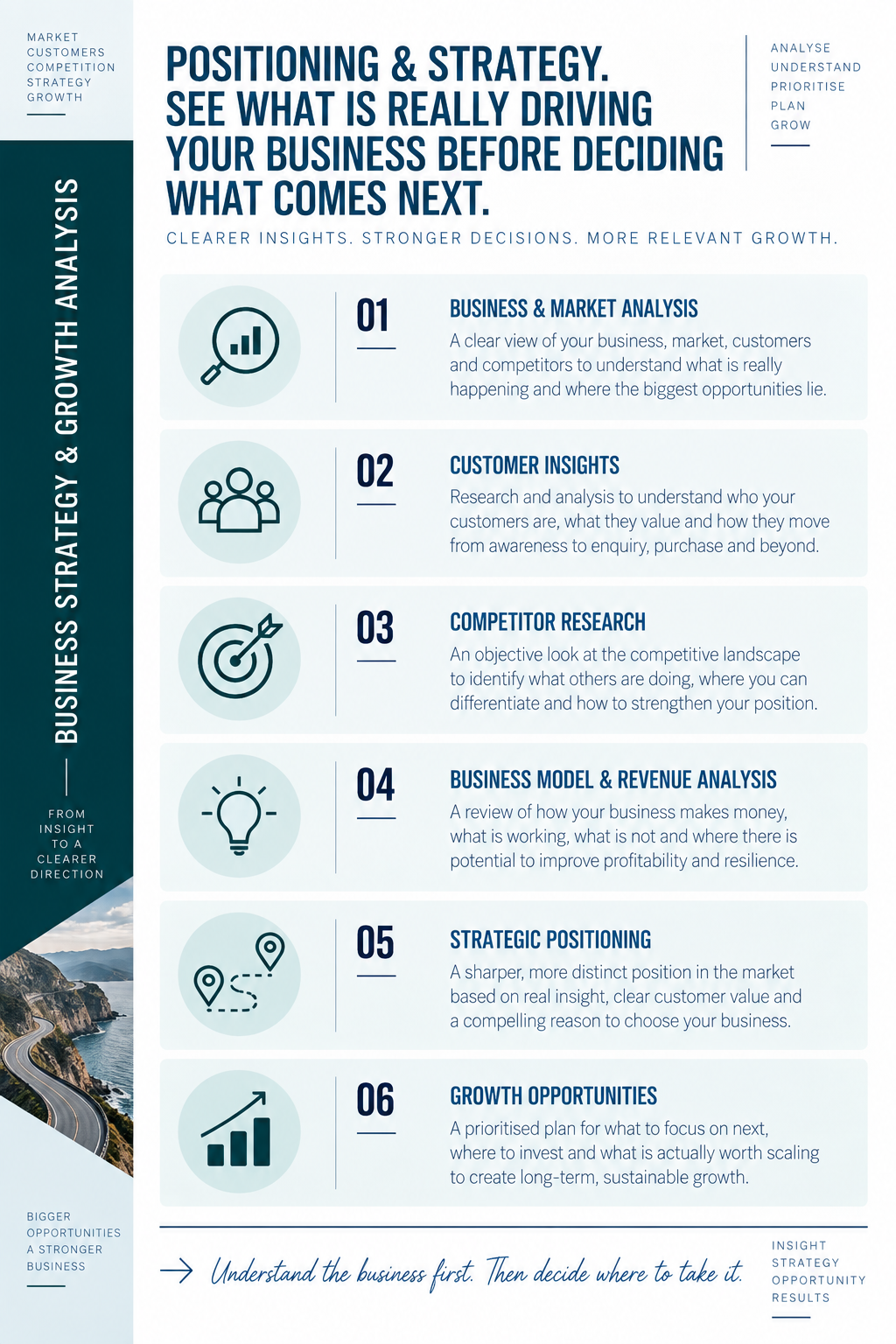
Positioning & Strategy. See what is really driving your business before deciding what comes next.
A growing business can look successful from the outside and still leave its owner unsure where the next stage of growth should come from. More marketing? A different offer? New markets? Higher prices? More people? A change in the business model?
We do not start by guessing.
We analyse the business, the market around it and the way customers move through it to understand what is actually creating growth, what is holding it back and where the strongest commercial opportunities sit.
That can include market analysis, competitor research, business model and revenue analysis, customer research, customer journey mapping, strategic positioning and growth economics brought together as one connected picture rather than a collection of separate reports.
The result is not strategy for the sake of strategy. It is a clearer basis for deciding what to change, where to invest and what is actually worth scaling.
Understand the business first. Then decide where to take it.
BUSINESS VIABILITY REVIEW
Before you build the business, find out whether the idea is worth building.
A good idea is not automatically a viable business. Before you invest in a business plan, branding, a website or the launch itself, we take an independent look at the idea: the market around it, the competitive landscape, its commercial potential and how well it fits your resources, experience and ambitions. The review combines an initial strategic session with independent research and a second meeting where we walk through what we found.
We look at:
You leave with something much more useful than encouragement: an independent view of whether the idea is worth pursuing, what may need to change and what your next step should be.
Sometimes the answer is go.
Sometimes it is change the idea.
And sometimes the smartest business decision is not to build it at all.

£300 · 1 – 2 strategic sessions · Initial analysis within 2–5 days
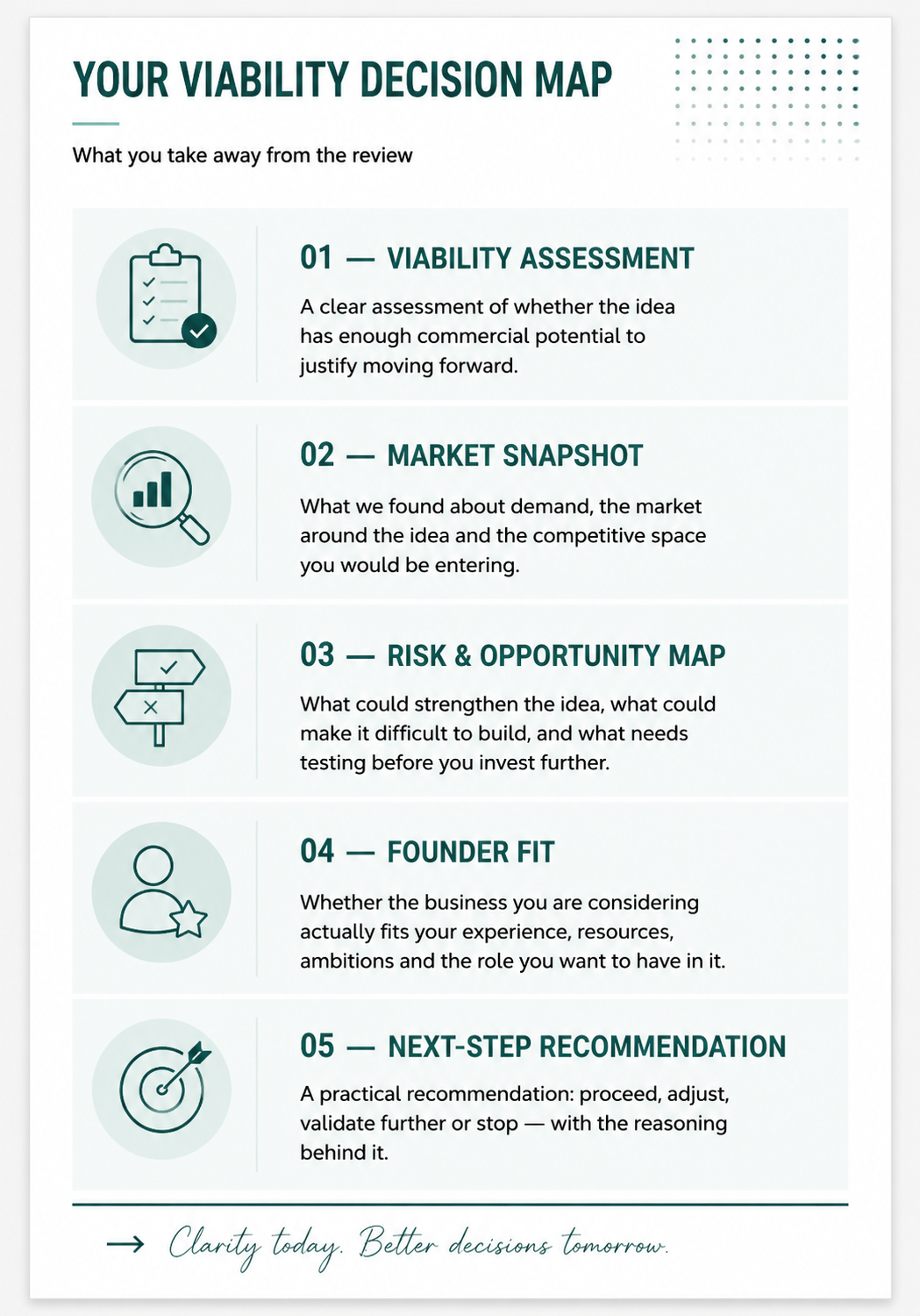
YOUR VIABILITY DECISION MAP
WHAT YOU DO WITH IT
Use it before committing significant money or time.
It gives you a basis for deciding whether to:
GO → move into deeper market research and business planning
ADJUST → change the concept, audience, offer or model before launch
TEST → validate the areas where evidence is still missing
STOP → walk away before the idea becomes an expensive commitment
MARKET ANALYSIS
Know which part of the market is actually worth pursuing.
A large market does not automatically mean a large opportunity for your business. We analyse the market around your company to understand its size, current demand, growth potential and the customer segments you can realistically reach. We then connect that picture with your services, pricing, location and the way people are actually searching for what you sell.
The purpose is practical: to stop treating “the market” as one large group of potential customers and identify where your strongest commercial opportunities actually are.
We look at:
You leave with something much more useful than encouragement: an independent view of whether the idea is worth pursuing, what may need to change and what your next step should be.
Sometimes the answer is go.
Sometimes it is change the idea.
And sometimes the smartest business decision is not to build it at all.
£2,600 · 1 – 2 weeks · minimum 2 strategic sessions
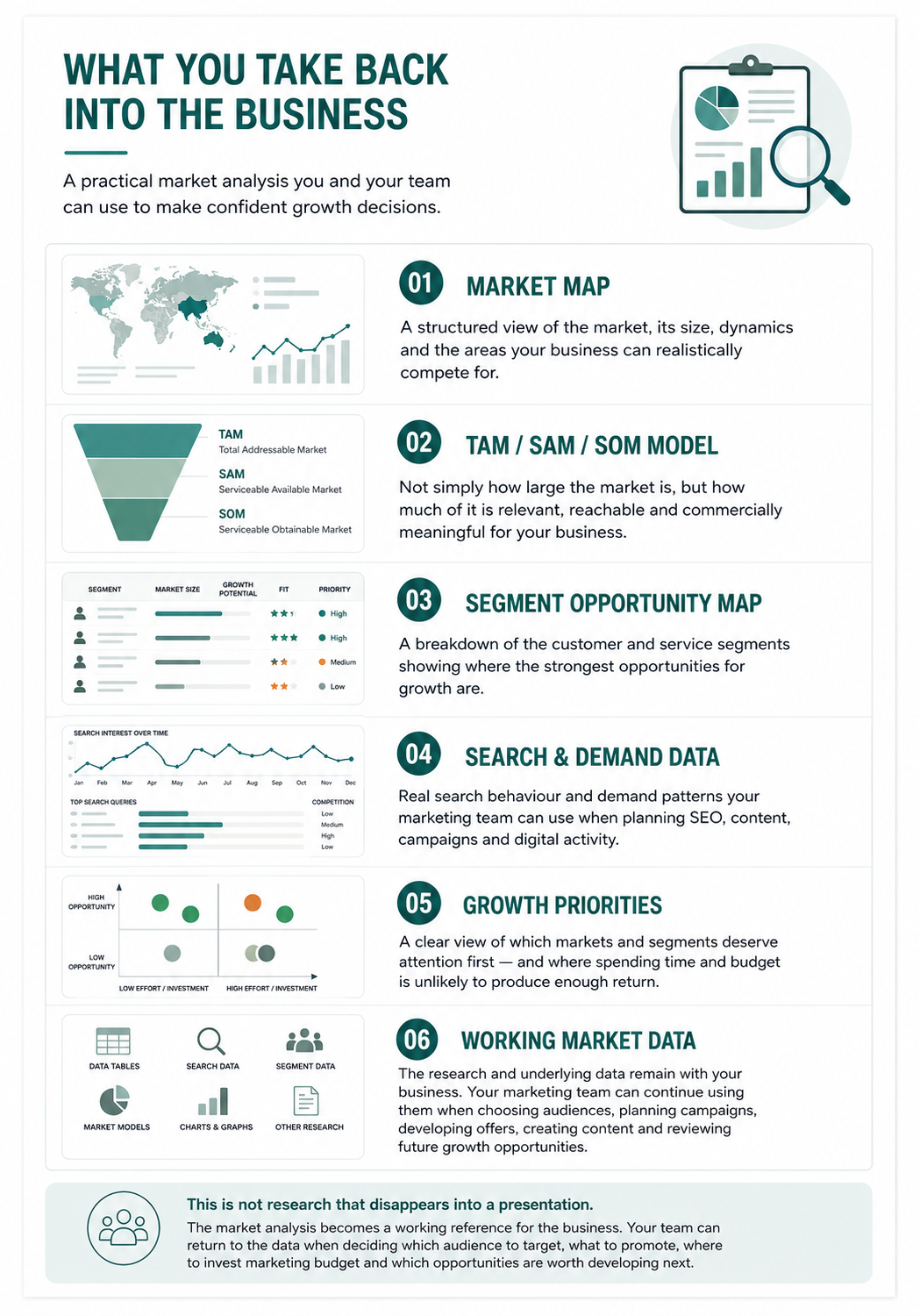
WHAT YOU TAKE BACK
WHAT YOU DO WITH IT
Use the analysis to decide where your marketing and growth effort should actually go. The data gives you a practical basis for deciding:
TARGET → which customer and service segments deserve priority
POSITION → how your offer should be presented to the parts of the market with the strongest potential
PLAN → which channels, campaigns, content and search activity are worth building around real demand
BUDGET → where marketing spend is justified and where it is unlikely to produce enough return
TEST → which assumptions still need validating before you scale
REVIEW → return to the data as the market changes and use it to compare new opportunities against the original market picture
BUSINESS DECOMPOSITION & GROWTH ANALYSIS
See how your business actually works.
Not just how much it turns over.
Most owners know their revenue. They know roughly which months were good, which were difficult and which services seem to sell. That still does not show what is actually creating the result.
We take the business apart and rebuild its numbers into one working model: month by month, product by product, from the first customer enquiry through marketing and sales to delivery, costs and final profit.
This allows us to see why one month performs differently from another, which products or services genuinely make money, where customers are being lost, which parts of the business are overloaded and where there is still capacity for growth.
We look at:
The question is not simply “How can we sell more?”
First, we establish what is worth selling more of, how much the business can currently deliver, where the money is being made or lost, and what needs to change before growth is accelerated.
Business Decomposition is built from your actual business data, not estimates or industry averages.
To carry out the analysis, we will need:
- Sales data. Monthly sales reports for at least the previous 12 months, with individual products or services identifiable wherever the existing reporting allows.
- Cost data. Monthly expenditure reports for the same period, including direct, fixed, variable and commercial costs.
- Web analytics access. Access to platforms such as Google Analytics and other analytics tools used by the business.
- Lead-generation data. Access to Meta, Google Ads and any other platforms or channels currently generating enquiries or leads.
- Sales funnel data. CRM, enquiry, quote, order or other available records that allow us to follow what happens between lead generation and completed sales.
- Business context. A minimum of three working sessions with the owner to understand how the numbers connect to what was actually happening inside the business.
The numbers tell us what happened. The sessions with the owner help us understand why.
£5,300 · 2 – 6 weeks · minimum 3 working sessions with the business owner
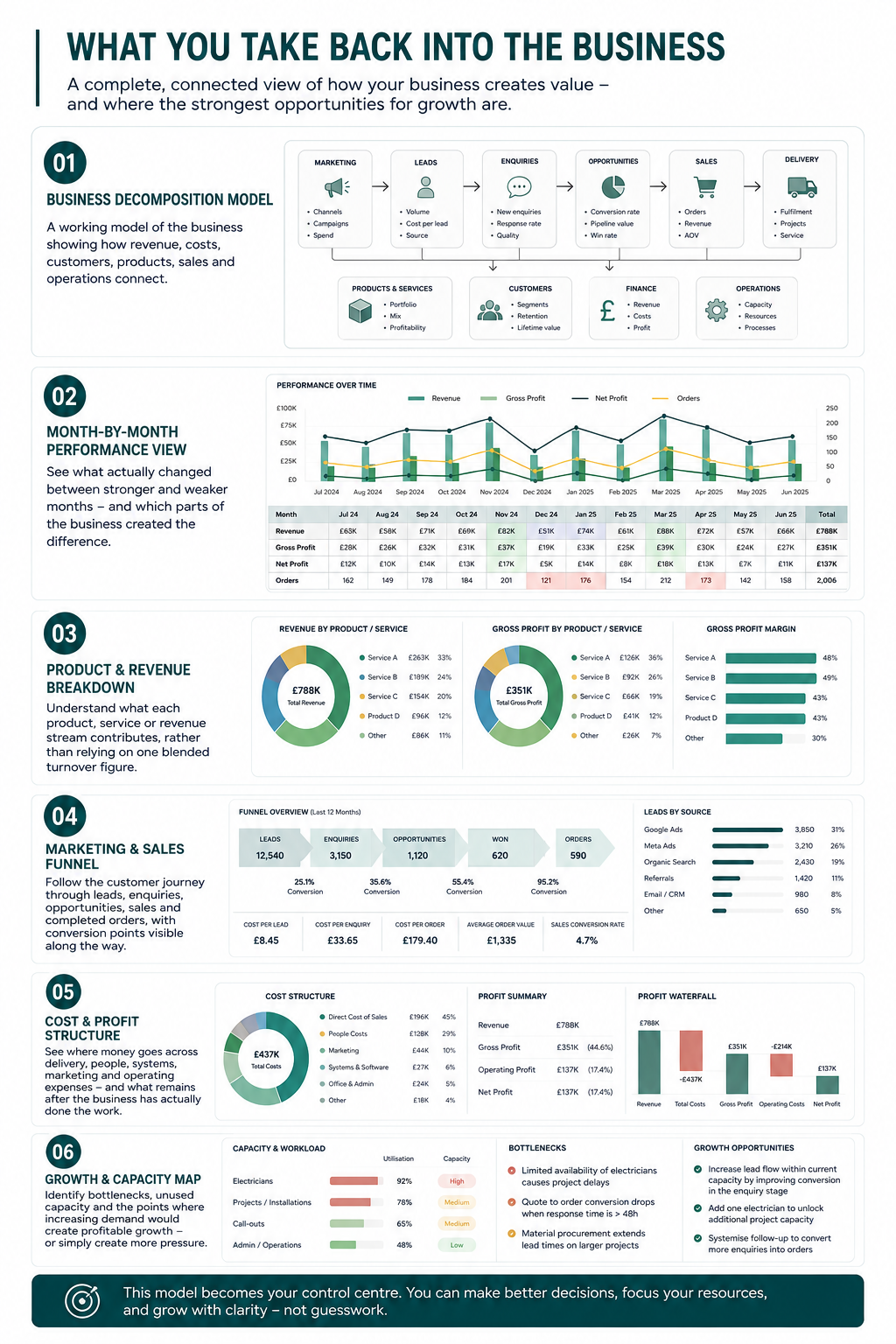
WHAT YOU TAKE BACK
WHAT YOU DO WITH IT
Use the model to stop guessing what needs to grow.
COMPARE → understand why one month produces £15k and another £35k instead of treating both as unexplained fluctuations
PRIORITISE → decide which products, services and customer types deserve more of the company’s time and resources
FIX → find where leads, sales, money, capacity or working time are being lost
PLAN → connect marketing activity with the amount and type of work the business can actually deliver
MODEL → test what happens if you change prices, sales volumes, product mix, marketing spend, team capacity or operating costs
SCALE → know what needs to happen before the next stage of growth: more demand, better conversion, different work, another employee or a stronger internal system
The decomposition becomes the baseline for everything that follows.
Before we recommend more marketing, change the sales process, restructure the offer, hire people or build a growth plan, we can see what the existing business is already capable of and what is preventing it from doing that consistently.
And it does not become a static report once the analysis is finished. The model stays with the business and can continue to be updated month by month. As new sales, costs, leads, conversions and operational data are added, you can see how the business is changing over time: where performance is improving, where margins are moving, where conversion is falling and where new pressure is beginning to appear.
It can also be used for business forecasting. A separate forecast column allows you to test future scenarios in numbers: what happens if lead volume increases, conversion improves, prices change, a new product is introduced or additional people are hired. Instead of planning growth around assumptions, you can see what those decisions are likely to mean for revenue, costs, capacity and profit before you make them.
It becomes a working management tool. Not an analysis you file away. The owner can return to it with the team, compare actual performance against expectations and make future decisions from the numbers the business is producing.
COMPETITOR ANALYSIS
Know who you are really competing with and what you are competing for. Knowing the names of your competitors is not enough. We look at who already competes for your customers, how they win their attention and trust, what they sell, what they charge and where your business has room to compete differently.
The analysis goes beyond websites and price lists. We compare the parts of the competitor businesses that influence a customer’s decision:
The work includes two strategic sessions with the business owner or key decision-makers.
Session 1. Business & Competitive Context
We establish what you sell, who you currently compete for, which competitors you already encounter, how customers make their decisions and what questions the analysis needs to answer.
Independent Competitor Research
We build the competitor set, research and benchmark the relevant businesses and alternatives, and analyse the patterns, gaps, threats and opportunities emerging across the market.
Session 2. Findings & Strategic Review
We take you through the findings, explain what they mean for your business and identify the competitive priorities that should influence the decisions that follow.
£2,600 · 1 – 2 weeks · minimum 2 strategic sessions
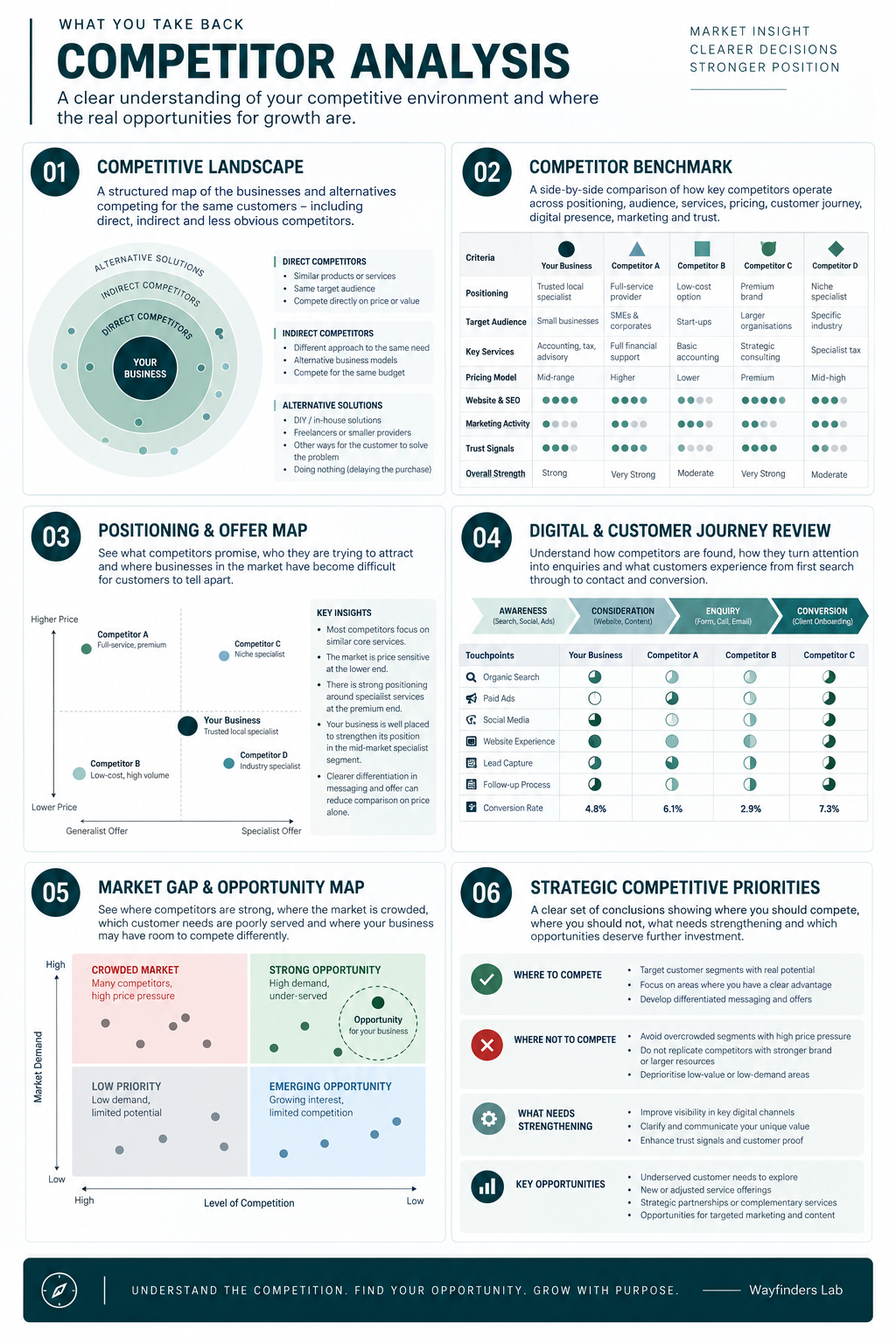
WHAT YOU GET
WHAT YOU DO WITH IT
This analysis becomes a reference point for the decisions that follow.
Use it when developing or reviewing your positioning, products, pricing, website, SEO, marketing channels, customer journey and sales proposition. Instead of making those decisions by looking only at your own business, you can see what the customer is already being offered elsewhere — and what you need to do differently to give them a reason to choose you.
For an established business, it helps identify where you are losing competitive ground, where you are already stronger than you may realise and where further investment can create a meaningful advantage.
For a new business or new offer, it helps answer an even more fundamental question: is there enough room in the market to enter with something commercially credible — and what would that proposition need to look like?
The competitor benchmark also stays with your business. It can be revisited as competitors change their pricing, offers, websites, positioning or marketing activity, giving your team a structured way to monitor the competitive environment rather than starting the research again from zero.
BUSINESS MODEL & REVENUE STRUCTURE
Understand how your business actually creates revenue and whether that model can support sustainable growth. Revenue alone does not tell you whether a business has a strong business model.
Two companies can generate the same turnover while operating very differently. One may need to find and convert new customers every month to maintain its revenue. Another may acquire a customer through one service, retain them for years, introduce additional products and build predictable recurring income over time.
We look beneath the total revenue figure to understand how money is actually created inside the business, what role each product or service plays, and how those parts work together as a commercial system.
We look at:
For a startup or new business model, the same work helps test whether the commercial logic holds together before significant resources are committed: who pays, what they buy first, how often they may buy, where further revenue can come from and whether the model has enough potential to finance its own growth.
£1,600 · 1 – 2 weeks · 2 strategic sessions
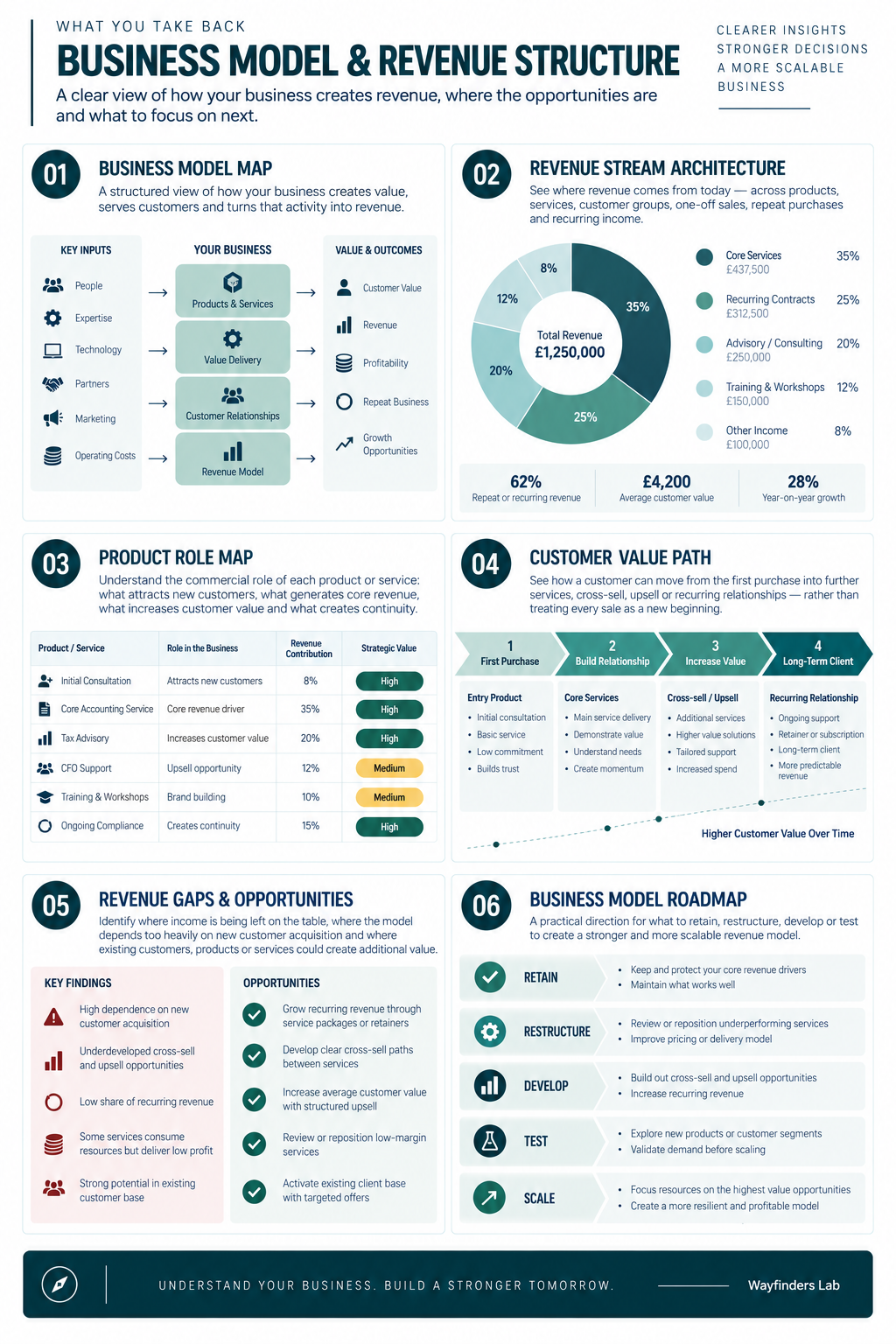
WHAT YOU GET
WHAT YOU DO WITH IT
This becomes the commercial architecture behind your future growth decisions.
You can use it to decide which customers are worth acquiring, which products should bring them into the business, what you want them to buy next and which parts of the offer deserve further investment.
For an established business, it can reveal growth that is already sitting inside the company. Instead of automatically spending more on acquiring new customers, you may find greater potential in restructuring existing services, creating a clearer product sequence, increasing average customer value, improving retention, introducing recurring revenue or developing cross-sell and upsell opportunities within the existing customer base.
It also gives marketing a much stronger commercial foundation. Instead of simply asking marketing to generate more leads, you know which customer you want to acquire, for which product, what that first sale can realistically lead to and what the customer may be worth over the full relationship with the business.
The model remains a reference point as the business develops. New products, pricing changes, subscription or recurring services and additional revenue streams can be tested against the wider architecture rather than added simply because they appear to create more turnover.
The goal is not simply to grow revenue. It is to understand which revenue is worth growing.
STRATEGIC POSITIONING
Define the position your business can credibly own…before you build the marketing around it.
Positioning is not a slogan, a brand statement or a workshop where we try to invent something that sounds different.
We build it from evidence.
We bring together what we know about the market, competitors, customers, business model, products and the direction of the business to identify a position that matters to the customer, is credible for the company to deliver and gives it a meaningful reason to be chosen over the alternatives.
The result is not simply a better way to describe the business. It becomes a shared strategic reference point for how the company presents itself, develops its offer and makes future commercial and marketing decisions.
We look at:
RESEARCH FOUNDATION REQUIRED
Strategic Positioning is a dependent module. It cannot be developed responsibly in isolation from the market it needs to work in.
The work requires a sufficient research base covering the market, competitive landscape, target audience and business model.
If your business already has recent, reliable research at the depth required, we can review and work from it. Where that foundation does not yet exist, the relevant research modules are added to the project before the positioning architecture is developed.
£2,600 · 1 – 2 weeks · 2 strategic sessions
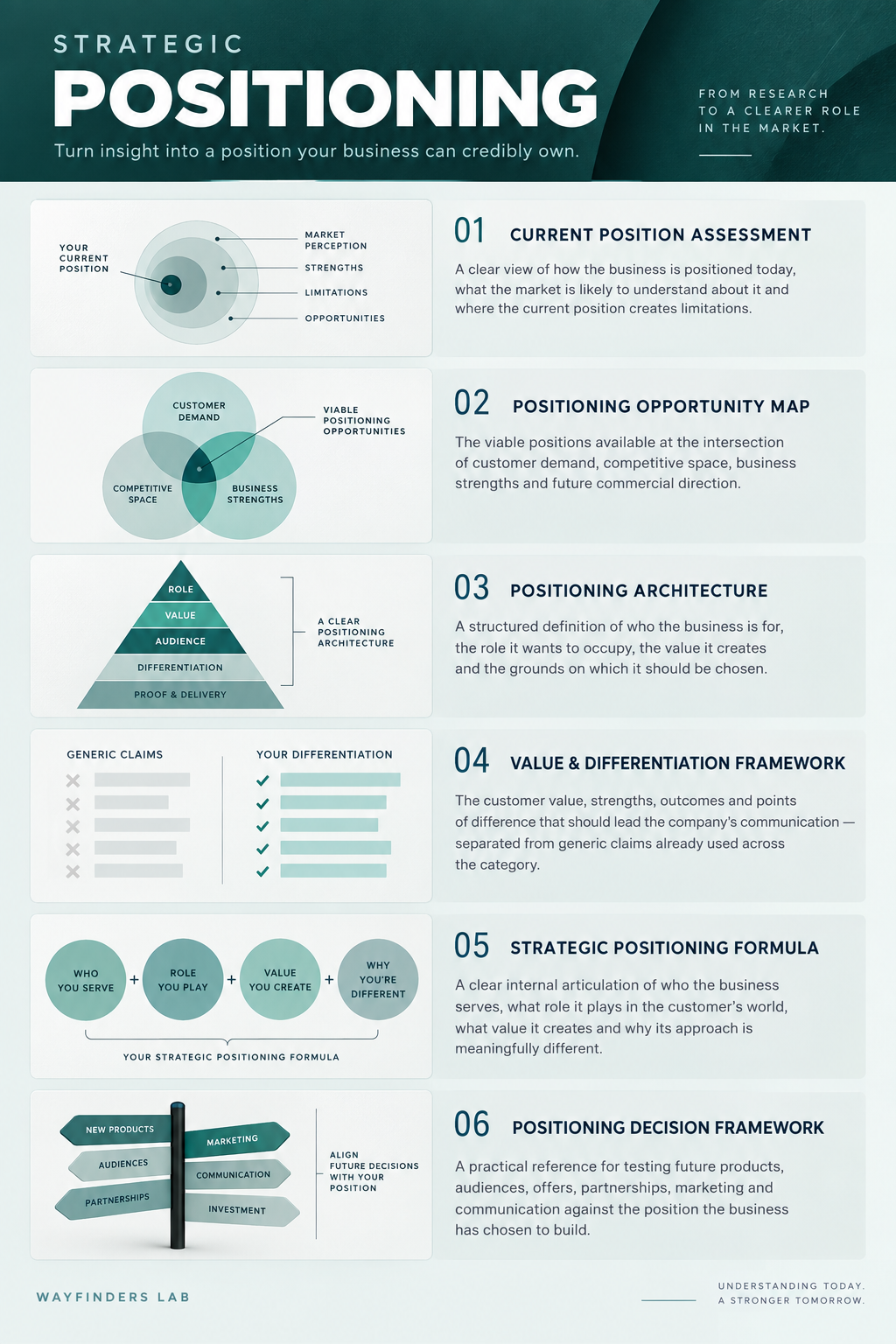
WHAT YOU GET
WHAT YOU DO WITH IT
The positioning architecture becomes a decision-making framework for the business, not simply a piece of marketing copy.
Your team can use it when deciding what the website should say, which messages advertising should lead with, what content should reinforce, how sales conversations should introduce the company and which value should remain consistent across every customer touchpoint.
But its role goes further than communication.
Use it when considering a new product, entering another customer segment, changing pricing, choosing partnerships or deciding where to invest marketing resources. Instead of asking whether an idea simply sounds good, you can ask whether it strengthens the position the company is trying to occupy, or pulls the business away from it.
For an established company, this is particularly valuable when the business has outgrown the way it currently presents itself. The company may have developed stronger expertise, better services, a different customer base or a more valuable role in its clients’ businesses while its website and marketing continue to communicate an older, narrower version of what it does.
For a startup, it creates the foundation from which the offer, messaging, website and market entry can be built… after the underlying market and commercial assumptions have been properly researched.
Once the position is clear, marketing no longer has to invent a different explanation of the business every time it creates a website page, campaign, presentation or piece of content.
CUSTOMER & DECISION ARCHITECTURE
Understand not only who your customers are, but what has to happen for them to choose your business.
Knowing a customer’s age, location, income or job title tells us very little about why they buy.
We go deeper into the people behind the market: what creates the need, what they are trying to achieve, what worries them, what triggers action, what delays a decision, what alternatives they consider, what creates trust and what ultimately makes one option feel right while another is rejected.
We then connect this behaviour to the way your business currently attracts, converts, serves and retains customers.
The result is not a collection of generic buyer personas. It is a working model of how different customers move from recognising a need to choosing a business and what needs to happen at each stage for that relationship to continue.
We look at:
We can develop up to 10 detailed customer profiles, depending on the number of meaningful segments in your business. Each profile is then connected to the customer journey, showing how different customers move from need and first consideration through to purchase, retention and recommendation.
£4,800 · 2 – 4 weeks · 2 strategic sessions
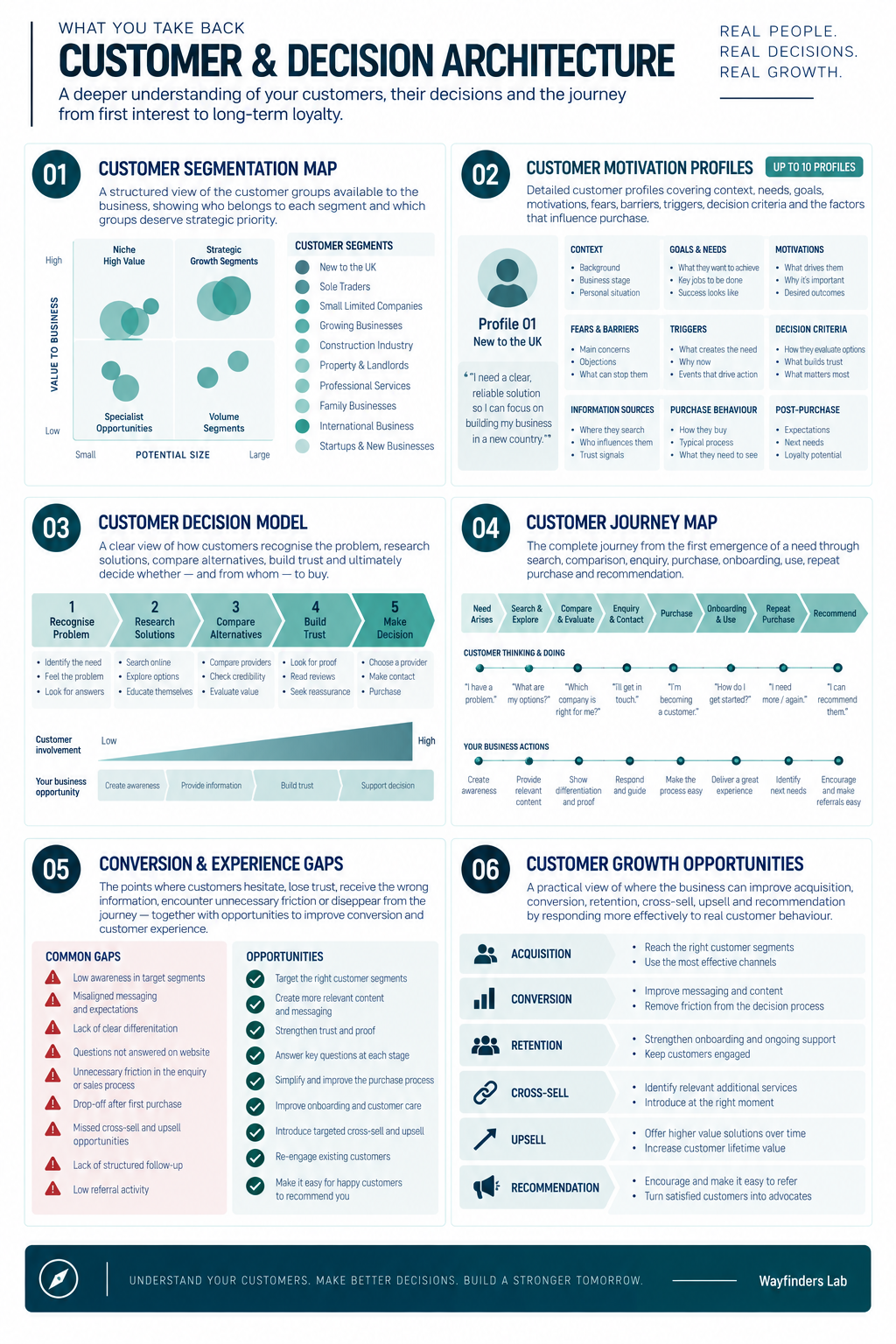
WHAT YOU GET
WHAT YOU DO WITH IT
This becomes the customer intelligence behind your marketing, sales and customer experience.
Instead of creating a website, campaign or sales message for an abstract “target audience”, your team can see which customer it is speaking to, what is happening in that person’s life or business, what they need to understand at that moment and what may prevent them from taking the next step.
Marketing can use the research to choose audiences, search themes, content topics, advertising messages and lead-generation channels. Website decisions can be built around the questions and evidence customers actually need before making contact. Sales can understand the motivations, objections and decision criteria behind an enquiry rather than treating every lead in the same way.
The Customer Journey Map then connects those individual decisions into one continuous journey. It shows where marketing needs to create awareness, where trust needs to be built, where sales should enter, where onboarding needs improvement and where the business currently misses opportunities to retain, cross-sell, upsell or bring a customer back.
And because different customer groups rarely buy for exactly the same reasons, the business does not have to force every customer through one generic message and sales process.
You can see how a potential customer becomes a buyer and what the business needs to do to help that buyer become a long-term client.
GROWTH ECONOMICS ARCHITECTURE
Turn growth ambitions into numbers, before you turn them into marketing spend. A business can have a strong strategy, clear positioning, well-researched customers and dozens of possible marketing channels. None of that answers one of the most important commercial questions:
If we want to grow, how many customers do we actually need and how much can we afford to invest in acquiring them?
Growth Economics Architecture connects the company’s financial goals with customer economics, sales conversion, acquisition channels, marketing budgets and operational capacity.
We work backwards from the result the business wants to achieve.
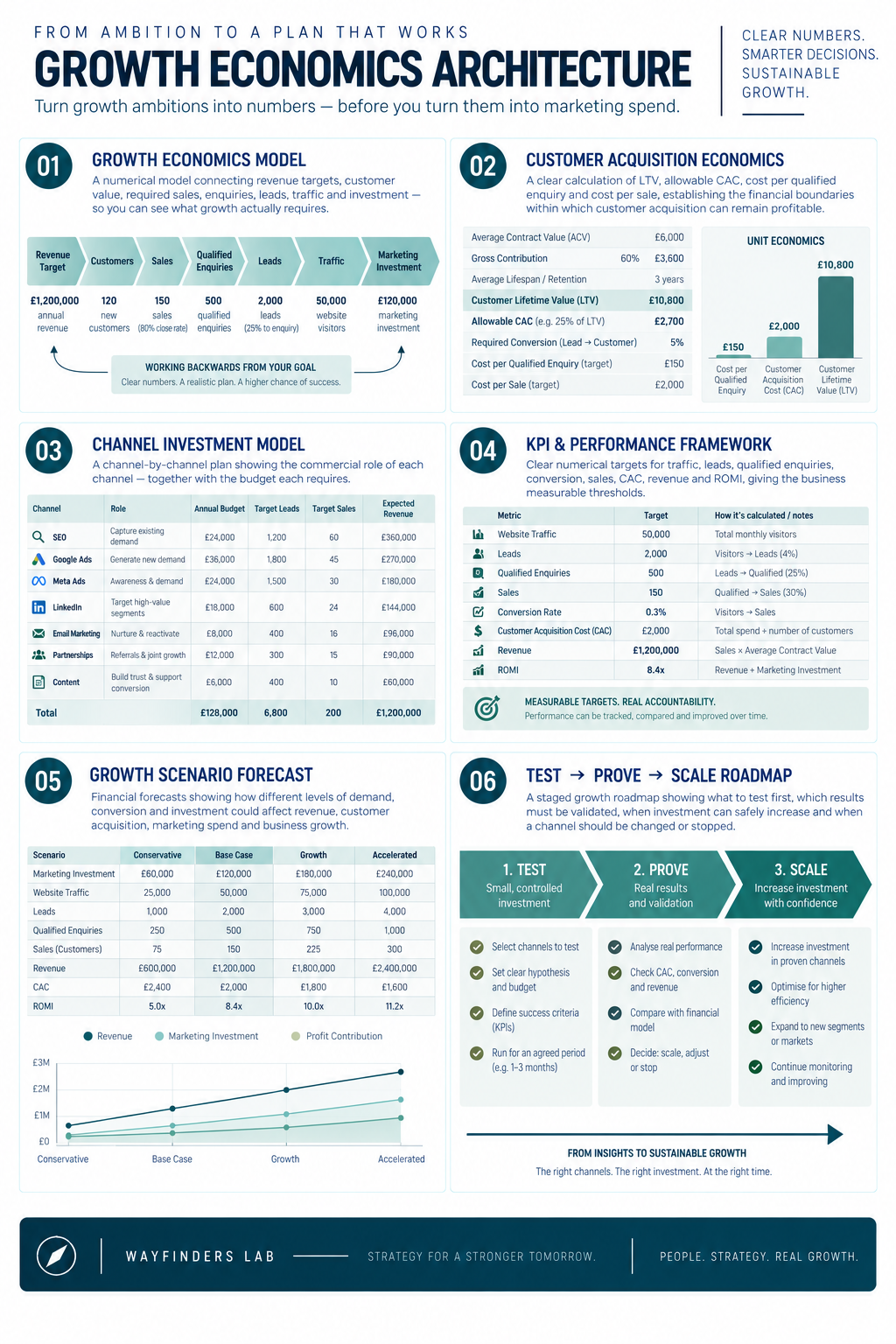
Instead of starting with “How much should we spend on marketing?”, we start with the revenue target and calculate what needs to happen commercially for that target to become achievable:
Revenue Target → Clients → Qualified Enquiries → Leads → Traffic → Required Investment
This allows us to move beyond generic industry benchmarks and build the economics around your actual products, customer value, margins, conversion and growth capacity.
We look at:
This is a financial growth model, not a marketing plan built around assumptions. Forecasts are developed in numbers, with budgets and KPIs set by channel, so the business can see what each growth scenario requires, what needs to be proven and at what point additional investment becomes commercially justified.
£6,700 · 3 – 5 weeks · duration depends on the scale and complexity of the business · 4 strategic sessions
WHAT YOU GET
WHAT YOU DO WITH IT
Wayfinders Lab Growth Economics Architecture is a numbers led framework for established and growing businesses that need to understand what sustainable business growth actually requires. It connects revenue targets with customer acquisition, sales performance, marketing investment and the financial capacity of the business, creating a measurable growth system rather than a marketing plan based primarily on activities.
The Growth Economics Model works backwards from the commercial target. Revenue goals are translated into the number of customers, qualified enquiries, leads and website traffic required to reach them. Conversion rates between each stage make it possible to see how much demand the existing sales system needs to generate and whether the planned level of growth is realistic within the current business structure.
Customer acquisition economics then establishes the financial boundaries for that growth. LTV shows the value a customer can create over the full relationship with the business. CAC shows how much it costs to acquire that customer. Cost per qualified enquiry and cost per sale reveal what happens between marketing activity and actual revenue, allowing the business to distinguish inexpensive leads from commercially valuable customer acquisition.
The channel investment model connects those numbers with SEO, paid search, social media, email marketing, partnerships, referrals, content and other relevant acquisition channels. Each channel receives a defined commercial role, investment level and measurable KPIs based on what it is expected to contribute to the customer journey and sales flow.
Performance is measured through traffic, leads, qualified enquiries, conversion rates, sales, CAC, revenue, LTV and ROMI. ROMI shows the financial return generated by marketing investment, while the wider KPI framework helps the business understand why that result occurred. This creates marketing clarity for business owners because decisions can be made from connected commercial data rather than isolated metrics such as clicks, impressions or lead volume.
Growth scenario forecasts allow different levels of demand, conversion, customer value and marketing investment to be modelled before larger budgets are committed. The Test → Prove → Scale roadmap then provides a practical business growth framework for validating channels, comparing actual performance against forecasts and increasing investment only where the economics support it. The result is a scalable business system with clear financial boundaries, measurable priorities and a stronger basis for deciding where future growth capital should go.
LEAD & OFFER ARCHITECTURE
Understand not only who your customers are, but what has to happen for them to choose your business. Knowing a customer’s age, location, income or job title tells us very little about why they buy.
We go deeper into the people behind the market: what creates the need, what they are trying to achieve, what worries them, what triggers action, what delays a decision, what alternatives they consider, what creates trust and what ultimately makes one option feel right while another is rejected.
We then connect this behaviour to the way your business currently attracts, converts, serves and retains customers.
The result is not a collection of generic buyer personas. It is a working model of how different customers move from recognising a need to choosing a business and what needs to happen at each stage for that relationship to continue.
We look at:
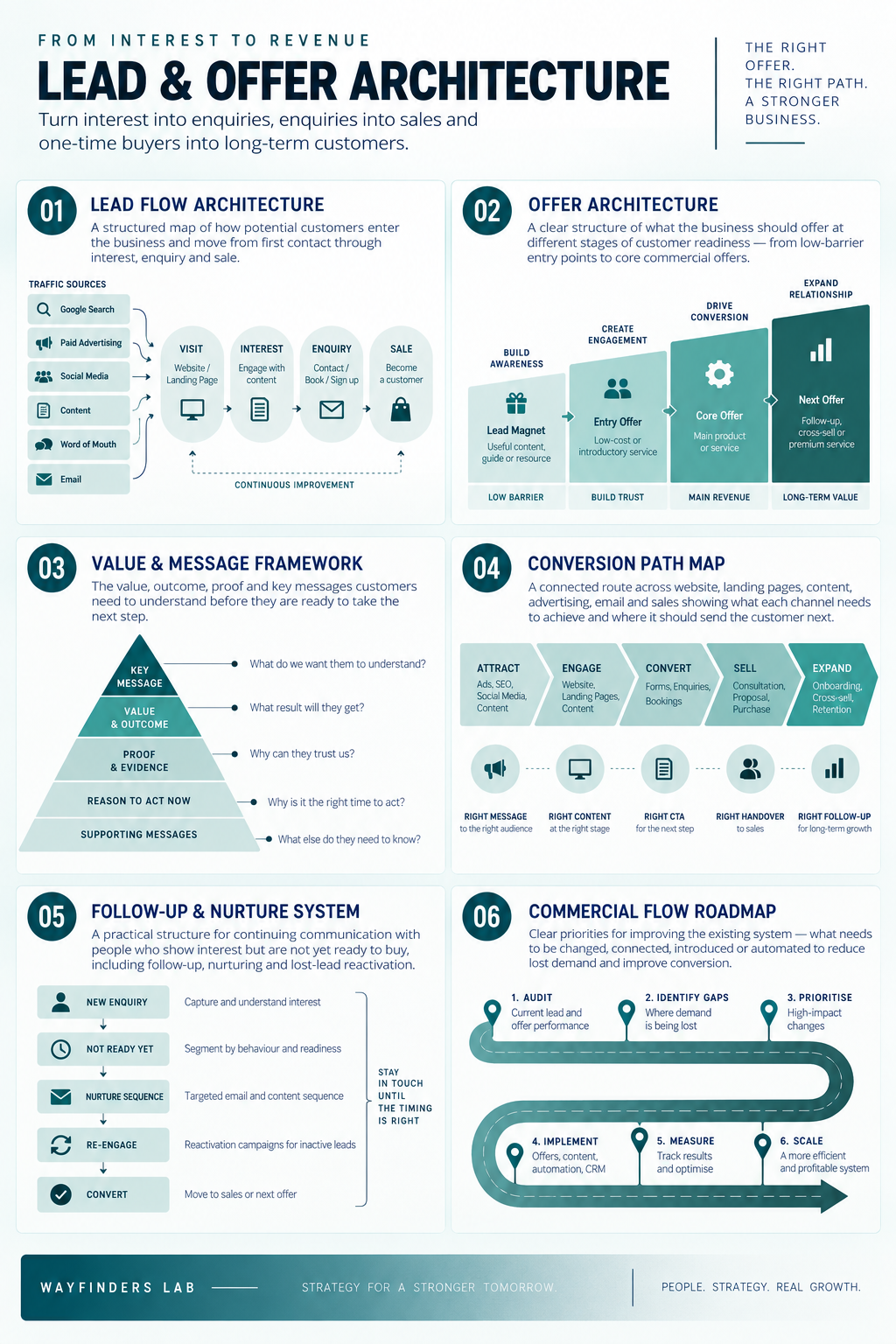
The architecture is designed around the customer journey rather than individual marketing channels. Each offer, message and conversion point has a defined role… moving the right customer towards the next appropriate action instead of expecting every interaction to produce an immediate sale.
£3,800 · 3 – 4 weeks · 3 strategic sessions
WHAT YOU GET
WHAT YOU DO WITH IT
This gives the business a commercial structure for turning attention into revenue instead of treating every new lead as an isolated enquiry.
Your marketing team can see what each campaign, page, piece of content and call to action is supposed to achieve. Sales can see where an enquiry has come from, what the customer has already experienced and what the appropriate next step should be. Follow-up can continue with people who are interested but not yet ready to buy instead of allowing that demand to disappear.
It also gives the owner a much clearer way to diagnose growth. If sales are too low, you can look at the actual flow and ask whether the business needs more demand — or whether existing demand is being lost between first contact, offer, enquiry, follow-up and sale.
That distinction matters commercially. If the system is losing potential customers, increasing the advertising budget simply sends more people into the same points of loss.
BUSINESS & MARKETING ANALYTICS SYSTEM
Stop looking at marketing reports in isolation. See what actually turns activity into customers, revenue and profit. Most established businesses already have data. Website analytics show traffic. Advertising platforms show clicks, impressions and leads. Social media has its own reports. A CRM or sales spreadsheet contains enquiries and sales. Accounting shows revenue and costs.
The problem is that these numbers often live in different places and answer different questions.
A marketing report may show that a campaign generated 40 leads. But that does not tell the owner how many were qualified, how many became customers, how much revenue they generated, what it cost to acquire them or whether the channel was commercially worthwhile.
The system is designed for ongoing use. New data is added as the business operates, allowing the owner and team to compare periods, recognise changes in conversion, track customer acquisition costs and understand whether marketing performance is improving or simply becoming more expensive.
For clients who complete the relevant strategic modules with Wayfinders Lab and then work with us on the implementation and setup of their lead generation channels, we build this analytics system into the work at no additional cost. It gives both the client and our team the same measurable basis for testing, improving and scaling those channels.
It can also be commissioned separately. This is most relevant to an established business that already has active marketing and sales channels but lacks a connected business analytics system for understanding what those channels actually contribute to commercial performance.
We look at:
£1,200 · 1 week · 2 strategic sessions
WHAT YOU GET
WHAT YOU DO WITH IT
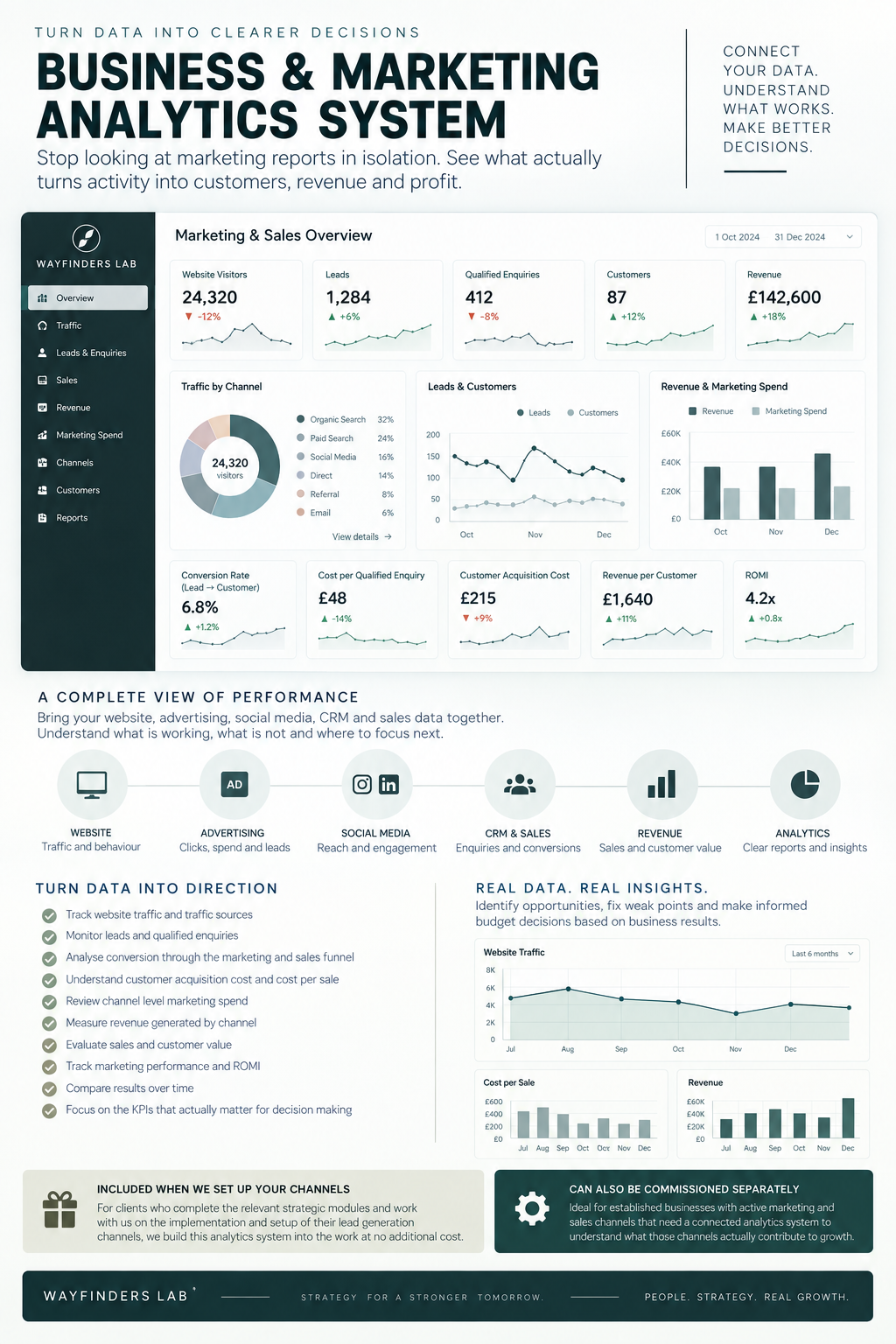
The Business & Marketing Analytics System connects separate data points into one management view. We define the KPIs that actually matter to the business, establish how they should be measured and create a reporting structure that follows performance from marketing activity through enquiries and sales to revenue.
This means the owner can see which channels generate traffic, which create qualified demand, which convert into customers and which produce commercially valuable sales. It also makes it easier to identify where performance is falling before the problem disappears inside a monthly marketing report.
Use the system as an ongoing control panel for marketing and commercial performance. Compare channels, track changes in conversion and acquisition cost, see whether additional marketing spend is producing additional revenue, identify weak points before they become expensive and make budget decisions from business results rather than platform reports.
When we manage or develop lead generation channels with you, the same system becomes the basis for deciding what to test, what to improve, what to stop and what is ready to scale.