

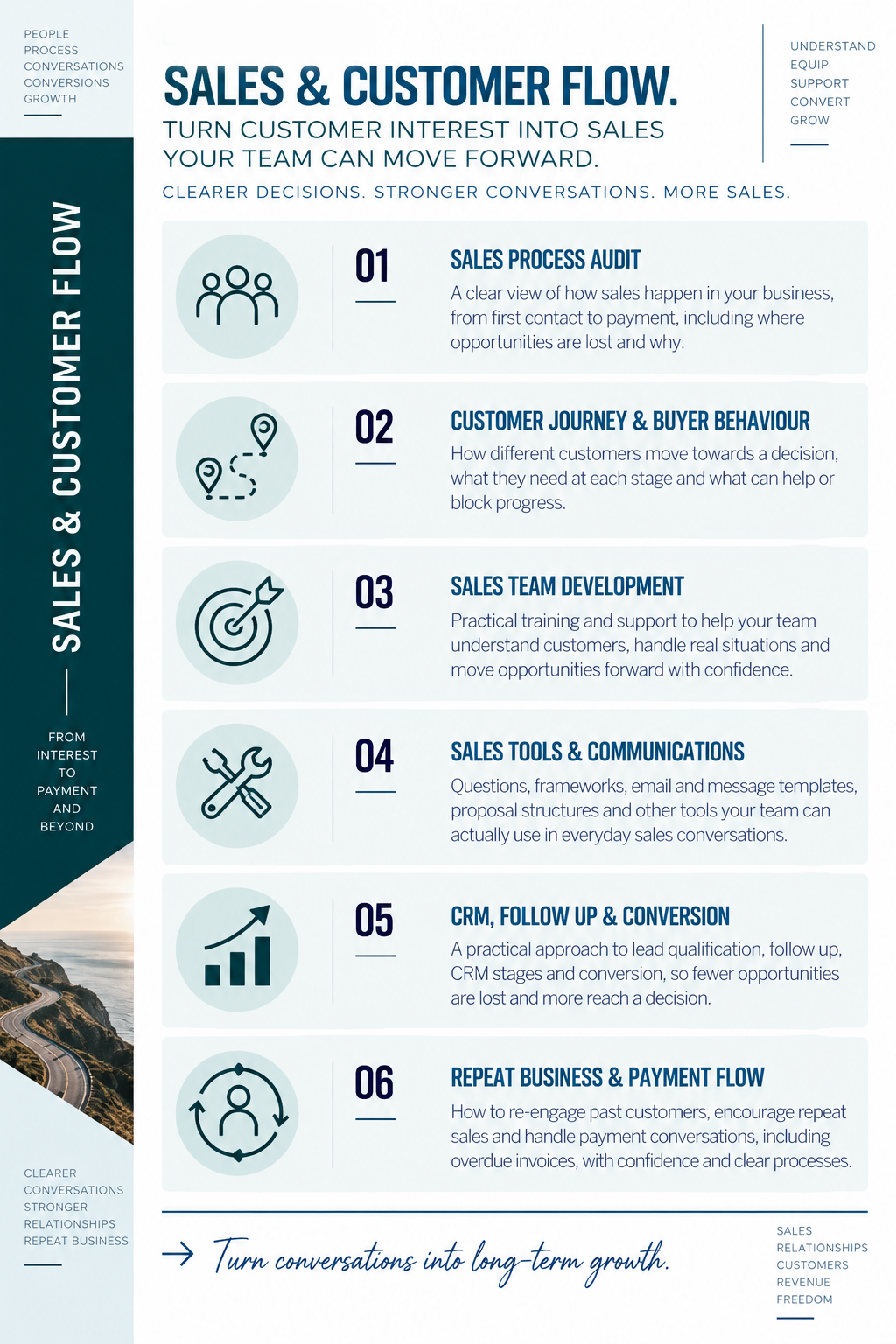
Sales & Customer Flow. Turn customer interest into sales your team can move forward.
A business can generate enough leads and still lose customers inside the sales process. An enquiry comes in, but the first conversation goes nowhere. A quotation is sent and nobody follows up. A salesperson starts defending the price before the customer questions it. An old lead is forgotten. An unpaid invoice becomes a conversation everyone would rather avoid.
We do not start by giving your sales team another script. We look at how sales actually happen inside the business, how customers make decisions and what your team needs to move each opportunity towards the right next step.
That can include the sales process, customer journey, lead qualification, buyer behaviour, sales team training, quotations and proposals, follow up, objection handling, CRM stages, customer reactivation, repeat sales and payment conversations, connected around the real situations your team deals with every day.
We also look at the human side of selling. How confidence, assumptions about price, fear of being pushy, defensive communication or premature discounting can change what happens in a customer conversation. Then we turn those findings into practical sales tools your team can actually use. The result is not a team trained to repeat better phrases. It is a clearer sales system with people who understand the customer, recognise what is happening in the sale and know what to do next.
Build a sales team that can think, adapt and move customers from interest to decision and payment.
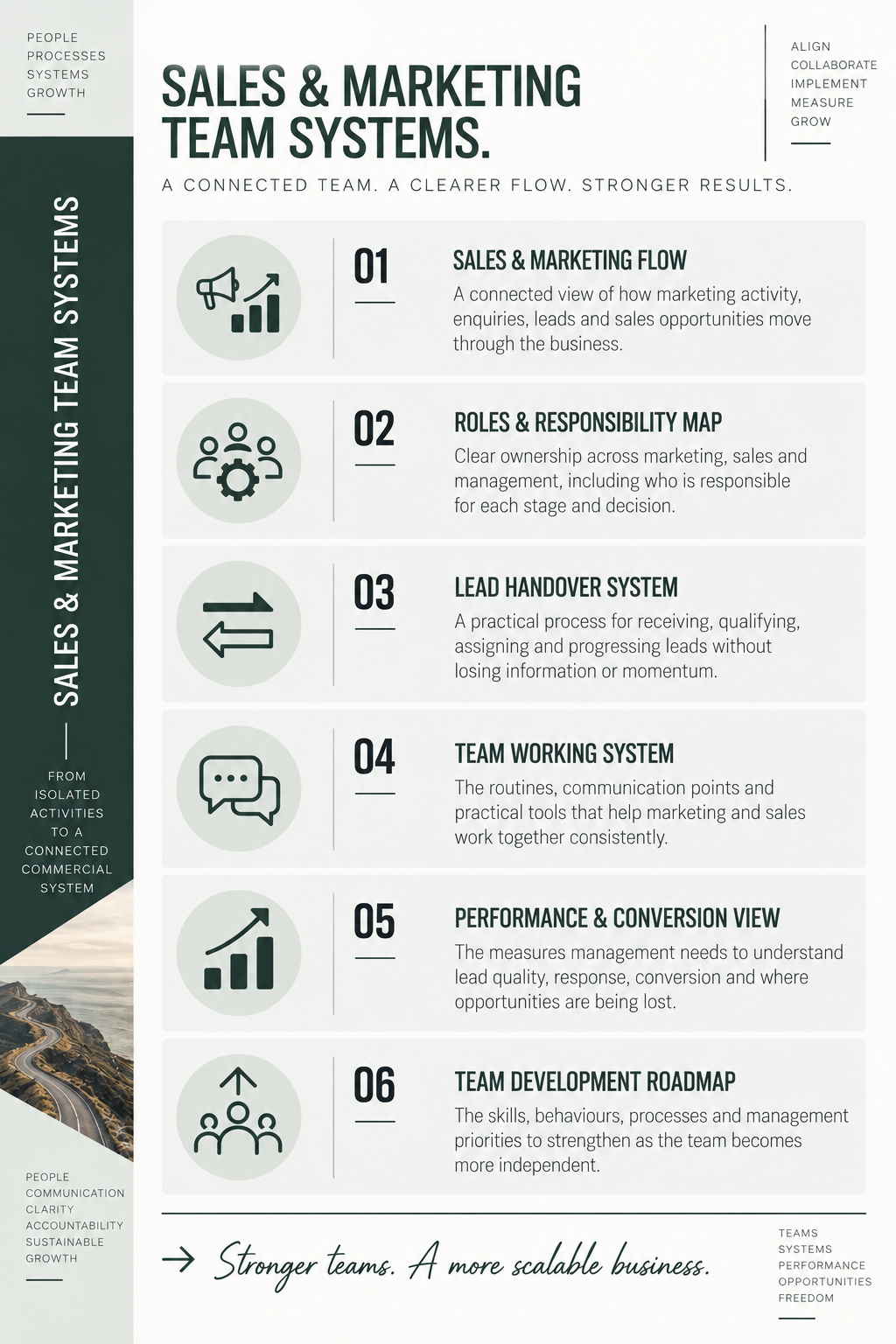
SALES & MARKETING TEAM SYSTEMS
Build a connected sales and marketing system your team can use consistently without the owner having to hold everything together. Marketing and sales often work alongside each other without really working as one system.
Marketing generates activity, leads arrive through different channels, sales responds in different ways, information gets lost between people and the owner becomes the person who knows what is happening, chases decisions and steps in when something goes wrong.
We do not solve this by adding more meetings, reports or management layers. We build the working system around how leads are generated, handed over, developed and converted, then work with the team to put it into practice.
That means defining how marketing and sales responsibilities connect, how leads enter the business, who takes ownership at each stage, what information needs to move with them, how follow up works, how performance is measured and where management needs visibility.
A core part of the programme is weekly working sessions with the team. We use real situations, current leads, communication challenges and performance data to develop the system in practice, strengthen individual capability and make sure the tools we create are actually being used. The result is a more coordinated sales and marketing team with clearer responsibilities, stronger communication and a system that can continue working as the business grows.
We look at:
This is an implementation and team development programme rather than a one off strategic review. We work with the people responsible for marketing, sales and customer communication to understand how work happens in reality, then develop the processes, tools and responsibilities around the business rather than imposing a generic sales model.
Weekly team sessions are built into the programme. They give us the opportunity to introduce new tools, work through real cases, identify where the system is breaking down and help the team build the confidence and judgement to operate it independently.
After the initial implementation period, ongoing advisory support can be continued where useful, particularly while new routines are becoming established, responsibilities are changing or the team is growing.

£4,700 · 4 – 8 weeks · Weekly team sessions
WHAT YOU TAKE BACK
WHAT YOU DO WITH IT
Use the system to make sales and marketing easier to manage without relying on the owner to personally connect every part.
The team knows where leads come from, who owns them, what needs to happen next and when another person needs to become involved. Marketing receives better information about what happens to the opportunities it generates, while sales has clearer processes and tools for moving those opportunities forward.
Weekly sessions allow us to work with what is actually happening rather than simply handing over a system and expecting people to adopt it. Problems can be identified, tools adjusted and individual team members supported while new ways of working become established.
Over time, the business gains a sales and marketing system that can be taught to new employees, adapted as the company grows and managed through clear responsibilities and meaningful performance information.
Sales and marketing stop depending on the owner to connect the dots and start operating as one accountable commercial system.