

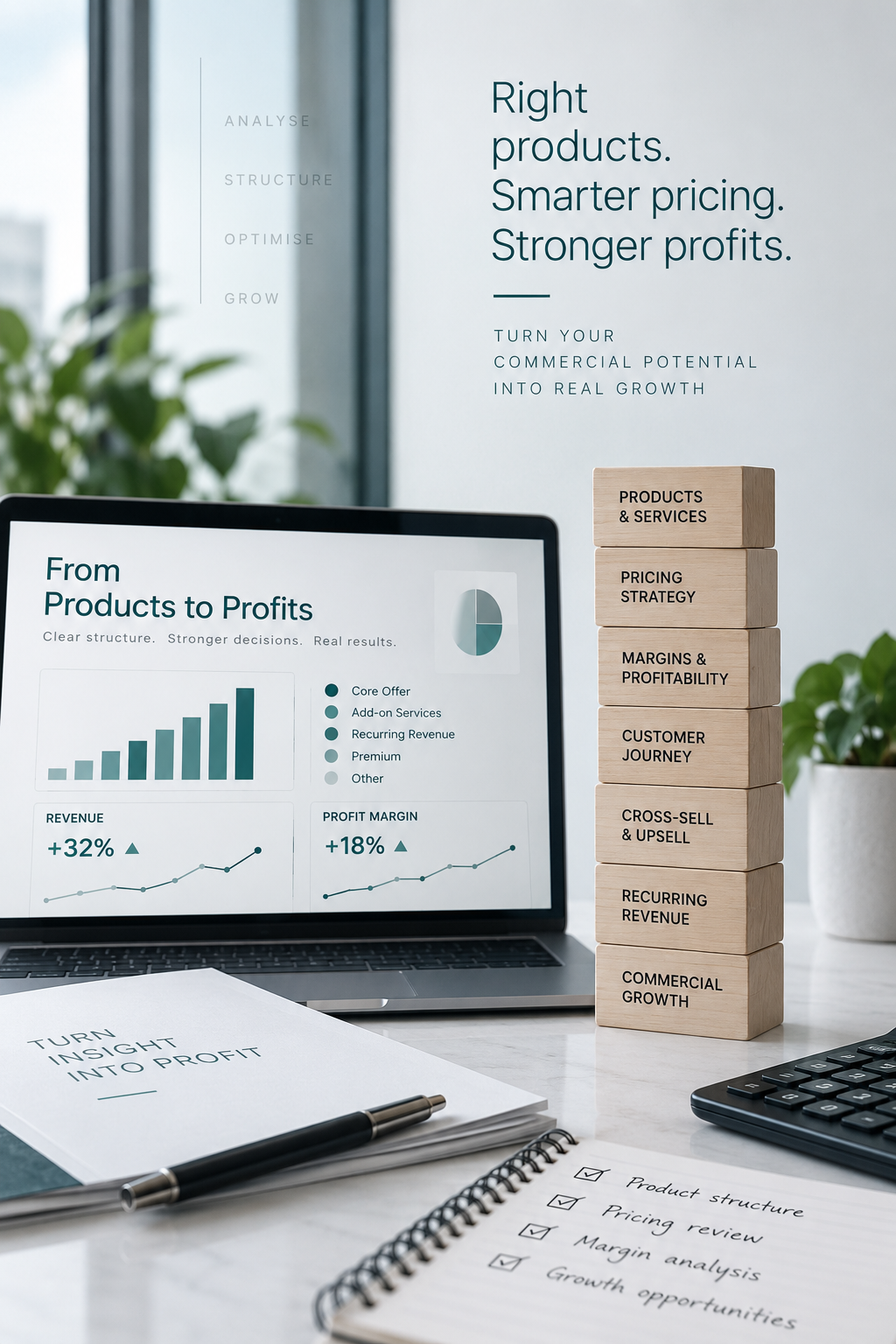
PRICING & COMMERCIAL STRUCTURE.
See what is really making money before deciding what to sell, price or grow.
When the business is busy but the numbers do not quite make sense, the problem is not always a lack of sales. You can have plenty of customers, a broad range of products or services and healthy turnover while some offers generate very little profit, others consume too much time or resource, and pricing has grown without a clear commercial logic.
We do not start by simply raising prices. We analyse what you sell, how you price it and where the business actually makes money to understand what is commercially strong, what is draining margin and where better profit can be created. That can include product and service structure, pricing strategy, price positioning, margins and profitability, customer price sensitivity, cross-sell and upsell opportunities, recurring revenue and customer value, brought together as one commercial system rather than a series of isolated pricing decisions.
The result is not higher prices for the sake of higher prices. It is a stronger basis for deciding what to sell, what to restructure, where pricing needs to change and which offers are actually worth growing.
Understand where the money is made. Then build the commercial structure around it.
PRODUCT & SERVICE STRUCTURE
Build a product and service portfolio where every offer has a clear commercial role.
A business can accumulate products and services over time without ever designing how they should work together. New offers are added because customers ask for them, competitors have them or they seem like another opportunity to generate revenue. Eventually the business may be selling a lot, but the structure underneath becomes difficult to see.
We analyse your current or planned products and services to understand what each one contributes to the business, which are commercially valuable, which consume disproportionate resources and where different offers compete with or duplicate each other.
We then look at the role each offer should play within the wider product structure. Some products bring new customers into the business. Some generate core revenue. Others increase customer value through cross-sell or upsell, create recurring revenue, serve premium customers or give existing customers a logical reason to buy again.
The aim is not to create more products. It is to build a clearer and more commercially useful product and service structure around what customers need and what the business can profitably deliver.
We look at:

£2,600 · 1 – 2 weeks · minimum 2 strategic sessions
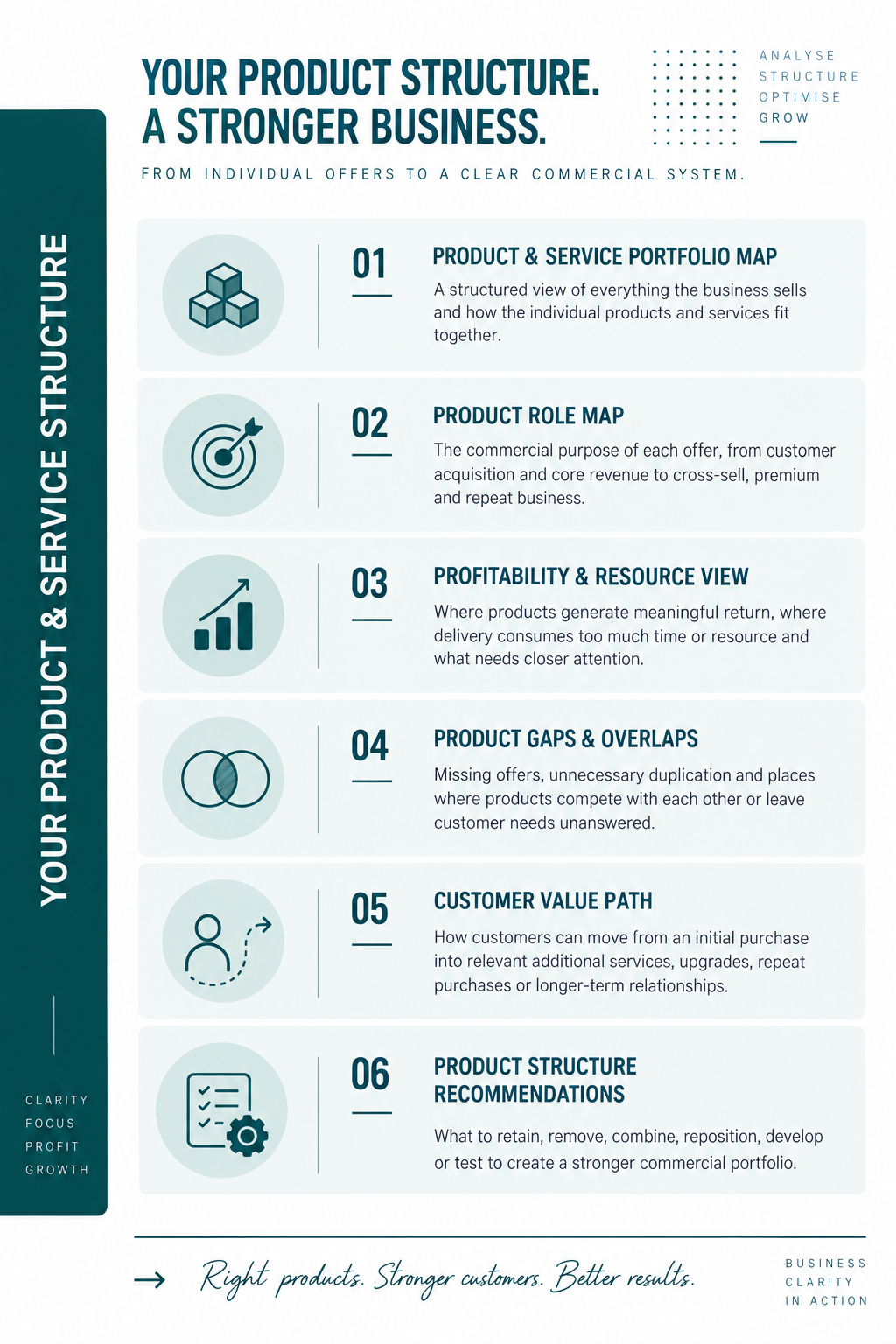
WHAT YOU TAKE BACK
WHAT YOU DO WITH IT
Use the structure as a working framework for decisions about what the business sells.
When a new product or service is proposed, you can see where it belongs, which customer need it serves, what commercial role it should perform and whether it strengthens the existing portfolio or simply adds more complexity.
It also gives marketing and sales a clearer system to work with. Instead of promoting every service independently, the business can decide which offers should attract new customers, which should generate the main revenue, where cross-sell or upsell belongs and how existing customers can move naturally towards their next purchase.
As the business develops, the structure can be reviewed against actual sales, profitability and resource use so products that no longer make commercial sense do not remain in the portfolio simply because they have always been there.
PRICING & REVENUE STRUCTURE
Build a pricing system that reflects customer value, protects profitability and gives the business a clearer way to make money.
Pricing often develops gradually. A price was set several years ago. A new service was added at a figure that felt reasonable. Discounts appeared for particular customers. Competitor prices influenced another decision. Costs increased, but prices did not move with them. Eventually the business has prices, but not necessarily a pricing system.
We analyse how your products and services are currently priced, what customers are actually paying for, how price-sensitive different customer groups are, what competitors charge and how each offer contributes to revenue and profit.
We also look beyond the individual price. A commercially sustainable price has to make sense in relation to customer value, market position, delivery cost, margin, demand and the role of that product or service within the wider business.
This allows us to identify where services are undervalued, where margin is being lost, where customers may support a different price or offer structure, and where the business is relying on turnover that contributes less profit than it appears to.
The objective is not to increase every price. It is to create a clear pricing and monetisation structure that gives different offers and customer groups the right commercial logic.
We look at:
There is a particularly important distinction in your materials that I’ve deliberately built into this section: price is not considered independently from perceived value. Customers compare what they believe they receive with what they are being asked to pay, while different customer groups can have very different levels of price sensitivity.
And price positioning also has to correspond to the level of product, service, quality and brand. Your material specifically works through budget, middle, middle+, premium, luxury and cross-segment structures rather than treating the whole market as one comparable price range.
£4,700 · 2 – 4 weeks · minimum 2 strategic sessions
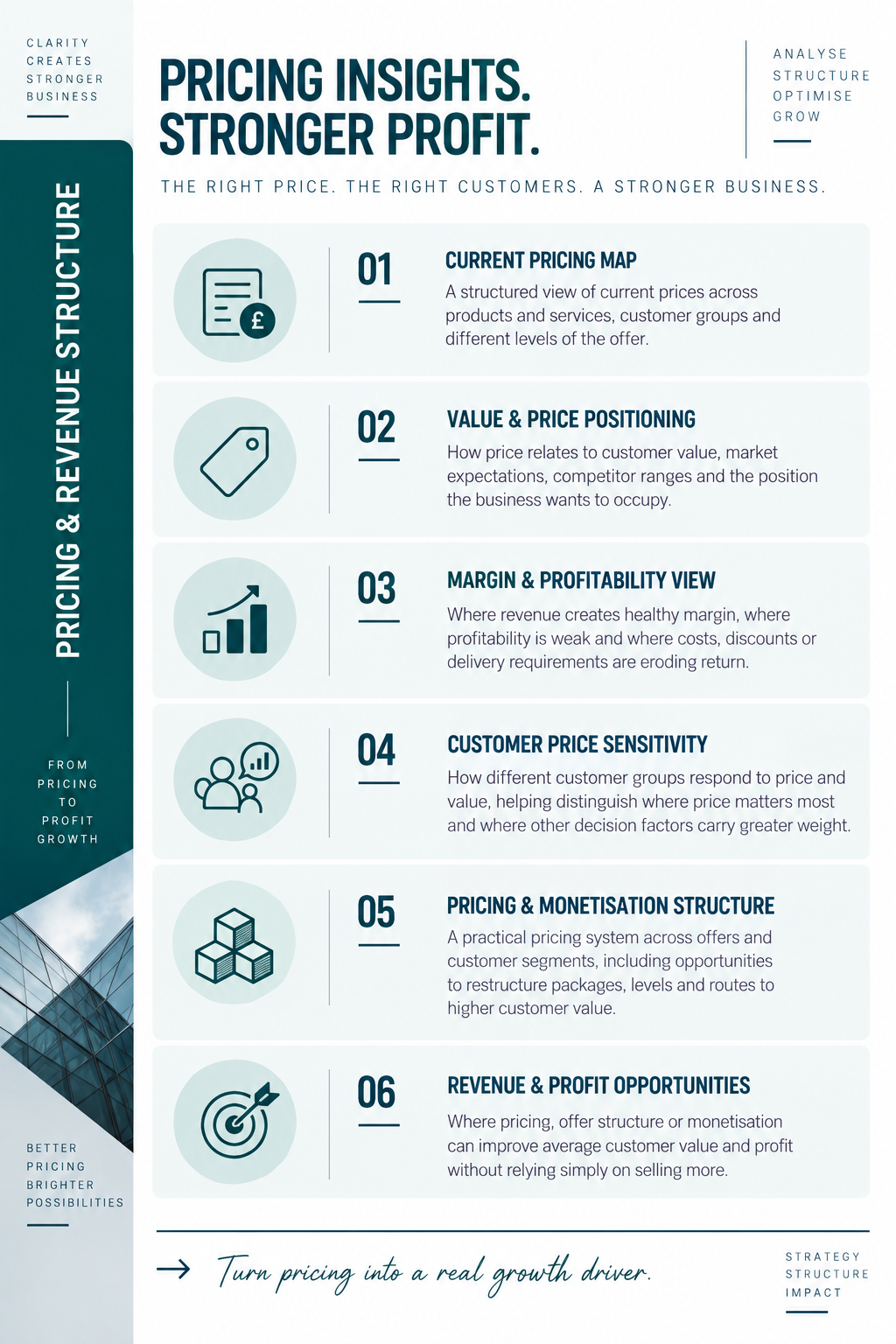
WHAT YOU TAKE BACK
WHAT YOU DO WITH IT
Use the pricing structure as a commercial framework rather than returning to isolated price decisions every time costs change, a competitor moves or a customer asks for a discount.
It gives you a basis for deciding what a product or service should cost, which customers or segments it is designed for, what margin it needs to protect and how its price relates to the value being delivered.
You can also use it when introducing new services, reviewing discounts, changing packages or testing higher-value offers. Instead of asking “Can we charge more?”, you can assess whether the market, customer value, demand, positioning and business economics support the decision.
Over time, actual sales and profitability can be compared against the structure so pricing evolves with the business rather than becoming another collection of historical numbers.