

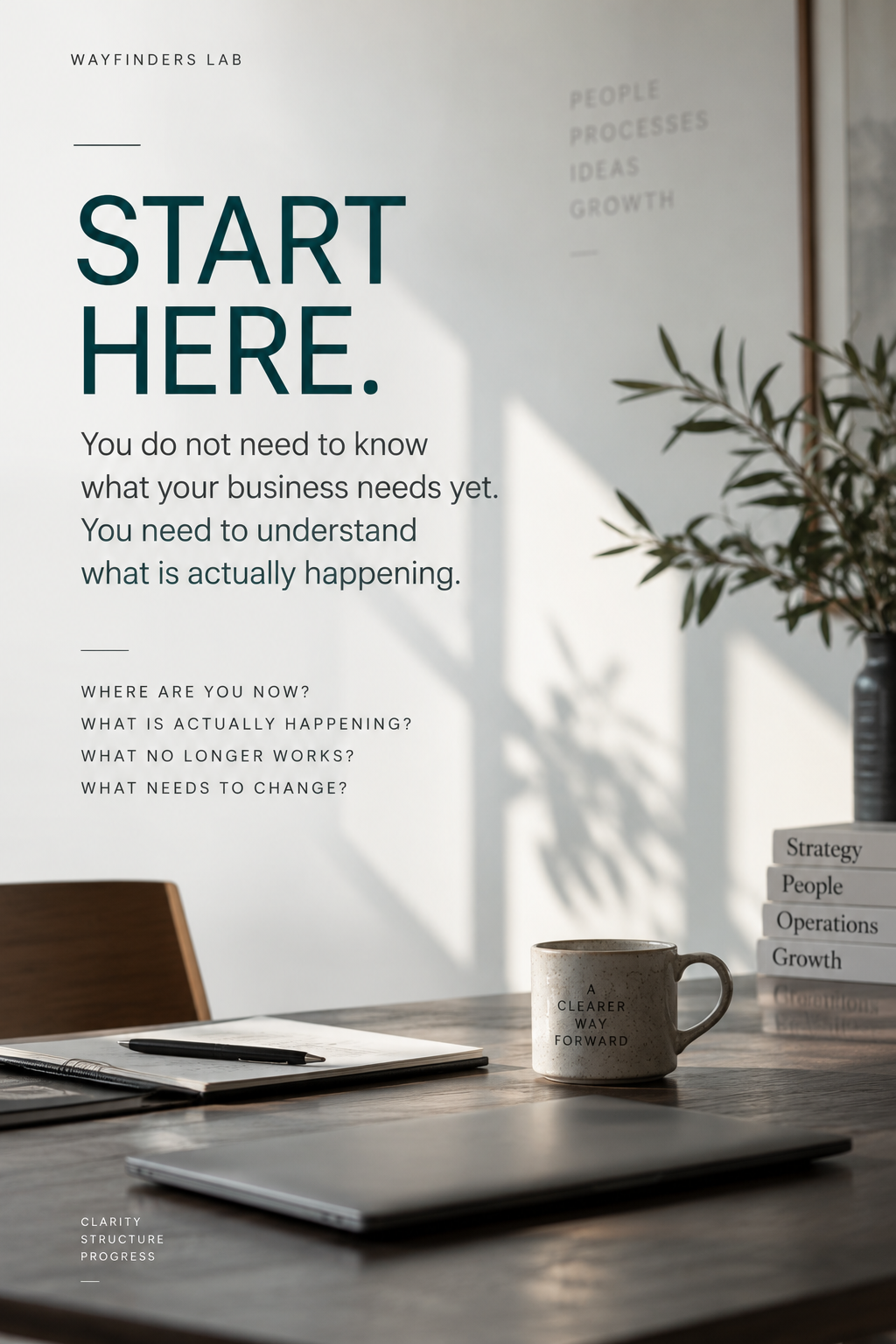
You do not need to know what your business needs yet…
You need to understand what is actually happening.
Business problems rarely arrive neatly labelled. You may know that the business is working harder than it should. Revenue may be growing without enough profit following it. Marketing is happening, but it is difficult to see what is actually driving results. Leads are coming in, but too many disappear before becoming customers. You may have a capable team, yet decisions, questions and problems still keep finding their way back to you. Or perhaps nothing is obviously wrong. The business has simply reached a point where the way it has worked until now no longer feels enough for where you want to take it next.
You do not need to diagnose the business before you come to us. Start with what you can see. The pressure points. The questions you keep returning to. The things that have become harder, slower, less profitable or more dependent on you. Then we look underneath them.
Where are you now?
What is actually happening?
What no longer works?
What needs to change?
A business does not have to be failing for something to stop working. Often, the business has simply grown beyond the way it was originally built. What once worked through instinct, direct involvement and a small number of people becomes harder to manage as the company adds customers, products, employees, channels and decisions.
The structure may still belong to a smaller business. The positioning may reflect a market that has already changed. Processes that once worked informally may now create delays, duplication or confusion. Decisions that used to take minutes begin to pile up because too much still needs to pass through the same people.
The business has moved forward. The way it works has not always moved with it.
The team has grown, but management still depends on the owner being involved in everyday decisions.
More marketing channels are active, but it has become harder to see what actually creates demand, customers or revenue.
Turnover has increased, but profit has not followed in the same way.
Products and services have accumulated over time, but their role, value and commercial contribution are no longer clear.
The market and customers have changed, but the way the business positions and presents itself has remained largely the same.
More people are now involved in running the company, yet the owner is working harder, coordinating more and carrying more decisions than before.
What worked to get the business here may not be what takes it forward.
FIND YOURSELF ON THE MAP
I DON’T KNOW WHERE THE NEXT STAGE OF GROWTH SHOULD COME FROM.
The business is working, but the next move is unclear. There are several possible opportunities, products, markets or directions competing for attention, and it is difficult to know which deserve investment and which will simply create more work.
You are making decisions, but without enough confidence that they are taking the business somewhere deliberate.
WE’RE BUSY. BUT THE NUMBERS DON’T FEEL RIGHT.
There is work. There may even be strong turnover. But the profit, margin or cash left behind does not seem to reflect the amount of effort, people and resources going into delivering it.
Some products or customers may be commercially stronger than others, but it is difficult to see clearly where the business is actually making money.
WE DO GOOD WORK. BUT THE MARKET DOESN’T REALLY SEE IT.
Customers who know the business understand its value. The problem is making that value obvious to people who do not know you yet.
Your website, message, brand or marketing may not reflect what the business has become, making it harder for the right customers to understand the difference, trust the offer and remember you.
WE KEEP DOING MARKETING. BUT I CAN’T TELL WHAT ACTUALLY WORKS.
The business is posting, advertising, updating the website, sending emails or trying different channels, but activity has become easier to measure than actual commercial impact.
You can see clicks, enquiries and engagement, but it is much harder to answer a more important question: what is genuinely creating customers, sales and profitable growth?
PEOPLE ARE INTERESTED. BUT TOO FEW BECOME CUSTOMERS.
Enquiries and conversations are happening, but too many opportunities disappear somewhere between initial interest and a decision.
Follow up may be inconsistent. Different people sell differently. Price becomes the centre of the conversation. Existing customers are not always developed into repeat or additional business.
There is demand, but the route from interest to revenue is not reliable enough.
WE’VE GROWN. BUT THE WAY WE WORK HASN’T CAUGHT UP.
More customers, employees, products and departments have been added, but many of the original ways of working are still in place.
Responsibilities overlap. Processes live in people’s heads. Information gets lost between teams. The same problems return because people keep solving individual situations rather than fixing what creates them.
The business has become more complex without becoming equally structured.
I HAVE A TEAM. BUT TOO MUCH STILL COMES BACK TO ME.
You have hired people precisely so that you would not have to do everything yourself. Yet questions, approvals, difficult customers, priorities and everyday decisions still keep returning to you.
You delegate tasks, but not always the responsibility that sits behind them. Stepping away feels risky because you are not confident that the business will continue to work in the way it should without your involvement.
I HAVE MANAGERS. BUT I’M STILL MANAGING THROUGH THEM.
There are people with management titles, but you are still setting many of their priorities, resolving problems for their teams and making decisions that should increasingly sit with them.
Managers may be good at their technical work but less confident in delegation, accountability, feedback or decision making. Instead of creating another layer of leadership, management becomes another route through which work reaches you.
And sometimes none of these describes it perfectly. You simply know that something needs to change, but you cannot yet see what should change first.
That is still a starting point.
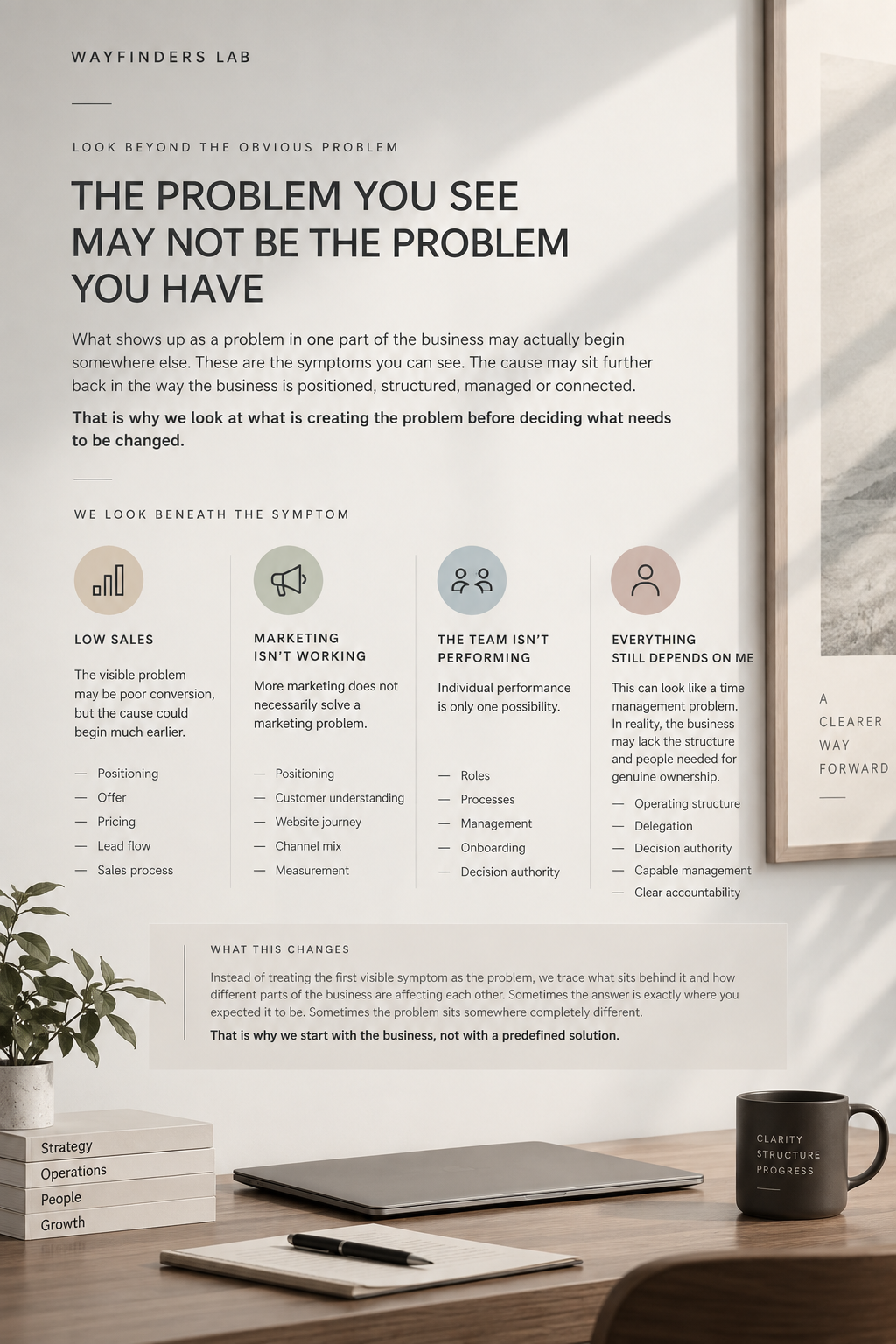
THE PROBLEM YOU SEE MAY NOT BE THE PROBLEM YOU HAVE
What shows up as a problem in one part of the business may actually begin somewhere else. A drop in sales does not automatically mean the sales team needs fixing. Marketing that produces little return does not necessarily need more content, another campaign or a bigger advertising budget. A team that struggles to perform may not have a people problem. These are the symptoms you can see. The cause may sit further back in the way the business is positioned, priced, structured, managed or connected.
That is why we look at what is creating the problem before deciding what needs to be changed.

WHAT THIS CHANGES
WE LOOK BENEATH THE SYMPTOM:
LOW SALES
The visible problem may be poor conversion, but the cause could begin much earlier. The positioning may be unclear, the offer may not match what customers value, pricing may create resistance, leads may be getting lost or the sales process itself may not give people a clear route to a decision.
MARKETING ISN’T WORKING
More marketing does not necessarily solve a marketing problem. The business may be speaking to the wrong customers, communicating an unclear value, sending people through a weak website journey or measuring activity without understanding which channels actually contribute to customers and revenue.
THE TEAM ISN’T PERFORMING
Individual performance is only one possibility. People may be working with unclear roles, weak processes, inconsistent management, poor onboarding or without enough authority to make the decisions their responsibilities require.
EVERYTHING STILL DEPENDS ON ME
This can look like a time management or delegation problem for the owner. In reality, the business may lack clear operational structure, defined responsibility, decision authority or managers capable of taking genuine ownership without repeatedly returning decisions upwards.
WHAT THIS CHANGES
Instead of treating the first visible symptom as the problem, we trace what sits behind it and how different parts of the business are affecting each other.
Sometimes the answer is exactly where you expected it to be. Sometimes the problem sits somewhere completely different. And sometimes several small weaknesses are combining to create one much larger problem.
That is why we start with the business, not with a predefined solution.
WE LOOK AT THE BUSINESS AS A CONNECTED SYSTEM
A business rarely changes in one place without affecting another. Positioning influences what people understand and why they buy. Pricing changes what can be sold profitably. Marketing creates demand that sales must convert. More customers create pressure on operations. Growth changes what the team needs from its managers and what managers need from the business.
We look at these connections because solving one problem without understanding what sits around it can simply move the pressure somewhere else.
MARKET & POSITIONING
Who the business is for, where it sits in the market and why customers should choose it shape almost everything that follows.
When this becomes unclear or outdated, the effects appear elsewhere: offers become harder to sell, marketing becomes less focused and sales conversations rely more heavily on persuasion or price.
OFFER, PRICING & COMMERCIAL MODEL
What you sell, how the offer is structured, what customers pay and what the business actually earns from delivering it determine whether growth is commercially worthwhile.
A stronger offer can improve sales. The wrong pricing can undermine profit. A product that sells well can still create problems if the resources required to deliver it make the economics weak.
MARKETING & BRAND PRESENCE
Marketing connects the business with the people it wants to reach, but it cannot operate independently from positioning, customer understanding or the offer itself.
More visibility only helps when the right people can find the business, understand what it offers, recognise its value and move naturally towards a commercial decision.
SALES & CUSTOMER FLOW
Sales sits between customer interest and commercial result.
How leads are handled, how value is communicated, how decisions are supported and what happens after the first sale affect conversion, revenue and customer value. Weakness here can also reveal problems further back in marketing, pricing or the offer.
OPERATIONS, LEADERSHIP & TEAM
Growth has to be carried by the business behind the sale.
More customers create more work, decisions and coordination. That puts pressure on processes, responsibilities, managers and employees. Without stronger operational structure and leadership, commercial growth can simply create more dependency on the owner.
A change in one part of the business can strengthen, expose or put pressure on another. We look for the connection, not just the symptom.
YOUR POINT A IS NOT WHERE YOU WANT TO GO.
IT IS AN HONEST PICTURE OF WHERE THE BUSINESS IS NOW.
Before deciding what needs to change, we need to understand the business as it exists today. Not the version described in plans, organisational charts or old strategy documents. Not where the business should be by now. And not the version you are trying to build next.
We start with what is actually there.
That means looking at the customers you have, what you sell, where the money comes from, how work gets done, how decisions are made, what the team depends on and where the owner is still carrying responsibility. Some parts may be working well. Others may have been outgrown. And some of the things creating pressure today may once have been exactly what helped the business succeed.
Point A gives us a grounded picture of the business before we decide what Point B should require.
WE START WITH FOUR QUESTIONS:
01 WHERE ARE YOU NOW?
What does the business actually look like today?
We look at the customers, products and services, revenue, team, processes, market position and the owner’s role to understand the business that exists now, not the business described on paper.
02 WHAT IS ACTUALLY HAPPENING?
Where does the reality differ from what is supposed to happen?
We look at how customers actually buy, how work actually moves, where decisions really sit, how people actually operate and what the numbers show rather than relying only on assumptions or intended processes.
03 WHAT NO LONGER WORKS?
What has the business outgrown?
We identify the offers, processes, responsibilities, structures, management habits or ways of working that may once have served the business but now create friction, dependency, wasted effort or commercial weakness.
04 WHAT NEEDS TO CHANGE?
What needs to become different for the next stage to work?
We separate symptoms from causes, identify what is genuinely holding the business back and establish which changes matter first rather than trying to improve everything at once.
This is your Point A. Not a judgement of the business, but a clear starting point for deciding what comes next.
YOU DON’T HAVE TO ARRIVE WITH A BRIEF.
You can come to Wayfinders with a business problem you cannot yet name. You might know that something is not working. That the business has become harder to manage. That you are doing too much. That there is plenty of activity but not enough profit. Or simply that the company has reached a point where you know something needs to change, but you cannot yet see what should change first. That is enough to begin.
Finding out what sits underneath the problem is part of the work.
We look at what is happening, what is connected to it and what is actually worth changing before deciding what the work should become. Sometimes the problem is relatively contained and a few specific changes are enough. Sometimes one visible problem leads us into several connected parts of the business. Sometimes we discover that the thing creating the problem is not where you originally expected it to be. And sometimes the business does not need a large programme of work at all. It needs the right changes, in the right order.
We do not make the business fit our services. We determine what the business actually needs first.
THEN WE DECIDE HOW THE WORK SHOULD CONTINUE
BUILD IT WITH US
We work alongside you, your managers or the people already responsible for that part of the business. Together we analyse what is happening, build the necessary structure and apply it to real situations inside the company. The aim is not to keep the knowledge with Wayfinders. It is to strengthen the people inside the business so they can understand the system, use it and continue developing it.
This can mean working directly with an owner or manager, or mentoring someone already inside the company who needs to grow into greater responsibility.
BUILT FOR YOU
When the business needs deeper implementation, we take a more active role in designing and building what is required. That may mean creating the structure, systems, customer journeys, commercial tools, marketing foundations or operational elements identified through the work, while keeping them connected to the wider business rather than treating them as isolated projects.
For deeper implementation work, we protect the commercial interests of existing clients and do not take competing implementation clients within the same niche.
YOU CAN START WITH A CONVERSATION.
No presentation. No polished brief. No need to decide which service you need.
You can tell us: “Something isn’t working.” “We’ve grown and things are getting messy.” “I’m doing too much.” “We’re making money, but not enough.” “I don’t know what we should do next.”…We can start there.
Talk in whatever way feels easiest. Send a message, write it out by email, continue the conversation on WhatsApp or arrange a call if talking it through is easier. The first conversation is simply about understanding where you are.