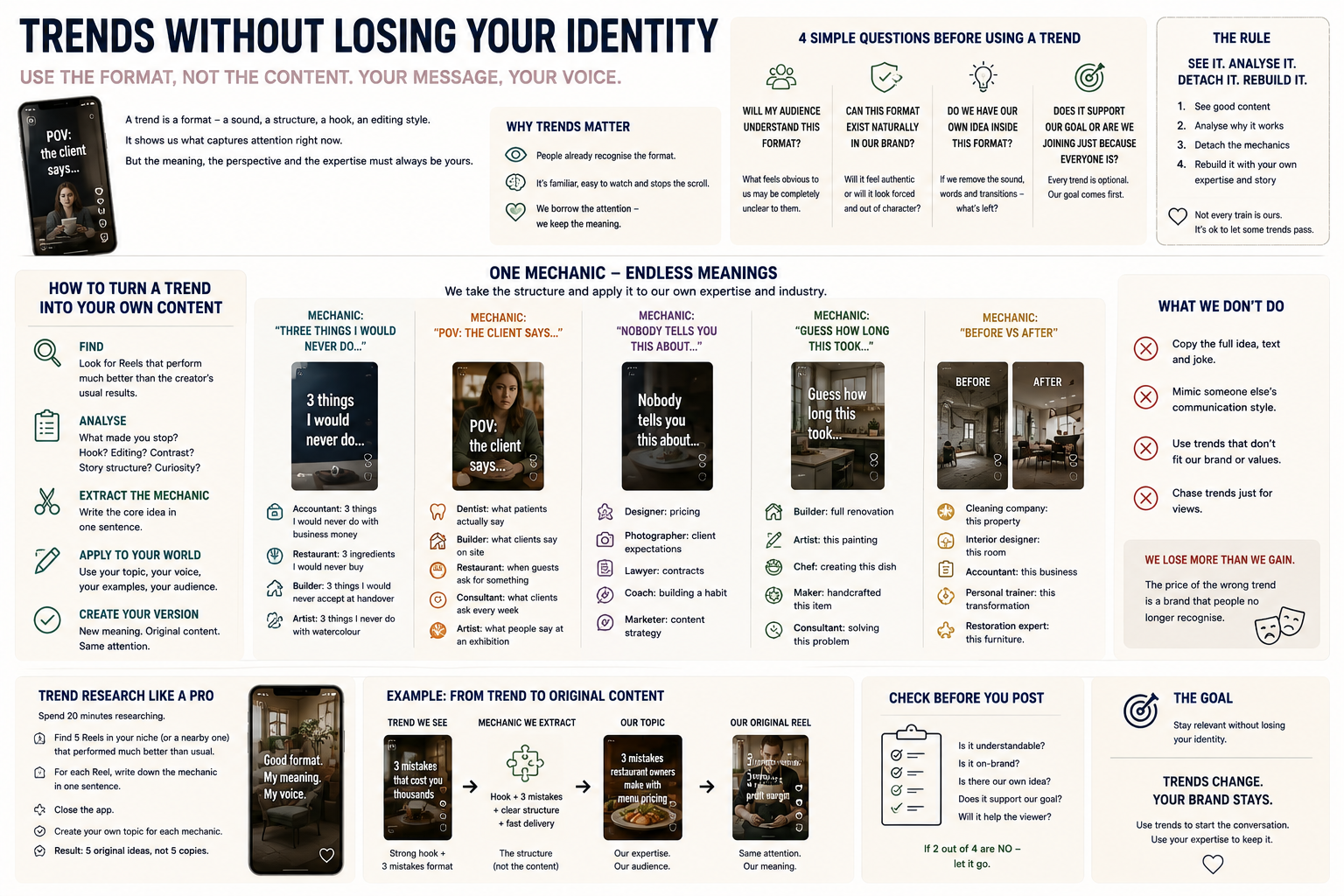
Will my audience understand it? Can I do it naturally? After watching it, will someone understand me, my product or my business better?
If the answer to two out of three is no, let it go.
Imagine an expensive corporate law firm deciding to repeat a dance trend simply because it is currently generating views. Could it work? Of course. If that is genuinely the company’s personality, employees regularly appear in its content, the audience already knows their sense of humour, and the execution is cleverly connected to their profession, why not?
But if the firm has spent five years building the image of a restrained adviser for complex corporate matters and one morning three partners suddenly start dancing in sync to trending audio, there is a perfectly reasonable question: why?
The question is not “Can a brand create funny content?”
It is why should this particular format belong to this particular brand?
A trend should not force you to become somebody else temporarily.
This matters particularly for personal brands. Sometimes I look at an Instagram Reel and can see perfectly well that the mechanics are strong, but I would never speak that way myself. I would not make that facial expression, perform that emotion or communicate in that manner.
So I let it go.
Not because the trend is bad, but because the price of those views is too high. I would be attracting attention through a version of myself that I do not want to become afterwards.
We do not need just any reach. We need recognisable reach.
Someone may see five completely different Reels from your business over the course of a month, but gradually they should still develop a sense that they are meeting the same person or the same brand.
Topics change. Formats change. Music changes. Pace changes. Sometimes even the visual style changes. But the character remains. The perspective remains. The values, level of humour, attitude towards customers, way of explaining things and understanding of what matters should still feel familiar.
This is why adapting social media trends can happen on several different levels.
We can keep the mechanics and change the subject.
Keep the audio and completely change the story.
Take the editing structure but film our own business process.
Borrow the opening sentence structure but write our own words.
Use a popular question but give an answer that could only come from our own professional experience.
Sometimes only ten per cent of the original trend remains in the final Reel, and for me that is usually a good sign.
Imagine the popular “POV: the client says…” format. The mechanism might suit us perfectly, but there is absolutely no reason to repeat somebody else’s joke.
A dentist can use a typical sentence from a patient. A builder can use something a customer says. A restaurant can use a guest request. A consultant can use a client question. An artist can use something somebody said at an exhibition.
One mechanism. Five completely different meanings.
Or perhaps we notice the popular structure “Nobody tells you this about…”. There is no need to translate somebody else’s script and present it as our own. What we want is the underlying principle: tell people something they usually discover too late.
The content itself comes from real experience.
What do customers in your business genuinely discover too late? What information could save them money, time, stress or a poor decision?
Now that Reel belongs to you.
I also want to talk specifically about copying because the boundary can sometimes feel rather thin.
If you take somebody else’s idea, text, sequence of arguments, joke and visual decisions and simply replace the creator with yourself, that is copying.
If you notice that audiences respond well to a “three mistakes” format and then explain three mistakes from your own professional experience, that is a mechanism.
If you see an effective transition and use it to show a completely different process, that is a mechanism.
If you hear trending audio and create your own context for it, that is adaptation.
If you rewrite somebody else’s Reel almost word for word and simply replace “photographer” with “designer”, no amount of talk about adaptation is going to rescue it.
There is a useful internal test.
If the original Reel disappeared, could you explain why your content deserves to exist on its own?
If yes, you have probably moved far enough away from the source. If your idea collapses without the original, it needs more work.
This matters not only for maintaining your own brand identity. The way Instagram approaches original content has also changed, so I would not build our content strategy around literally reproducing successful Reels. The useful part of studying high performing content is the research itself. We analyse the structure, audio, angle, style and audience response, but then take that process in a different direction:
we do not clone the post. We extract a working hypothesis and create our own version.
I would keep the testing as well, but I suggest testing ideas rather than duplicates.
If a Reel built around “three mistakes” performs well, there is no need to publish almost the same video six times.
Create several new pieces of content using the same mechanism.
“Three mistakes before buying.”
“Three mistakes after buying.”
“Three mistakes that cost the most.”
“Three mistakes I see most often with new clients.”
We are testing the content format hypothesis, while the audience receives something new every time.
That is a fundamental difference.
Your Instagram profile does not become a testing ground filled with clones of the same Reel. Followers do not start wondering why they have seen virtually the same thing three times this week. And you still collect useful social media analytics.
Was it the mechanism that worked, or simply the topic?
Was it the opening hook or the specific example?
Did people keep watching because of the structure or because they wanted to see the result?
Your next pieces of content gradually begin to answer those questions.
And sometimes the best professional skill in working with social media trends is not being able to reproduce them quickly. It is being able to walk past them calmly.
The trend has become so widespread that people are already tired of it. Skip it.
It requires behaviour that does not suit the brand. Skip it.
It is funny, but the joke is at the customer’s expense. Skip it.
It generates views but attracts completely the wrong target audience. Skip it.
You have to force your product into the concept to make the trend work. Skip it.
You discovered it too late and would now simply become the one hundred and twenty eighth account making exactly the same joke. Perhaps skip that one too.
Nothing terrible will happen.
Another trend will arrive.
I would not set a business the goal of being trendy. A far more interesting goal is to stay current without losing your own voice.
For practice, I suggest opening Instagram Reels not for entertainment but for twenty minutes of social media research. Find five pieces of content in your own niche or a neighbouring one that performed noticeably better than the creator’s usual results.
Do not save them simply because they are popular.
For each one, write down the mechanism in a single sentence. Then close the originals and create your own topic for each mechanism.
The result should not be five copies of somebody else’s successful Reels. It should be five original content ideas whose source the viewer would never need to guess.
And the next time you see a Reel with a million views, I do not want your first thought to be, “I need to make the same thing.”
Let the question be different:
“What exactly worked in this structure, and what would this mechanism sound like if it had originally been created by us?”
Because trends move quickly. Social media formats change. Popular audio becomes tiresome. An editing style that feels fresh today may look dated six months from now.
But brand recognition should accumulate.
And if every new trend requires us to become somebody different, then we are not using trends.
The trends are using us.