Wayfinders LabWayfinders LabWayfinders Lab
Social Media & Content

Instagram & Facebook

Hmm… where does creating content for a business actually begin?

The answer seems fairly obvious. With an idea for a post. Or a beautiful video. Or, if you open the internet and wander around for a while, you’ll very quickly discover that you urgently need Reels. Then it turns out you need Stories too. Carousels would be a good idea. Apparently, posts haven’t disappeared either. Oh, and… algorithms. Trends. Hooks. Consistency. Analytics.

Content doesn’t start with....

And somewhere around this point, a person who was actually planning to run their own business suddenly discovers they’ve acquired another profession. Congratulations. You’re now a social media manager too.

Although… hang on a minute. Do you actually need to become one?

I think this is where we often confuse two completely different things. One is professionally managing social media for other businesses. The other is understanding your own business well enough to decide for yourself what you want to say to your customers, why you want to say it, and which content format makes sense for that particular message. That second part is what we’re going to learn.

Because technically, creating social media content isn’t particularly difficult. Click a button. Upload a photograph. Add some text. Edit a short video. Most of that can be learnt fairly quickly. The difficulty seems to start earlier.

What should I post? Why this particular thing? Why a video rather than a carousel? Do I actually need to post anything today? What do I do with a trend everyone else is already using? And if a Reel gets five thousand views but not a single customer, was it good or bad?

And the other way round: if far fewer people see a post, but three of them message afterwards to ask about your service… perhaps that was the content that actually worked.

Because social media marketing stops looking like a competition for the highest number of views. It starts looking more like another place where a business meets a person. And that gives me a completely different question.

Not: What should I post today?” But: “What do I actually want to say to this person right now and why?”

Do I want them to discover me for the first time? Understand what my company does? See the result of our work? Begin to trust us? Understand something complicated? Remember us? Reply? Visit? Buy? Curiously, once you have the answer to that question, choosing the right social media content format suddenly becomes much easier.

The format is a tool, not the strategy

Sometimes you need a Reel. Sometimes one photograph will say more than an entire video. Sometimes an idea needs several frames and becomes a carousel. And sometimes it makes far more sense simply to open Stories and show what is happening inside the business right now.

So perhaps the problem was never really about Reels, Stories or posts in the first place. They are formats. Tools. Nothing more and, perhaps, nothing less. An artist chooses watercolour, pencil or charcoal depending on what they want to express. Social media content works in much the same way. You choose the format according to the message, the audience and the purpose.

That’s why this training won’t begin with the idea that there is one correct way to manage Instagram or Facebook. I’m rather suspicious of universal social media strategies such as: “post this many times a week”, “only create video content”, “this format doesn’t work anymore” or “everyone needs to be doing this now”.

Hang on… works for whom? For what kind of business? With which target audience? And for what purpose?

A restaurant and an accountancy firm can use exactly the same social media platforms while speaking to completely different people, in completely different circumstances, and leading them towards a buying decision in completely different ways. So first, we’re going to understand the logic behind social media content strategy itself.

How do people encounter content? Why do they scroll past one piece and stop at another? What are Reels, Stories, carousels and regular posts actually for? How does content hold attention? Why does storytelling help us do more than simply communicate information… why can it create connection? How does visual content affect whether somebody even wants to read what we have to say?

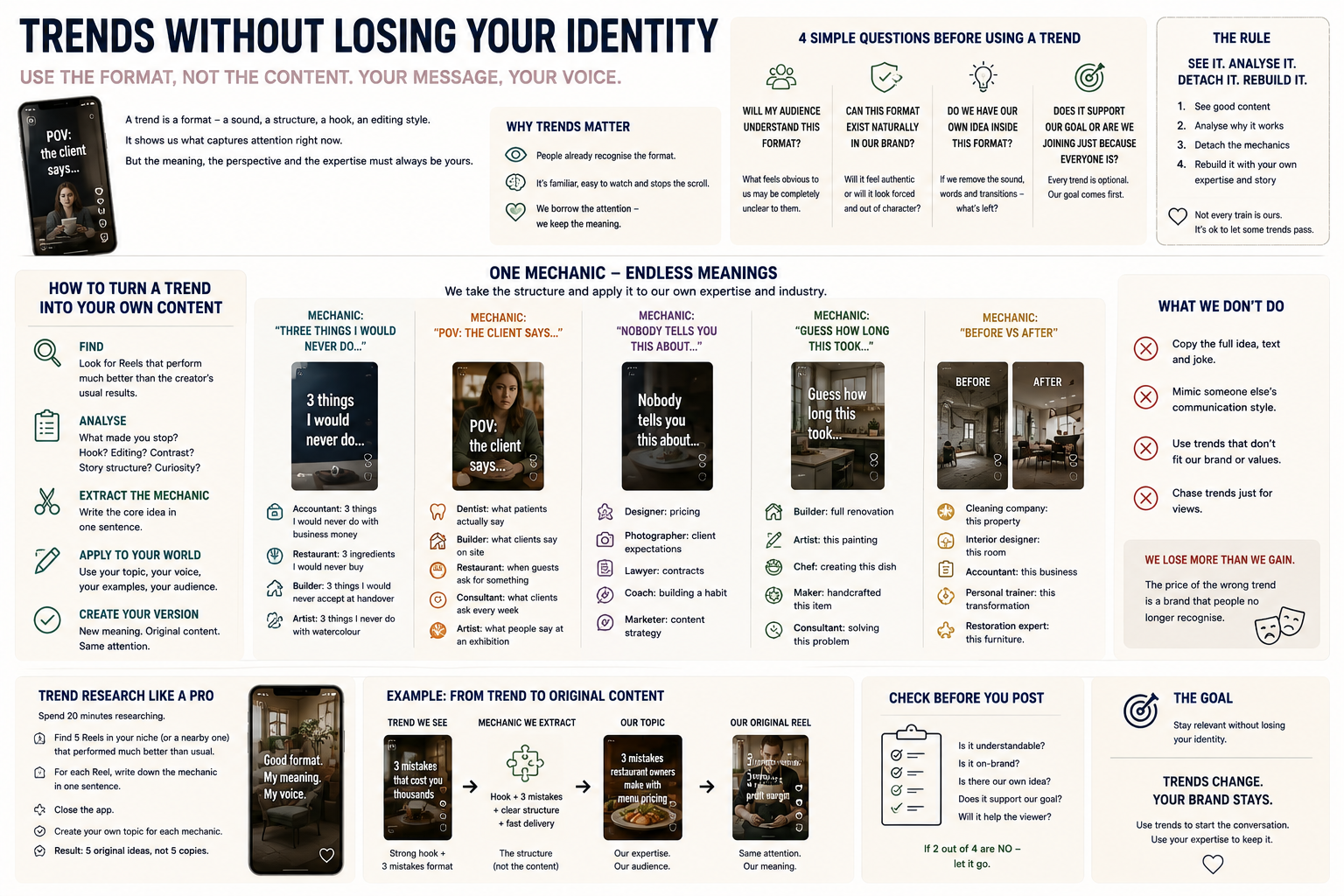
And why can a social media trend sometimes help a business become more visible, while at other times it simply turns that business into another copy of hundreds of accounts around it?

Social media analytics are there to tell you something

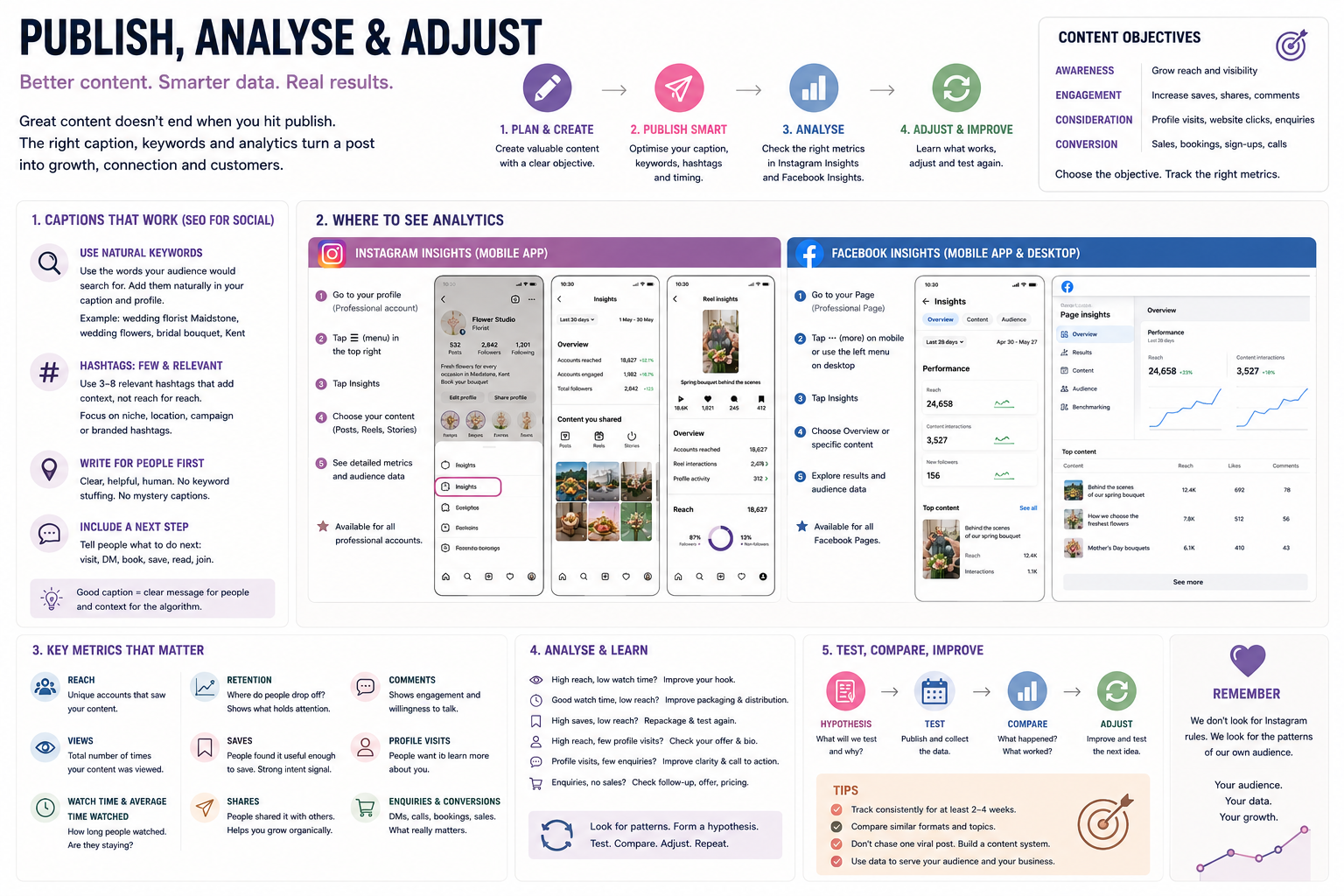
And, of course, we’ll look at the numbers. But not because you now need to open your social media analytics anxiously every morning to check how many people have viewed your content. I’m much more interested in something else. What are those numbers trying to tell us?

Perhaps people are watching but not staying. Perhaps they save your content but don’t comment. Perhaps one type of content reaches new audiences, while another helps people who already know your business finally decide to get in touch. A Reel with high reach might be doing one job. A carousel with fewer views but more saves might be doing another. A post that generates enquiries may be doing something else entirely.

So analytics aren’t a judgement on whether you’re “good” or “bad” at social media marketing. They’re a way of observing. We created something. We watched how people responded. We compared the results. Then we tried again, slightly differently. Hmm… that already sounds much more like sensible business and marketing strategy than trying to guess the mood of some mysterious social media algorithm.

There’s one more thing I want to keep somewhere very close to all the rules, formats and techniques we’re going to explore. You are running a business. You do not work for Instagram, Facebook or, more specifically, Meta. And you certainly don’t have to build your life around the constant need to produce content for social media. Which is why, for me, a good content strategy isn’t the one with the most posts. It’s the one you can actually sustain.

If, after a month of doing social media “properly”, the mere mention of the word Reels makes you want to throw your phone out of the window… hmm… perhaps the problem isn’t your discipline. Perhaps you’ve simply built a content system that doesn’t suit you.

Build a content system that fits your business

So gradually, we’re going to find your own social media content system. We’ll work out what your business genuinely needs. Which content formats make sense for your audience and your goals. What you can create yourself without becoming overwhelmed. What can be prepared in advance. What can be repeated, repurposed and reused without constantly reinventing everything from scratch.

And we’ll look at what, at some point, makes more sense to hand over to a social media specialist…but this time with a clear understanding of what you want them to do and what result you expect from their work.

I don’t want you to finish this training feeling as though you’ve acquired another twenty social media rules that now need to be followed. Quite the opposite. I want you to reach the point where opening Instagram or Facebook no longer creates that familiar blank-screen paralysis. “So… what am I supposed to put on there today?” Instead, another set of questions begins to appear.

“What is actually happening in my business right now? What part of that matters to my customer? And how can I show it in a way they will understand?”

Only then does the technical side begin. Reels, carousels, Stories, captions, visual content and everything else that usually seems like the most important part of social media content creation.

But by then, they are simply tools.

Content starts with a purpose...not a post

Well… let’s start with the simplest question. Why does your business need social media in the first place? Not Instagram specifically. Not Facebook. Not because “you can’t run a business without it these days”. And not because your competitors have lovely looking profiles. Why does your business need social media?

Hmm… it sounds like an easy question. But the moment you actually try to answer it, you quickly realise that “doing social media” cannot be a business goal in itself.

Imagine that tomorrow you create a brilliant Reel. Then another one. You write a post. Add some Stories. A month later, you open your profile and everything looks rather lively. You have a consistent social media content schedule, people are watching, somebody is liking your posts, and your follower count has even grown a little. And? What exactly was supposed to happen to the business as a result?

For a moment, let’s leave content creation alone and look at the business itself. What does it actually need right now? Perhaps you need people who have never heard of you to discover the business. Perhaps someone has already found your company through Google or a recommendation, then opens Instagram, looks through several posts and wants to make sure the company is real, active and trustworthy. Maybe you need to explain a service people do not yet fully understand. Show a product. Bring previous customers back. Generate an enquiry, a booking or a sale. Or perhaps selling is not the priority at all right now. Maybe what matters is getting to know your target audience and giving them some time to get to know you.

These are completely different business and marketing objectives, and social media will have a different job to do in each case.

I like to think of Instagram and Facebook not as a separate business activity, but as another customer touchpoint. People rarely encounter a company once and immediately make a decision. Especially when the decision involves a service, trust or a fairly significant purchase.

Someone might see a Reel and forget your name. A week later, they come across another post, visit your profile, look through your photographs, read a couple of posts and leave. Later, a friend recommends you and they come back again. Only then do they send a message.

So when did the content work? Probably at every stage. One piece of content introduced the business. Another helped them remember it. A third explained something. A fourth showed the people behind the company. A fifth provided social proof that you really can do what you say you can do. And the sixth simply appeared at exactly the moment when the need was already there.

Content does not have to sell every single time. But every piece of content should have a job.

It might introduce, explain, create interest, help someone understand, demonstrate something, build trust, remind, start a conversation, encourage the next action or sell. And sometimes its only job is to stay somewhere in a person’s memory until the moment they need you.

Which brings us to the next question. Who are we actually talking to?

Because “our target audience is everyone who might need our service” sounds wonderfully convenient, but it tells us almost nothing. Different people have different reasons for noticing the same business. They make decisions differently, hesitate for different reasons, ask different questions and can see completely different value in exactly the same product.

So before creating social media content, I want to understand the person on the other side of the screen. What do they already know? What do they not understand yet? Why might they stop at this particular post? What are they worried about? What do they need to see before they feel ready to get in touch? What might make them hesitate? What should change in their mind after encountering our content?

And this brings us to something that looks very small at first, but makes the entire content strategy much easier later.

Before every post, ask yourself:

What do I want to change after this person sees this content?

It does not have to be anything dramatic. Before seeing the post, they did not know the company existed. Afterwards, they do. They did not understand the service. Now they do. They thought the product was too expensive, but now they understand what goes into its price. They were not sure whether they could trust you, then they saw your process, your team or a client result. They were simply scrolling through their feed and suddenly thought, “Oh… I actually need this.” Or perhaps they had been following you for months, but this was finally the moment they clicked the button and sent a message.

That is the purpose of the content. First the Purpose, Then the Format

Now we can return to the question people usually start with: “What should I make today, a Reel, a post or a carousel?” I don’t know.

And that is probably the most sensible answer until we understand what we want this particular piece of content to achieve.

A Reel, carousel, photograph, caption or Story does not solve anything by itself. They are simply different ways of communicating an idea. First comes the purpose. Then we decide who we are speaking to and what we want to say. Only after that do we choose the social media content format that can communicate it best.

And this is where one of my favourite principles comes in.

First the purpose. Then the format.

  • Not “I need to make a Reel”. Instead, “I need to introduce our business to people who have no idea who we are yet.”
  • Not “I should make a carousel”. Instead, “People keep asking the same question, and I want to explain it properly once in a useful piece of content they can save.”
  • Not “I haven’t posted any Stories today”. Instead, “Something is happening inside the business right now that could help people understand how we actually work.”

Can you feel the difference? The format stops controlling us. We start using it. And only then does it make sense to look at the tools themselves.

If I need to reach new people quickly, catch their attention, show movement, a face, a process, an emotion or one fairly simple idea, a Reel will often be interesting to me. That person owes me nothing yet. They may be discovering my business for the first time among dozens of other videos, which makes the opening seconds and the reason to keep watching particularly important.

If I need to explain something, take someone through several ideas, show stages, comparisons, mistakes or a sequence, or create useful content they may want to save and return to, a carousel becomes much more interesting. Here, the person is no longer simply watching. They are swiping, reading and comparing. They are interacting with the information differently.

A regular Instagram or Facebook post can work perfectly when you do not need an elaborate structure. Sometimes there is one photograph, one result, one piece of news, one thought or one message that absolutely does not need seven slides and some music attached to it simply because somebody announced that ordinary posts no longer work.

Stories operate rather differently. They happen now. They are useful for showing the day to day life of a business, continuing an existing conversation, asking questions, answering them, reminding people, showing a process, a reaction or small details. Someone watching your Stories is usually a little closer to your business than someone who happened to discover a Reel.

Facebook should not automatically be treated as the place where a copy of everything from Instagram gets sent. Sometimes that makes perfect sense. Sometimes it does not. The audience may behave differently there. Conversations may develop differently. Longer posts, local information, events, recommendations or content people share within their own networks may work better.

There is no permanent table where every marketing objective has one correct content format assigned to it. The same message can be communicated in different ways. The more useful question is what action do we want to make easier for this person right now?

If we want them to notice us, we need a format capable of attracting attention. If we want them to understand, we need enough space to explain. If we want them to trust us, our own words may not be enough, so we need people, process, results, customer reviews or other proof. If we want to start a conversation, we need to leave space for the person to enter it with their own response. If we want to sell, it needs to be clear not only what we are offering, but what they should do next. And if we want to bring someone back, we first need to remember why they chose us before and what else might be useful to them now.

And that leads to something rather interesting.

Content creation begins before we open the camera, Canva or the new post window. It begins when we understand who we are speaking to, what we want to communicate and what, ideally, should happen next.

Whether that becomes a Reel, a Story, a photograph, a carousel or a piece of written content… now we can choose.

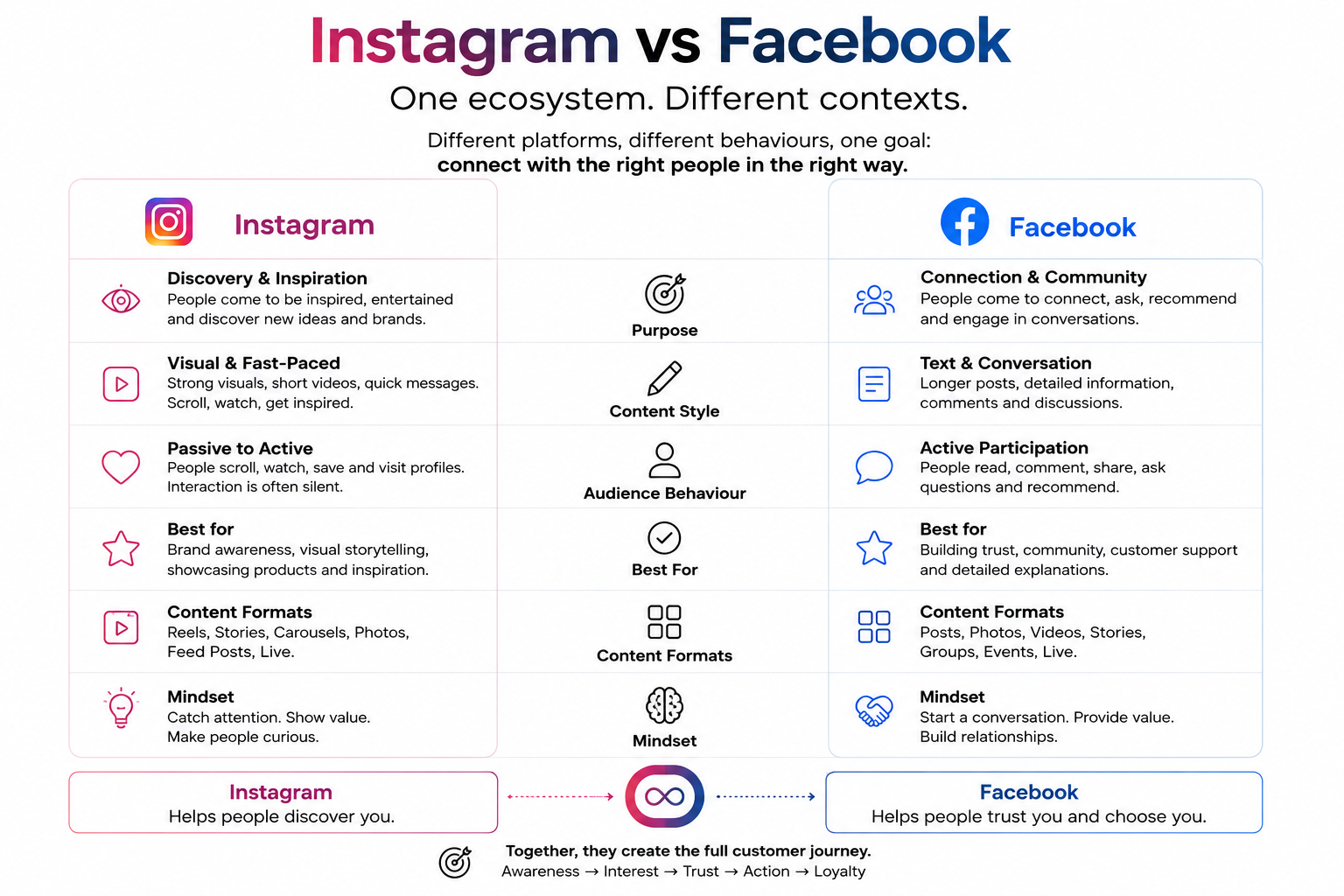
Instagram and Facebook. One acosystem...different contexts

All right, we have dealt with the objective. We have a rough idea of what we want to say to a person, why we want to say it, and what should happen after they encounter us. And that brings us to the next fairly logical question. Where exactly are we going to meet them? In our case, that means Instagram and Facebook.

At first glance, it seems wonderfully convenient. Both platforms belong to Meta, the accounts can be connected, content can be published to both at the same time, Reels exist on both platforms, Stories do too, and the advertising system is shared. So the natural thought is: perfect, create one piece of social media content, press a few buttons and publish it everywhere.

And sometimes that is exactly what makes sense. But sometimes it does not. Technically, Instagram and Facebook really do live inside the same Meta ecosystem. People, however, do not necessarily behave in the same way on both platforms.

Take Instagram. We open the app and our eyes begin moving quite quickly. The Feed, Stories, a Reel, the next Reel, somebody’s profile, then Stories again. A great deal here happens through that first visual impression. We may know absolutely nothing about a company, see one video, become curious, open the profile and within seconds begin forming our own picture of the business. Who are they? What do they do? Do I like what I am seeing? Is this even relevant to me? Do they feel real? Can I trust them?

And the person may never press Like, leave a comment or even follow the account. They might simply look. Then come across us again a week later. Then watch our Stories. And then, quite suddenly, send a message.

Facebook works a little differently. People are often more likely to pause over a longer post, open the comments, join a discussion, see something a friend has shared, or discover a business through a local community, event or recommendation. This becomes particularly interesting for local business marketing, where people still quite actively ask one another, “Who would you recommend?”, “Who did your installation?”, “Where is best?”, or “Does anyone know a good specialist?”

And the very same person may behave completely differently across the two social media platforms.

On Instagram, they might notice a beautiful dish. On Facebook, they may read that somebody in their neighbourhood recommended the restaurant. On Instagram, they might watch a Reel featuring the owner of the company. On Facebook, they may come across a detailed post explaining the service. The company is the same. The person may be the same. But the context in which they meet the business is different.

That is why I would not treat Instagram and Facebook as two entirely separate universes for which we now have to produce twice as much content. Goodness, that is the last thing we need. We can quite easily have one idea, one topic, one content shoot and even one original piece of material.

The only question is whether we should leave it exactly as it is or adapt it slightly for the platform where it will appear. Reels can work perfectly well on both Instagram and Facebook, particularly when the video itself makes sense without much additional context. The same applies to many photographs, company updates, offers, customer reviews and product content.

But suppose we have a Reel that only needs a short Instagram caption. On Facebook, it might make sense to give the same video more context, especially if the subject naturally invites discussion.

Or perhaps we have an Instagram carousel that explains a complicated topic beautifully. There is absolutely no need to transfer it mechanically to Facebook just so we can tick the box marked “published everywhere”. The same idea might work better there as a standard Facebook post with several photographs and a proper piece of text.

So adapting social media content does not mean recreating everything from scratch. Sometimes we only change the caption. Sometimes the opening image. Sometimes the call to action. Sometimes the length of the text. Sometimes we change nothing at all. And sometimes we realise that a particular piece of content has no real purpose on the second platform. That is perfectly fine too.

Now let’s look at what we actually have available. On Instagram, there is the business profile and the main Feed. This is where our posts, photographs, videos and carousels remain. In a sense, when somebody visits the profile, they are no longer looking at one individual post. They are seeing the accumulated picture of the business. So what matters is not only whether each piece of content works on its own, but also what somebody understands after looking at several posts together.

Then there are Instagram Reels. Short vertical videos are particularly useful because they can help us reach not only people who already know the business, but also new audiences.

There are Stories, a faster, more immediate and temporary layer of communication. This is where we can show things that do not need to become a full permanent post. What is happening today. What has just arrived. What is being prepared. What has changed. Which question we want to answer. What happened behind the scenes. Stories also make it easy to talk with people through reactions, questions, polls and replies.

Then there are carousels. A sequence of images or slides that allows us to spread one idea across several frames. They are particularly useful when somebody needs not simply to see something, but to move with us through a short journey from the first question to the answer.

And there are still ordinary social media posts. And no, they are not dead. We will come across the internet’s rather entertaining habit of declaring a particular content format dead, only to announce six months later that it works perfectly well, more than once. If we have a strong photograph and something genuinely worth saying alongside it, there is absolutely no reason to turn it into a Reel simply because somebody currently insists that businesses should only create video content.

On Facebook, a business has a Page. This is the company’s own space, where people can find information, contact details, posts, photographs, videos, reviews and other available Page features. If we are running a business rather than a personal blog, it makes sense to separate a person’s private Facebook account from the company’s official business presence from the beginning.

The same applies to Instagram. For a business, we need a professional account. It gives us access to professional tools and social media analytics, while connecting it with a Facebook Page makes managing both platforms inside the Meta ecosystem considerably easier.

One Content System, Several Different Spaces.  And that brings us quite naturally to a tool I really would recommend learning to use, even if you have absolutely no intention of becoming a social media manager.

Meta Business Suite.

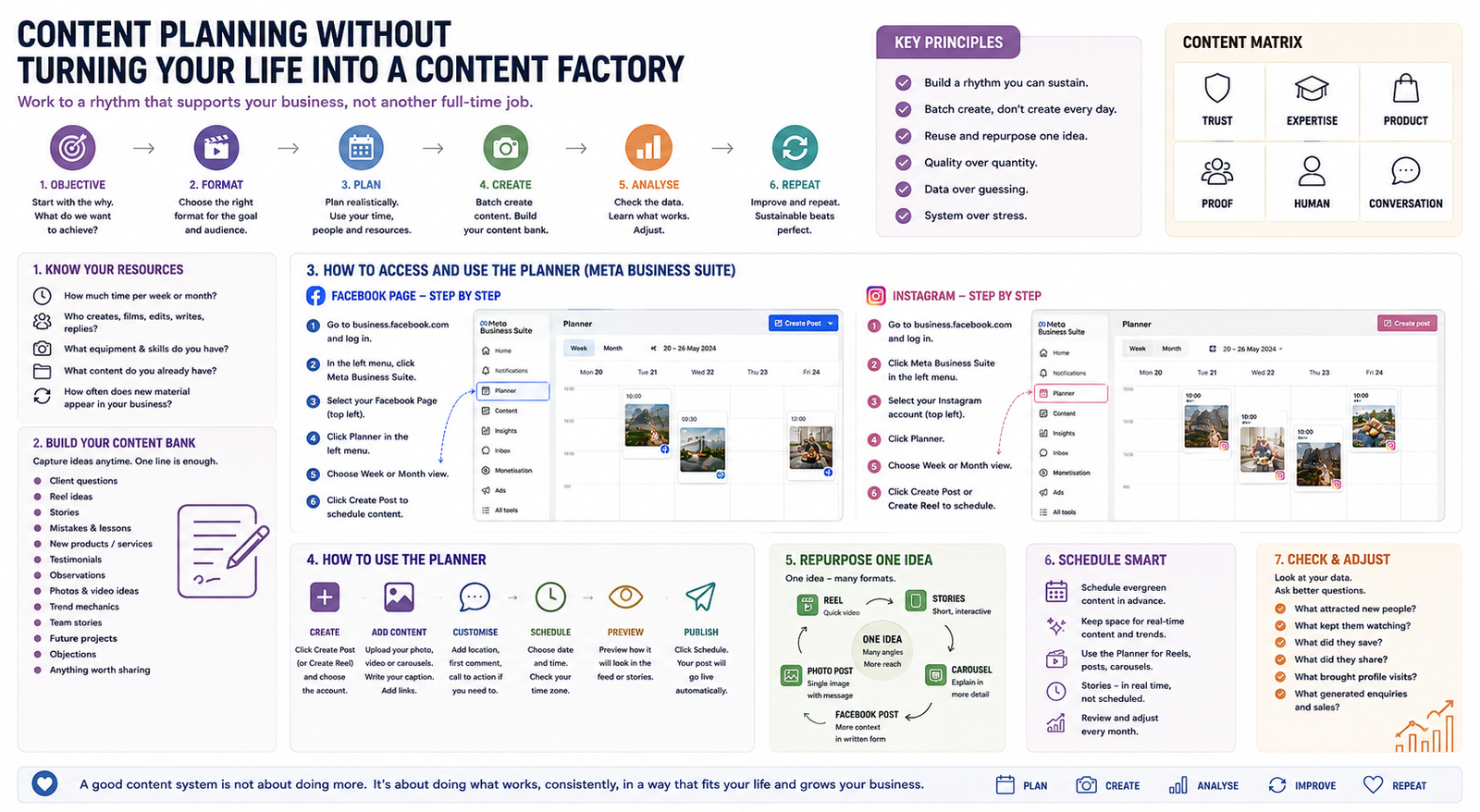
The name sounds considerably more intimidating than what it actually does. Essentially, Meta Business Suite is a business dashboard from which you can manage your company’s presence across Instagram and Facebook. Instead of constantly moving between different apps, you can bring part of your social media management into one place. For example, you can prepare social media posts in advance and schedule them.

And that, incidentally, can change the life of the person responsible for business content quite dramatically. Because there is an enormous difference between remembering every evening at six o’clock that once again nothing has been published today, and calmly preparing several pieces of content in one session and deciding in advance when each one will go live.

You can see what has already been published and what has been scheduled. You can manage Facebook and Instagram content from one place. The same system also provides basic performance data, allowing you to see what happened after publication and how people responded. Meta effectively brings business asset management and performance data together within its business tools.

But at this point, I am going to ask you to resist the urge to open every available number and immediately start worrying about it. We do not need to become Meta analysts just yet. At this stage, it is enough to learn how to ask social media analytics a few perfectly ordinary human questions.

How many people saw the post? How many interacted with it? What did they actually do? Did they watch the video for a few seconds and leave? Did they watch to the end? Did they visit the profile? Save the content? Share it? Send a message? And, most importantly, does that behaviour match the objective we gave the content before publishing it? Because remember where we started. First the objective. Then the format. Now we can add one more piece.

First the objective. Then the format. Then we look at what happened. Gradually, instead of the vague feeling that “this post seems to have done well”, we begin to build a simple social media analytics system based on observation.

Perhaps we decided that the objective was to introduce the business to new people. We chose a Reel, published it and then looked at whether it actually reached people beyond our existing audience and whether enough of them were interested to take a next step.

Another time, the objective might be to explain a complicated subject. We create a carousel. Here, a completely different kind of response may matter. Did people read it? Save it? Share it with somebody else? Did it generate questions? So even social media metrics cannot be evaluated separately from the purpose of the content.

Viewed this way, Instagram and Facebook stop looking like two enormous machines that constantly need to be fed with new content. Instead, we have one social media content strategy with several different spaces inside it.

We can start with one strong idea. Choose the most appropriate way to present it. Publish it where it genuinely makes sense. Adapt the content slightly when necessary. Schedule what can be prepared in advance. Then look at the results.

Only after that do we decide what to do next.

And somehow, that feels considerably calmer than trying to guess every day what Instagram wants from us now.

Instagram vs Facebook comparison for business social media content strategy, showing differences in purpose, content formats and audience behaviour.

A content system for your business

So, we have made some sense of the platforms, and the formats too. And the next question usually appears quite naturally: fine, but what am I actually supposed to talk about all this time?

The first ideas tend to come quite easily. Talk about a service. Show a product. Introduce the team. Share a customer review. Then another review. Then talk about the service again… and eventually we arrive at that wonderful moment when you stare at your phone and think, “Right… I think I have already said everything.” You have not.

We are simply looking at social media content as a collection of individual posts again, when it is much easier to look at the business itself….What does someone need to know about your business before they are ready to buy? What do they need to understand? What do they need to see? What do they need to be sure about? What do they need to feel? What doubts might they have? What makes us different? And who exactly is behind the company name?

Once you start asking those questions, you quickly discover that almost every business has several larger themes from which you can continuously create content. I call this a content matrix.

I like the idea of a matrix precisely because it is not a thirty day social media content plan filled with boxes saying “Monday, educational post”, “Wednesday, sales post”, “Friday, entertaining content”. I have never quite understood why someone should suddenly want to buy on Friday simply because our social media calendar says that today is sales content day. A content matrix works differently.

It helps us see which parts of the business we can actually talk about. Then, within each of those areas, we can find dozens of individual content ideas for Instagram, Facebook and other social media platforms.

The first area I would call Trust. Why should someone trust us at all? Especially if this is the first time they have come across our business. And trust does not necessarily come from saying, “We have been in business for 15 years and we are professionals in our field.” Anyone can write that about themselves.

It is far more interesting to show how we work. How we make decisions. What matters to us. How we treat our customers. What happens when something goes wrong. Which principles we are not prepared to compromise. Who takes responsibility for the result. Sometimes customer trust is built through one tiny detail that the business itself does not even consider worthy of becoming a piece of content.

The next area is Expertise. What do we actually know, and what can we genuinely do?

Not how many clever terms we can squeeze into one Instagram carousel, but what someone can understand after spending time with our content that they did not understand before. This is where educational content comes in. Explanations, professional observations, common mistakes, frequently asked questions, comparisons, practical advice, industry changes and those small details of your profession that have long become obvious to you, but may be a genuine revelation to a potential customer.

And good expert content, at least as I see it, should not constantly be trying to prove how much cleverer we are than the person reading it. Quite the opposite. Afterwards, something complicated should feel a little easier to understand.

Then there is Product. And this one is simple. Although, for some reason, this is often the part businesses become slightly embarrassed about. What do we actually sell? What products or services do we offer? Who are they for? What problem do they solve? How are they different from one another? How much do they cost, if the price is public? What is included? How does someone order or enquire? What happens after they do?

People can follow a very interesting business account for months and still have absolutely no idea what the company actually does or whether they can buy anything from it. So yes, we need product and service content. Not constantly. But often enough that a potential customer does not have to conduct an investigation.

The next area is Proof. We can say as much as we like about ourselves. At some point, however, people want evidence. Customer reviews, case studies, results, before and after examples, completed projects, returning customers, the working process and meaningful numbers can all become forms of social proof.

Sometimes the proof is not even the final result. It is the process itself. How an order is packed. What a project looks like while the work is underway. How preparation happens. How the team checks quality. What the kitchen looks like before a restaurant opens for the evening.

In other words, Proof answers a very simple question sitting somewhere in the customer’s mind: “Fine, you say you can do it. Can I actually see that?”

Then we have Human. Because businesses are still built by people. Even when a company has a very serious corporate exterior, decisions about whether to work with it are still made by real people. And quite often, they want to know who they are actually going to be dealing with.

Who is the founder? Who works in the team? Why do they do this work in the first place? What happens behind the scenes? What makes them laugh? What annoys them? What does an ordinary working day look like? What habits, personality and attitude towards its work does the business have?

Human content does not mean that the business owner now has to show their coffee, children, dog and bedroom every morning. Personal content and human content are not the same thing. You can keep your private life entirely private and still create a very real sense of the people behind the business.

And finally, Conversation. Because social media is, after all, supposed to be social… although sometimes we seem to forget that rather spectacularly. We publish and publish and publish, then wonder why our audience does not talk to us.

But did we actually give people a way into the conversation? Did we ask what they think? Did we invite them to choose? Did we leave a question that someone might genuinely want to answer? Did we ask them to share their experience? Did we reply to a comment in a way that allowed the conversation to continue? Conversation is content that does not end when you press Publish. There is space in it for another person.

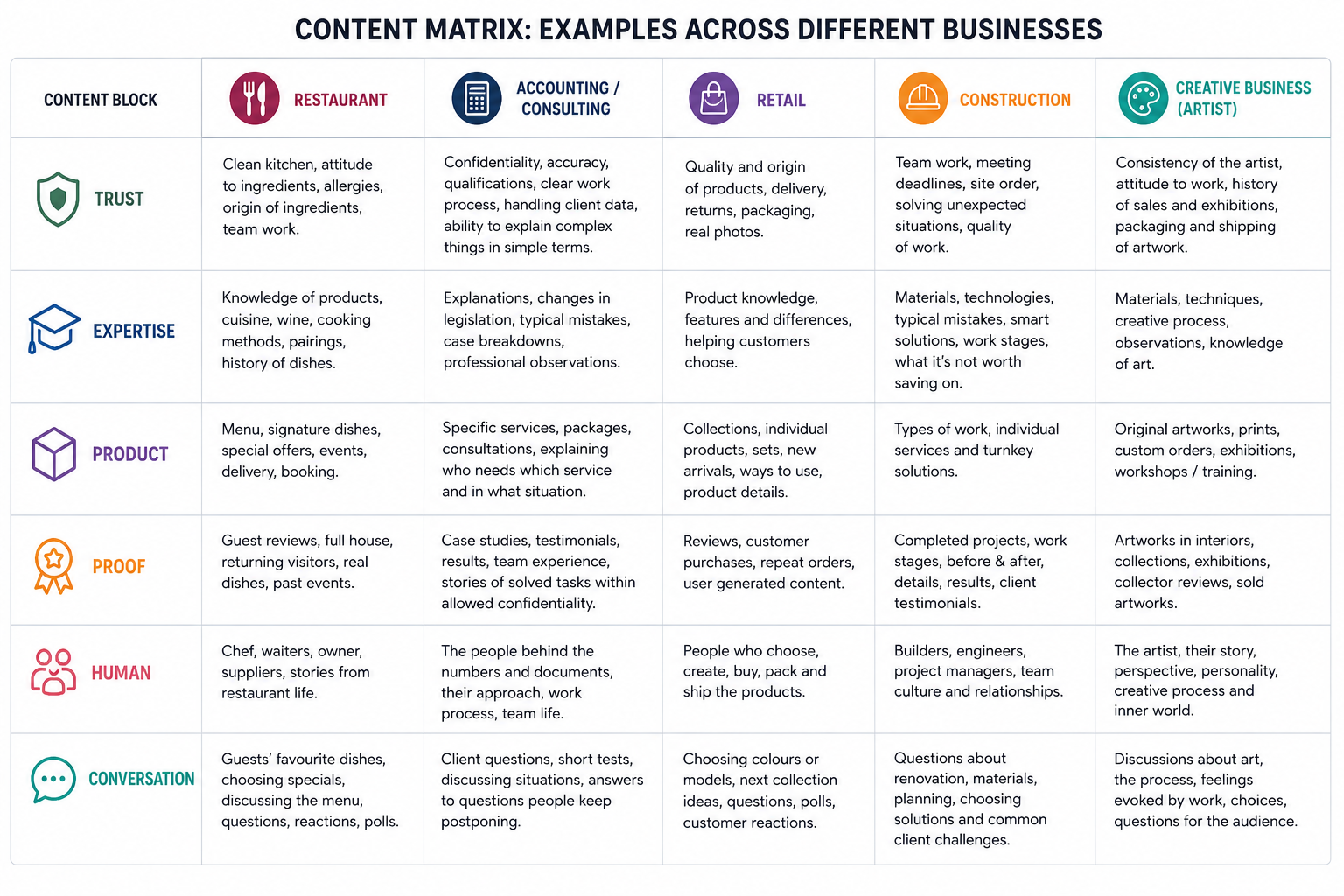
So now we have six core content pillars: Trust. Expertise. Product. Proof. Human. Conversation. And this is where it starts to become much more interesting. Because we can now take each content pillar and apply it to an actual business.

Imagine a restaurant. Trust might be the kitchen, hygiene, ingredients, suppliers, the way food is prepared, or the owner explaining why they refuse to compromise on a particular product. Expertise might be a chef explaining why a particular cut of meat behaves differently, how a dish is prepared, why ingredients are combined in a certain way, or how to choose a wine to go with dinner. Product is the menu itself. A new dish. A set menu. Lunch. Delivery. A seasonal offer. A table available for booking. Proof might be customer reviews, a full restaurant on Friday evening, returning guests, photographs from an event or a dish leaving the kitchen exactly as promised. Human is the chef, the waiter who has worked there for seven years, the person who arrives first in the morning, the team preparing before opening, the owner talking about why this restaurant exists at all. Conversation might be asking guests which dish should return to the menu, inviting them to choose between two specials, asking about their favourite combination or simply continuing a discussion that started in the comments.

Now imagine an accountancy firm. The six content pillars remain exactly the same, but suddenly the content looks completely different. Trust might come from explaining how client information is handled, what the onboarding process looks like, what happens when a deadline is approaching, or how the firm communicates when something needs attention. Expertise might be explaining VAT, expenses, tax deadlines or changes affecting small businesses in the UK in normal human language rather than producing another piece of financial content that requires an accountant to understand it. Product might explain bookkeeping, payroll, tax returns, management accounts or business advisory services. Who needs each service? What is included? At what stage of business does it become useful? Proof might be a client case study, measurable results, years of working with a particular type of business, professional qualifications or a situation where a problem was identified before it became expensive. Human content might introduce the accountant who actually answers clients’ questions, show the team at work, explain why someone chose this profession or simply let clients see that there are approachable people behind all those numbers. Conversation might begin with a question businesses genuinely struggle with. “What part of your accounts causes the most confusion?” Suddenly we are not broadcasting information. We are listening too.

The same thing happens with a clothing brand, construction company, consultant, beauty salon, online shop, artist or local service business.

The content matrix does not depend on whether we sell dinners, accountancy services, clothes, house construction or our own paintings. The subject changes. The examples change. The customer journey changes. The balance between Instagram content and Facebook content may change too. But the underlying human logic remains surprisingly similar. Before buying, people usually need some combination of understanding, trust, relevance and proof. They may want to know who they are dealing with. They may need time. They may have questions. They may want to see the product more than once. They may simply need to remember that we exist when the right moment finally arrives. And that is why a sustainable social media content strategy does not begin by desperately inventing thirty unrelated posts for next month.

It begins by looking at the business and asking: What do people need to know, understand, see and believe before choosing us?

Once we have those answers, content ideas stop being something we have to pull out of thin air. We already have the material. It has been inside the business all along.

Social media content matrix with six content pillars and examples for restaurants, accounting and consulting, retail, construction and creative businesses.

One matrix. Completely different businesses. And suddenly content no longer feels like an endless demand to keep inventing something new. Instead, we can simply look at our own social media presence and ask:

What is actually happening here at the moment? Are we showing the product constantly, while people still know almost nothing about us? Are we always educating our audience, but forgetting to mention that they can actually buy something from us? Are we talking about ourselves without ever showing results? Do we have beautiful work, but no real person behind it? Or are we doing all the talking ourselves and have not asked our audience a single question in the past month?

That is when the content matrix becomes a useful way to spot imbalance in your social media content strategy.

And the six content pillars certainly do not need to take up exactly the same amount of space. The balance will be different for every business. For some, Proof will play a much bigger role. For others, Expertise. Somewhere else, Product may need more attention. And for another business, Human content may be essential for building trust and connection with its audience.

Even within the same business, those proportions can change depending on what is happening right now. A new service launch may naturally require more Product content. A business entering a new market may need more Trust and Expertise. A company with strong visibility but weak conversion may discover that Proof has been missing from its social media marketing altogether.

But now, at least, we have a map we can come back to.

And instead of asking: “What else can I come up with for Instagram?” We can look at the business itself and ask: “Right… which part of our business have we not talked about for a while?” And there, most likely, is your next content idea.

How to choose the right content format

So, now we have an objective, we have the person we want to reach, and we have a content matrix from which we can pull the actual topic. All that remains is to work out what form it should take. And this is where it is very easy to fall into the same trap again. “We need more Reels.” Why? “Because Reels get more reach at the moment.” Fine. What do we actually want to say? “Well… we’ll film something.” And just like that, we are pretty much back where we started. I would not treat an Instagram Reel, carousel, static post and Stories as competitors fighting for first place. They do different jobs. More importantly, people encounter these social media content formats in different circumstances and behave differently around them.

Let’s start with Reels. Imagine someone scrolling through Instagram Reels. Their finger is practically ready to swipe your video away before they have even worked out who you are. We have a very short moment to give them a reason to stay. Reels have one particularly interesting quality. When you publish ordinary Instagram content, it is often seen first by people who already know you and follow your account. Reels work a little differently. Instagram can actively recommend them to people who do not follow you yet. So someone may know absolutely nothing about your company, be scrolling through videos in the evening with a cup of tea, and suddenly come across your business.

For a business, that matters because Instagram Reels can become a discovery tool and a way to reach new audiences beyond your existing followers. Imagine a restaurant. Two thousand people follow its Instagram account, but a good Reel showing the kitchen, a new dish or the chef could potentially reach many more people, including those who have never encountered the restaurant before.

That is why I tend to think of a Reel as a tool for introduction and discovery. We need to enter the field of vision of someone who does not know us yet, quickly give them a reason to stop, and create that first flicker of curiosity. Then the content itself has to do the rest.

What did they see? What did they understand? Did they want to keep watching? Visit the Instagram profile? Remember the company? Share the video with someone? This is exactly why the first few seconds matter so much. We might need to show a person. Movement. A process. A transformation. An atmosphere. Demonstrate a product quickly. Catch attention with one thought. Show something that is simply easier to see than to read. Then video makes sense.

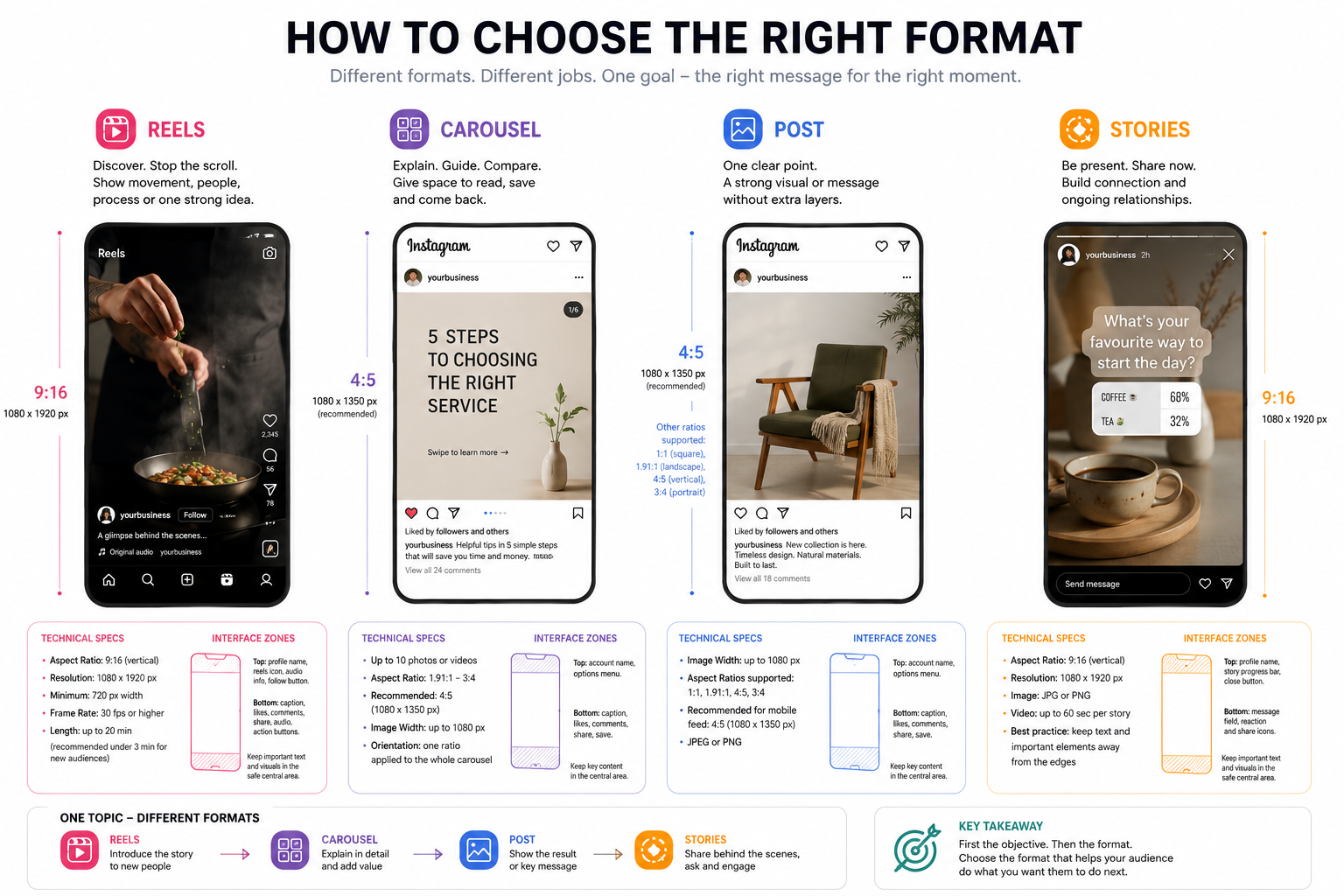
But a Reel does not become good content simply because it moves. If the opening seconds give someone no reason to stay, they will never see the beautiful edit waiting for them at second forty. Later, we will look separately at the internal structure of an effective Reel, including the hook, development, audience retention, ending and the action we want the viewer to take. Technically, for business Reels I would get used to creating video vertically in a 9:16 aspect ratio, which in practical terms means 1080 × 1920 px.

Instagram supports other proportions, but full screen vertical video remains our basic working format. Meta’s minimum technical requirements include 720 px resolution and 30 frames per second. Reels can now be considerably longer than the 30 or 60 seconds we became used to. Instagram allows videos of up to 20 minutes to be recorded and edited, but there is an important detail here. Reels longer than three minutes are not recommended to new audiences. So the technical maximum and the sensible length of a Reel for business are two very different things.

I would not tie you to rules such as “the perfect Reel is 17 seconds long” either. There is no magic number. If the idea is complete in 12 seconds, stop at 12. If it takes 45 seconds to explain something properly, use 45. If a story genuinely holds someone’s attention for two minutes, wonderful. The question is not, “How long am I allowed to talk?” The question is: “Does this person still have a reason to keep watching?”

The next format is the Carousel. Here, the person behaves a little differently. They are not simply watching. They make a small decision to swipe to the next slide. Then again. And again.

That creates an interesting mechanism because we do not have to throw all the information at them at once. We can guide them through it gradually. The first slide asks a question or promises what is inside. The next develops the idea. Then another adds something else. Gradually, we create a small journey through the information.

In my experience, carousels often work with people who are already closer to your account. You can frequently see this in Instagram Insights. Reels tend to bring a larger proportion of new people, while carousel posts are often viewed more heavily by existing followers. That is why I like using Instagram carousels not only for reach, but particularly for deeper engagement and educational content.

We can explain a complicated subject, guide someone through several steps, show a comparison, answer common questions or create useful content that people may want to save. But please do not turn that into another universal rule. Open your own Instagram analytics and look at what your audience actually does.

Technically, Instagram allows photographs and videos to be combined within the same carousel. At the time this material was prepared, the official Help Centre described up to 10 items through the relevant publishing interface, with the selected orientation applied across the carousel.

 For images, Instagram retains the original resolution up to 1080 px wide and supports aspect ratios between 1.91:1 and 3:4.

For our working content, I would generally lean towards vertical layouts because they occupy more of a phone screen. And if you are designing an Instagram carousel or static post today, it makes more sense to think beyond the old 1080 × 1080 square as your default. For a classic vertical Instagram post, 1080 × 1350 px, or a 4:5 aspect ratio, remains a very useful working size. Instagram profiles now display posts as more elongated tiles, so square designs can appear differently within the profile grid. That is why, when creating the design, we need to think about more than the dimensions. Keep important text, faces, logos and key visual elements reasonably close to the centre of the composition. That gives the post a much better chance of surviving the different ways Instagram may display it in the Feed and on the profile.

Now let’s look at the static post. I want to defend this format separately because every so often the internet solemnly announces that photographs are dead. And then we all continue looking at photographs. If we have one strong image, one result, one piece of work, one person, one announcement or one thought, there is absolutely no obligation to turn it into seven slides or film a video. Sometimes we need one clear point. Someone sees it. Stops. Reads. That is enough.

This becomes particularly important when the visual result is already the content. A beautiful photograph of a dish. A completed construction project. A painting. A new product. A person. A detail of the work. A finished result.

The caption can then do a completely different job. The image stops the eye. The text provides context, tells the story or explains what the person is looking at. For image size, I would again work around a width of 1080 px. You can use square, landscape or vertical images within Instagram’s supported aspect ratios. For the mobile Feed, I particularly like vertical posts simply because they occupy more physical space on the screen. Instagram currently supports photographs up to a 3:4 aspect ratio.

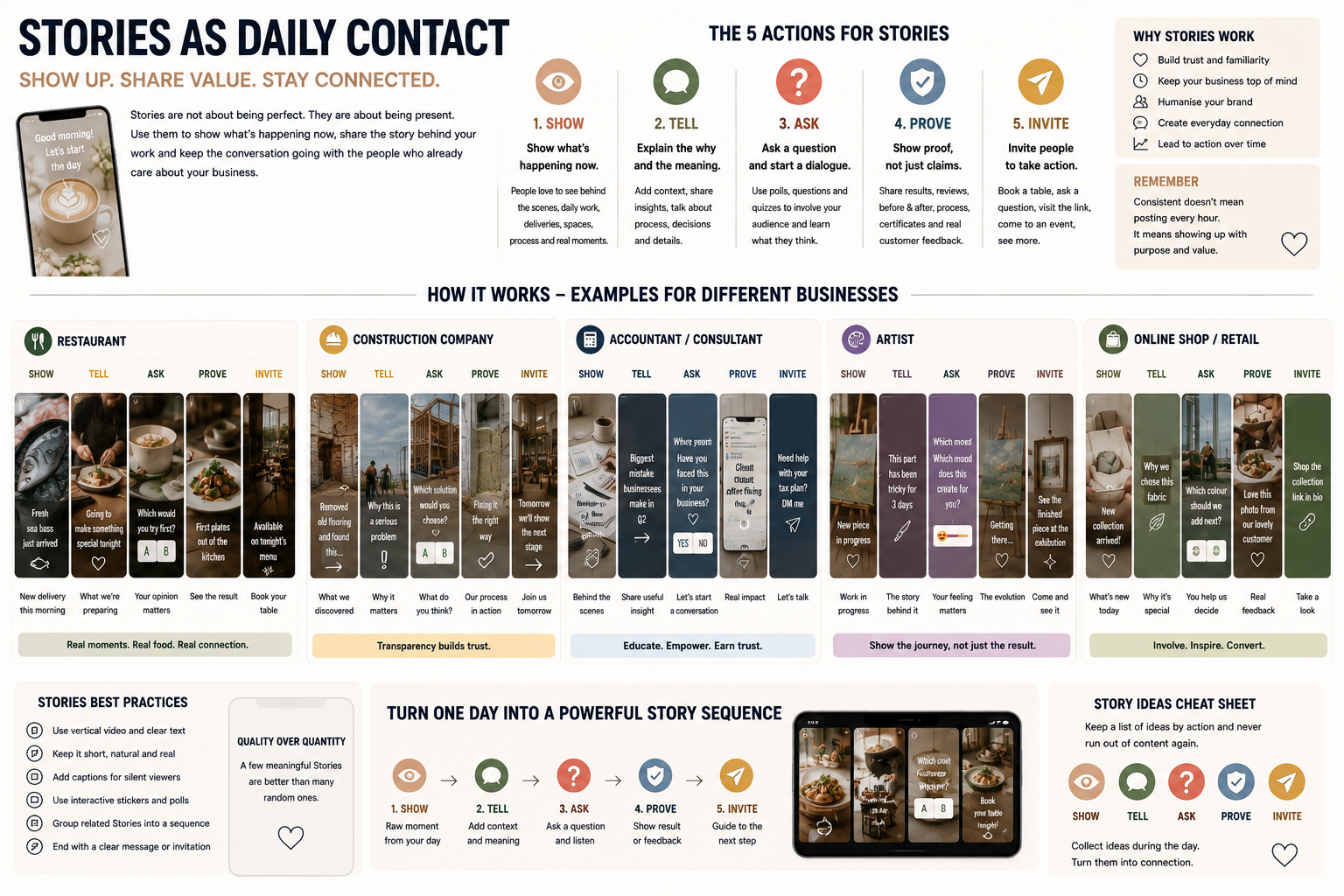
And finally, Stories. Here, the nature of the conversation changes. If a Reel often introduces us to someone who does not know us yet, Instagram Stories are much more likely to work with people who are already somewhere nearby. They followed us. They came to have a look. They noticed the circle around our profile picture. And here we really do not need to create a perfectly finished miniature masterpiece every single time. Stories can simply belong to today.

What is happening right now? What are we working on? What has just arrived? What are we preparing? What are we choosing? What did not go according to plan? What question did someone just ask us? What happened behind the scenes of yesterday’s post? We can show something. Ask. Answer. Run a poll. Return to yesterday’s conversation. Remind people about something. Invite them somewhere. That is why, for me, Stories are much more about presence, interaction and building relationships than producing yet another unit of social media content. And this matters for another reason too.

Not everything worth showing needs to live permanently on the main Instagram profile. Some things are valuable precisely because they are happening now. Technically, for Instagram Stories we are again working primarily with a vertical 9:16 screen, which means a practical design size of 1080 × 1920 px. But there is another very human technical recommendation here. Do not push important text, your logo or a call to action right against the top or bottom of the screen. That is where the Instagram interface lives. The account name, buttons, reply field and other interface elements are perfectly capable of sitting neatly on top of your beautifully designed message. And now look at what we have.

A Reel is particularly useful when we want to be discovered, stop someone’s attention, show movement, a person, a process, or communicate one idea quickly.

A Carousel becomes useful when someone needs time to understand, move through several steps, compare, read or save information.

A static Post works when we have one strong visual or meaningful point and it simply does not need a more complicated structure.

Stories work when presence, immediacy, interaction, response and an ongoing relationship matter.

And one topic can quite comfortably travel through several different social media formats. Suppose something happens inside the business. We could create a short Reel and use that story to introduce the business to a new audience. Then we could create a carousel explaining what happened, what we did and what we learnt from it. We could show the final result in a separate static post.

And in Stories, we could share what happened behind the scenes and ask people what they think. One story. Four tools. Four completely different jobs.

And that is why I keep coming back to where we started. Do not choose a topic because you need to make a Reel today. Choose the objective first. Then ask which content format will make it easiest for the person to do what we actually want them to do next.

Instagram content formats guide comparing Reels, carousels, posts and Stories, including recommended sizes, aspect ratios, interface safe zones and their role in a business social media content strategy.

And now let’s actually try this ourselves.

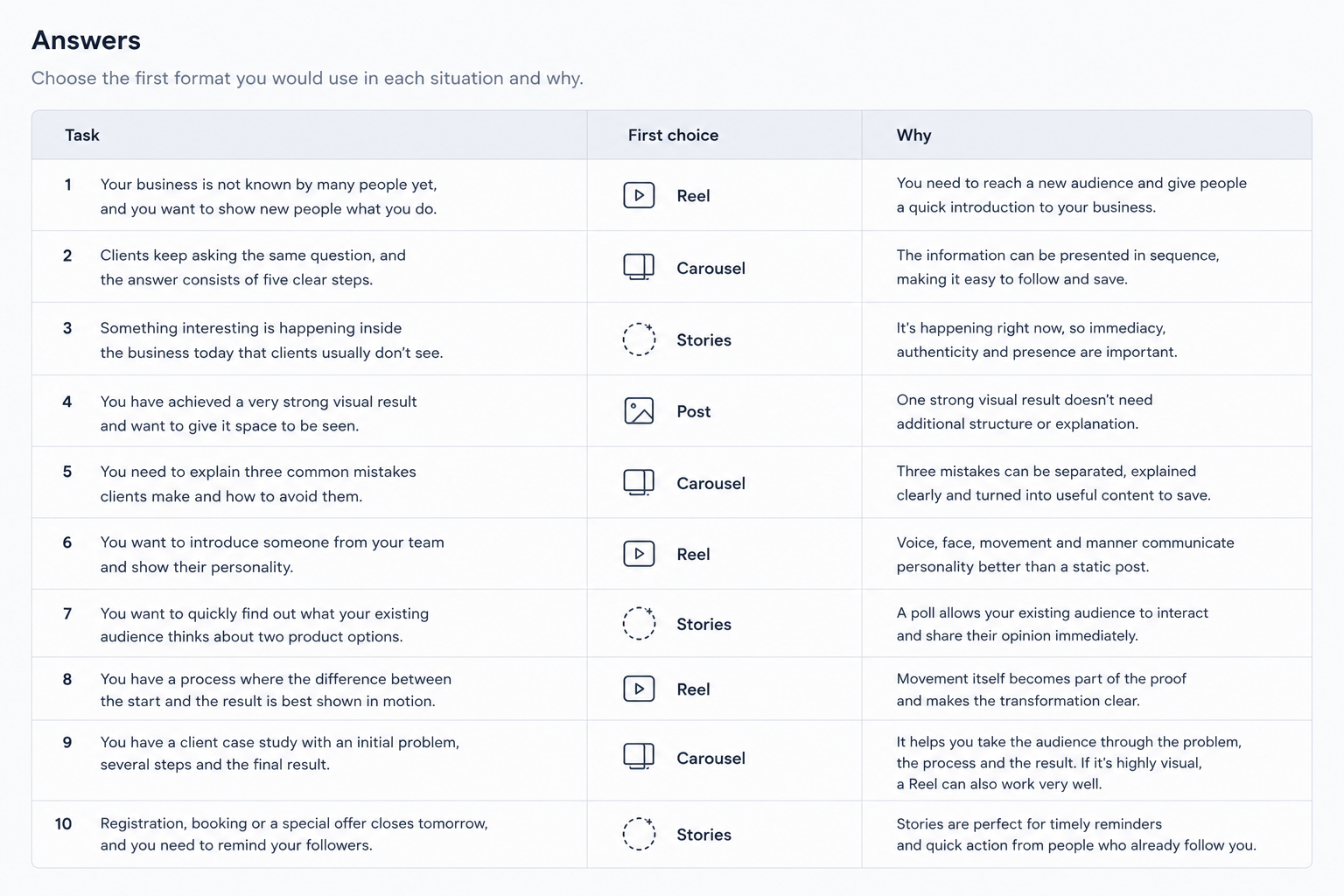
I’ll give you ten situations. I have deliberately left out any specific type of business. Imagine that each of these situations has happened in your own company, and choose the content format you would use first.

  1. Hardly anyone knows about your business yet, and you want to show new people what you actually do for the first time.
  2. Clients keep asking the same question, and the answer consists of five clear steps that need to be explained in sequence.
  3. Something interesting is happening inside the business today, something clients would not normally get to see.
  4. You have achieved a very strong visual result and simply want to give it enough space to be seen.
  5. You need to explain three common mistakes clients make and show them how to avoid them.
  6. You want to introduce someone from your team and let the audience get a sense of their personality.
  7. You want to quickly find out what your existing audience thinks about two options for a new product.
  8. You have a process where the difference between the starting point and the final result is particularly powerful when shown in motion.
  9. You have a client case study with an initial problem, several stages of work and a final result.
  10. Registration, booking or a special offer closes tomorrow, and you need to remind people who already follow the business.

Before looking at the answers, choose your first format for each situation.

There is not necessarily only one possible format. The point of this exercise is not to guess the “correct” answer. It is to practise making the decision in the right order: first understand the communication goal, then choose the content format that helps achieve it.

Social media content format exercise showing when businesses should use Instagram Reels, carousels, posts and Stories for different marketing goals.

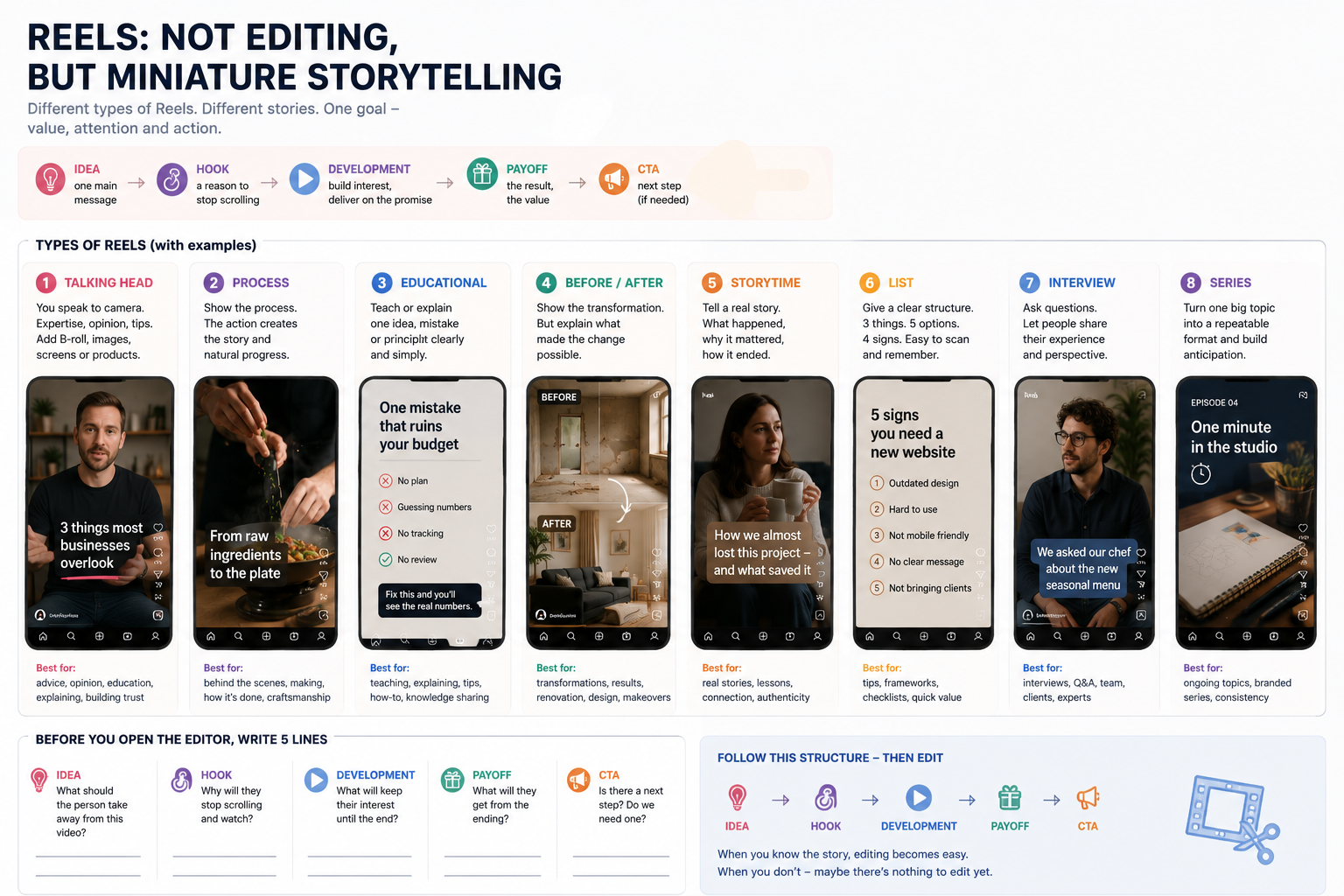
Reels: not editing, but miniature storytelling

There is something rather funny about Reels. When people first start creating them, an enormous amount of attention somehow goes into video editing. How do I join the clips beautifully? Which transition should I use? Where should I zoom in? What music should I choose? Which subtitles should I add? You can spend several hours doing all of this, end up with a technically beautiful Instagram Reel, publish it, and discover that, for some reason, nobody actually wants to watch it.

The problem is usually not the editing.

Try to remember a film that was beautifully shot, but somewhere around the twentieth minute you became bored. The cinematography was gorgeous, the actors were good, the music was wonderful, and yet you still wanted to check how much longer was left. Something very similar happens with short form video content, except that the viewer makes the decision much faster. They have absolutely no obligation to our Reel. They did not buy a ticket, go to the cinema or set aside two hours of their life. One movement of a finger is enough for us to disappear.

So I would start a good Reel not with editing, but with a very simple question: why should someone watch this video until the end? The answer, “because we need to post something today”, is immediately rejected.

Every Reel needs an Idea, one central thought that the viewer takes away after watching. Just one. This is particularly important because there is an enormous temptation to put everything into a short video at once. Introduce the company, show the product, introduce the owner, explain three benefits, add the story of how the business started and, just in case, mention the address as well. The result is forty seconds of content and a viewer who remembers absolutely nothing.

So before filming, try completing this sentence: “After watching this video, the person should understand…”

  • A restaurant might finish it with: “…why we prepare our meat in this particular way.”
  • A consultancy: “…why a small business should not wait until the end of the year to look at its numbers.”
  • A construction company: “…why the cheapest quote can sometimes become the most expensive.”
  • An artist: “…why this painting looks completely different in natural light.”

If you cannot complete the sentence with one clear idea, perhaps you do not have one Reel. Perhaps you have two or three.

Once we understand what we want to say, we need a Hook. The purpose of a hook is not to trick someone into watching. It is much simpler than that. It gives the viewer a clear enough reason not to scroll past the video right now.

And a hook does not necessarily have to be a phrase. It can be visual. We see a finished dish, and in the next shot it is literally broken down into its individual components. We see a terrible wall before renovation. A huge box that somebody begins to open. An unusual detail of a painting in close up. A person doing something unexpected. A finished result that makes us want to know how they got there. Sometimes the image itself already creates the question: “What is happening here?”

A hook can be text based. The first words appear directly on screen and give the viewer context before they have even properly engaged with the video. “Three mistakes we see all the time…” “This is why this paint started peeling after a year.” “£12,000 in turnover does not mean the business made £12,000.” “I was going to destroy this painting.”

On screen text is particularly useful because some people encounter social media video content without giving the sound their full attention. They may be travelling, sitting next to a sleeping child, standing in a queue or simply looking at their screen without wanting to listen to anything. A strong opening frame should already give them enough information to understand what they are looking at.

Then there is the spoken hook, where the voice does the first piece of work.

  • “Never order this if…”
  • “Yesterday, a client asked me a very good question.”
  • “Look what we discovered when we removed the old floor.”
  • “I thought this piece was finished. Then this happened.”

Natural delivery matters enormously here. If you would never say, “You will be shocked when you discover this secret” in real life, please do not suddenly start talking like that because somebody told you it makes a good social media hook. Viewers notice remarkably quickly when a real human being has suddenly been replaced by a television shopping presenter.

Sometimes the hook comes from contrast.

  • Before and after.
  • Expectation and reality.
  • An expensive solution and a cheap one.
  • What the client sees and what actually happens behind the scenes.
  • The first version and the final result.

Contrast works because the brain understands almost immediately that there is a difference between two points, and we naturally want to see how that difference happened.

You can also use curiosity. Show enough to create a question without giving away the answer in the first second. Or begin with a problem that the viewer recognises as their own.

  • “Do your clients ask for the price and then disappear?”
  • “Does the paint keep cracking in exactly the same place?”
  • “Are you posting regularly, but people still do not understand what your company actually does?”

You can begin with a promise, although I would be careful with this one. The promise has to be genuinely fulfilled within the video. If we say, “In one minute, I’ll show you how to choose…”, then one minute later the person really should understand how to choose it.

Or we can explain absolutely nothing at first and begin with a demonstration. Cut into the dish. Open the box. Make the first brushstroke. Remove the old surface. Show the screen with the numbers. Switch on the equipment. Sometimes action is more interesting than any introduction. But getting someone’s attention is not enough. If nothing happens during the next twenty seconds, no hook is going to save us.

This is where Development begins. This is the part where we fulfil the promise made in the opening seconds and gradually develop the central idea. And audience retention does not mean changing the shot every second and a half, jumping around, waving your hands and launching text above your head.

Attention is retained when the person is still interested in what happens next.

In a story, something continues to unfold. In an explanation, we discover the next part of the answer. In a process, we can see progress. In a comparison, we move from one option to another. In a list, the viewer knows that there are still several points to come. In a demonstration, they are waiting to see the final result.

Video editing helps that movement, but it cannot create it from nothing.

Then we reach the Payoff, the resolution. I particularly like this part because this is where we repay the viewer for their attention. They have given us twenty, forty or sixty seconds of their life. What did they receive in return?

An answer. A result. A useful idea. An emotion. A new understanding. The finished version of the project. The resolution of a small piece of intrigue.

Sometimes the payoff is something we can literally see. We have been watching the cooking process and finally cut into the finished dish. We have watched a restoration and now reveal the result. We have taken someone through a mistake in the calculations and now show exactly where the money was being lost.

Sometimes the payoff exists entirely in the thought: “Ah, now I understand.”

If, after watching, the viewer feels that the first few seconds promised far more than the video actually delivered, it will be harder to persuade them to stop for our next Reel. So I would think not only about how to capture attention, but also about how to reward it honestly.

The final element is the CTA, or Call to Action, an invitation to take the next step. And I want to make one important point straight away: not every Reel needs a CTA. Sometimes the video is complete in itself. The person watched it, got what they came for, and we can simply leave them alone.

But when there really is a logical next step, it is better to make it clear.

Book a table. View the menu. Ask a question. Save the guide. Send it to someone who might find it useful. Watch the next part. Explore the service. Message us.

The important thing is not to turn the ending into a list of homework: “Like, follow, save, send it to a friend, leave a comment and make sure you click the link.” The person came to watch a video, not to apply for a job with us.

So the basic structure of an effective Instagram Reel can be represented quite simply: Idea → Hook → Development → Payoff → CTA

But that does not mean every Reel should now look exactly the same. Quite the opposite. Within this simple short form video structure, an enormous number of different forms, stories and creative approaches can exist.

Instagram Reels for business guide showing Talking Head, Process, Educational, Before and After, Storytime, List, Interview and Series formats with Reel structure from idea and hook to payoff and CTA.

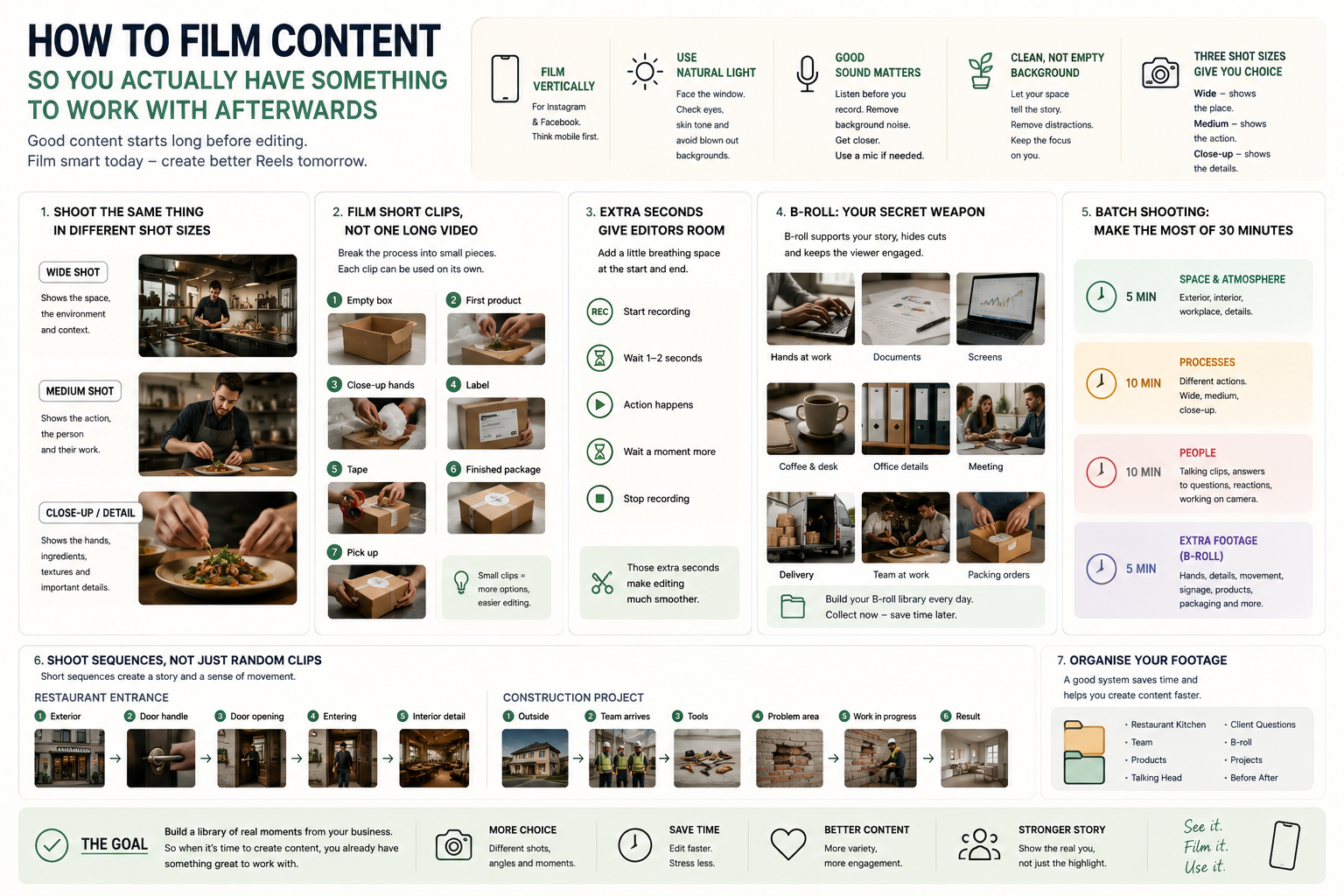
How to film content so you actually have something to work with afterwards

Let’s say we already know what we want to say, we have chosen the right content format, planned the Reel, know its main idea and even have a rough picture of the opening shots. We pick up the phone, record three videos, open them that evening and discover something wonderful. In the first one, someone walks straight in front of the camera. In the second, the important action has already started before we press record. In the third, we captured the whole process, but the camera is so far away that you can barely see what is happening. And tomorrow, somehow, we need to turn all of this into an Instagram Reel.

The video editor looks at the three files. You look at the video editor. A small human tragedy unfolds.

So learning how to create social media content also means learning how to capture useful video footage. And no, you absolutely do not need to become a professional videographer, buy an expensive camera or understand dozens of technical settings. What we need is much simpler. We need to learn how to film content in a way that gives us choices when we come to edit it.

The first rule is fairly simple. If you are creating content primarily for Instagram and Facebook, film vertically. Hold your phone vertically and think from the beginning about how someone will see that footage on a vertical mobile screen. Do not leave the main subject tiny somewhere in the middle of a huge empty frame. Do not place someone’s face right against the edge. And perhaps we do not need half a wall in the shot simply because it happened to be there.

The next thing I always pay attention to is lighting. You can have an excellent phone and still end up with terrible video quality if someone is standing with a bright window directly behind them. And you can create perfectly good social media video content on an ordinary smartphone simply by positioning the person properly in relation to the light.

The easiest light source is already there. A window.

If you are filming a person, try positioning them facing the window or slightly turned towards it. Then look at your screen. Can you see their eyes properly? Does their skin tone look natural? Has the window behind them turned into one enormous white patch?

The same principle applies when filming products. Food, artwork, retail products, documents and details of your work will often look far better in natural light than under a random mixture of ceiling lights. But the purpose of lighting is to help us show reality, not destroy it. This is particularly important when creating product videos, restaurant content, interior content, artwork photography and anything else where the customer needs to see the true colour.

Then there is sound quality.

If we are simply filming a process that will later have music or a separate voiceover, the original sound may not matter very much.

But if someone is speaking on camera, good audio becomes critical. People will forgive slightly imperfect video quality far more easily than a recording where they have to struggle to understand what is being said.

Before you start recording, simply listen to the room. Is the coffee machine running? Is the extractor fan humming? Is there music playing? Is there an open window beside a busy road? Is someone having a conversation nearby? Is the phone three metres away from the person speaking?

Sometimes moving two steps to the side, closing a door or bringing the phone closer completely changes the recording. And if you regularly create talking head videos or other spoken social media content, a small microphone can become a very sensible investment surprisingly quickly.

Then we have the background. And I specifically mean a clean background, not an empty one. Those are two different things.

You certainly do not need a sterile white wall. Quite the opposite. The real environment of a business can tell us far more about it. A restaurant kitchen, an artist’s studio, a construction site, an office or a shop can all work beautifully on camera. A clean background simply means there is no random box sticking out behind someone, no plant apparently growing from their head, no supermarket bag sitting on the table and nothing distracting enough to make the viewer spend the next thirty seconds trying to read a piece of paper taped to the wall.

Before filming, look not only at the person or product you are recording. Look at what is happening around them as well.

And now we come to one of the most useful habits you can train surprisingly quickly. Film the same thing using different shot sizes and camera angles.

Imagine a restaurant. The chef is preparing a dish. You could place the phone further away and film the entire kitchen. This is a wide shot. We understand the environment, see the person, the kitchen and what is happening around them.

Then move closer. Now the chef takes up more of the frame and we can clearly see their work and movements. This is a medium shot.

Then come closer again and film the hands, the knife, the ingredients, the flame, the sauce, the plate, the expression on the chef’s face and finally the finished dish. These are close ups and detail shots.

The process itself has not changed. But instead of one long video clip, we now have a collection of useful footage that can actually be turned into a story.

The wide shot shows us where we are. The medium shot shows the action. The close up lets us see the most interesting details.

And if you get into the habit of alternating between these three distances when filming business content, your raw footage will immediately begin to feel much richer, even without complicated camera work or professional video equipment. More importantly, when you later sit down to create an Instagram Reel, Facebook video or other short form video content, you will actually have something to work with.

There is another term worth remembering because you will come across it constantly: B-roll.

The name sounds rather more professional than the thing itself. Imagine a marketing consultant sitting in front of the camera explaining three mistakes new business owners commonly make. We could spend the entire forty seconds looking at the consultant. Or we could continue hearing their voice while the video shows hands working at a computer, documents, a desk, a client meeting, a spreadsheet on screen, a cup of coffee beside a laptop or folders in the office.

Those additional shots are B-roll footage. They help us show what the person is talking about, make the video more visually varied, hide editing cuts and simply give the viewer’s eyes a little movement. This is why I recommend developing the habit of building your own B-roll library. Do not wait until the day you urgently need to create an Instagram Reel.

If you notice beautiful morning light in the restaurant, film ten seconds. A delivery arrives, film it. The team is preparing the dining room, film it. You are travelling to a project, capture a few clips. Opening the studio, film it. Packing an order, film it. Working at your computer, ask someone to record a few seconds. Meeting a client, if filming is appropriate and you have their consent, capture part of the process.


After a month, the business begins to have its own little video library. And suddenly the sentence, “We have nothing to post today,” appears much less often.

Another habit is particularly useful when filming processes. Do not record everything as one endless video clip.

Imagine someone packing an order. There is no need to put the phone down and record seven minutes from beginning to end. Film a few seconds of the empty box. Stop. The first product going in. Stop. A close up of the hands. Stop. The label. Stop. The tape. Stop. The finished package. Stop. The person picking up the box. Stop.

Now we have seven short clips showing one process. Each can be used separately, rearranged, sped up or combined with other footage. More importantly, video editing becomes considerably easier.

I also often use the rule of a few extra seconds. Do not press record at exactly the same moment the action begins.

Start recording. Wait for a second or two. Let the person perform the action. Wait another moment. Then stop recording.

Those tiny pieces of breathing space are incredibly useful during video editing. If a clip begins at precisely the moment a hand is already entering the frame and ends in the same millisecond that the movement finishes, the footage becomes much harder to work with.

The same applies to the number of takes. If something important happens and it can be repeated, film it again. Use another shot size. Move slightly closer. Make the action slightly slower. Try another camera angle. We certainly do not need twenty takes of every cup of coffee, but two or three versions give us a choice.

Gradually, you can also learn to think not in individual shots but in small visual sequences.

Imagine someone opening the door of a restaurant. We have a wide shot of the entrance. A hand on the door handle. The door opening. The person walking inside. A detail of the interior.

Five short videos, filmed in literally a minute, already create the feeling of moving into the space.

Or imagine a construction project. The house from outside. The team arriving. The tools. A close up of the problem area. The work itself. The finished result.

We have not simply accumulated a collection of random video files. We have captured a beginning, a process and an ending.

Now we come to perhaps the most common objection from a business owner: “I don’t have time to film all of this constantly.” And I completely agree. A business owner certainly does not need to spend the entire day following employees around with a phone. It makes far more sense to learn how to batch film content.

Imagine we have only thirty minutes. The first five minutes can be spent capturing the space and atmosphere. A wide view, the entrance, the interior, the workplace and small details.

The next ten minutes can focus on processes. Capture several actions, each as a wide shot, medium shot and close up.

Another ten minutes can focus on people. A few short talking clips, answers to prepared questions, reactions and someone working on camera.

The final five minutes can be used to build up extra footage. Hands, details, objects, movement, signage, packaging, products, computers and everything else that can later become B-roll.

In half an hour, it is perfectly realistic to capture several dozen short video clips. That does not mean we now have to turn them into thirty social media posts.

The same shot might appear in an Instagram Reel today, become part of your Stories next month, appear in another video later and then be used as background footage six months from now. If a clip is not tied to a particular date, event or promotion, it can remain useful for quite a long time.

For a restaurant, I would regularly collect footage of the kitchen and cooking process, chefs’ hands, close ups of ingredients, flames, steam, chopping, plating, finished dishes, the empty dining room before opening, a busy service, interior details, the bar, drinks, guests arriving, the team at work, the chef, the owner, deliveries, seasonal ingredients, the exterior signage and all those little moments an ordinary guest would never normally see.

There is no need to capture all of this in one day. Simply build your business content library gradually.

For an expert or service based business, the task can feel slightly more difficult because the result of the work cannot always be beautifully arranged on a plate.

An accountant thinks, “What am I supposed to film? I sit at a computer.” A consultant sits at a computer. A solicitor sits at a computer. And a marketer, surprisingly enough, spends quite a lot of time sitting at a computer too.

But professional work is not limited to a physical end product.

You can film someone working, preparing for a meeting, hands taking notes, a whiteboard, books, documents without visible confidential information, travelling to a meeting, the office, a conversation with a colleague, parts of a presentation, the research process, writing down ideas, a video call filmed from behind, professional tools or preparing materials.

Talking clips are particularly valuable. You do not need to sit down in front of the camera every time and begin with, “Today we are going to talk about…” You can simply set up the phone and ask the person a few normal questions.

What mistake do clients make most often? What surprised you this week? What question did a client ask you today? What do people usually misunderstand about your work? What would you never recommend to a client? What is the first thing you look at when a new project comes in?

Five questions can become five separate videos or provide material for several future Reels.

And there is one more thing I strongly recommend doing after filming. Do not turn your phone gallery into a graveyard of four thousand files called IMG_8472.

Sort your footage. Delete the obvious unusable clips. Create folders. Restaurant Kitchen. Team. Products. Talking Head. Client Questions. B-roll. Projects. Before After.

Call them whatever you like, as long as a month later you still know where to find the footage you need.

A social media content system becomes considerably easier when we do not start every new post from zero. Gradually, we accumulate content ideas. We accumulate photographs. We accumulate video footage. We accumulate client questions. We accumulate stories.

And eventually filming stops feeling like a separate event that requires you to summon the energy and courage every single time. You simply begin noticing content inside the ordinary life of the business.

And that is probably the most useful skill in this entire chapter. Not learning how to hold a phone beautifully.

Learning to see what is worth filming.

How to film social media content for business, including vertical video, lighting, sound, shot sizes, B-roll, batch filming and organising footage for Instagram and Facebook

Photography for content:
not just capturing an object, but deciding how people will see it

We have looked at video in quite a lot of detail, but businesses have another source of social media content that, for some reason, is often treated as something much simpler. Photography.

It seems straightforward enough. Point your phone at a dish, a person, a product or a space, press the button and the photograph is done. Technically, yes. But two photographs of exactly the same subject can create completely different impressions.

In one photograph, a restaurant looks warm, inviting and alive. In another, it looks like an ordinary room with tables. In one photograph, a tradesperson looks like someone you would happily trust with your home. In another, he looks like a random man standing next to a wall. The same product can look desirable or completely unremarkable.

And the difference is not always the quality of the camera. More often, it appears earlier, at the moment when someone decides what exactly they are photographing and how they are going to place it within the frame.

For a moment, I would forget the word “photographer” altogether. We do not need to become professional photographers during one training session. We simply need to learn to look at the screen of our phone a little more carefully and stop treating business photography as proof that an object exists.

Here is a chair. Click. Here is a dish. Click. Here is our employee. Click. Here is the finished project. Click.

Technically, we have content. But we have made no decision about how the viewer should see any of it. So before pressing the button, ask yourself one very simple question: what is the most important thing in this photograph?

Is it the person? The dish? An interior detail? The size of the space? The quality of the finished work? The atmosphere? The team?

If you do not know the answer yourself, the camera will not find it for you.

One of the simplest ways to start controlling your composition is already built into almost every smartphone. Turn on the camera grid. The screen is usually divided by two vertical and two horizontal lines into nine sections. These lines help you keep the horizon straight, but they also introduce one of the best known principles of photography composition, the Rule of Thirds.

We do not have to place the main subject exactly in the centre of every photograph. Try positioning a person, dish or another important object closer to one of those lines or to the points where they intersect. Quite often, the composition immediately feels more natural, while the space beside the subject begins to work with it.

But the Rule of Thirds is called a rule mostly because people like giving names to things. It is not a law.

Sometimes a central composition will be considerably stronger. A person stands directly in front of the camera. A beautifully plated dish is the obvious hero of the photograph. A doorway, window, corridor, staircase or piece of architecture creates symmetry. An object has a strong geometric shape. In those cases, placing it in the centre is not a mistake. On the contrary, it can emphasise stability, order, strength or symmetry.

So we are not learning, “never put the subject in the middle”. We are learning something else: I decide why the subject is exactly where it is.

There is another very simple composition technique that people starting to create photography for business social media somehow rarely use, even though a phone handles it perfectly well. Negative space, the empty space around the subject.

Imagine a person standing in an open part of a room. A small product against a large, calm background. A cup of coffee on a table where much of the frame remains empty.

We do not have to fill the entire photograph.

Negative space can make a small subject much more noticeable. It can create calm, scale, isolation or a more premium visual feel. And very practically, it can leave room for text if the image is later used in Instagram Stories, social media advertising or a graphic design.

Just do not confuse negative space with accidental emptiness. If half the photograph is a white wall simply because nobody thought about the composition, it is doing nothing. If that wall directs attention towards the person or leaves room for a message, it suddenly has a purpose.

Now let us look at lines. They are literally everywhere around us. Roads. Tables. Bar counters. Shelves. Steps. Corridors. Walls. Fences. Rows of windows. The edge of a building. A path. Even a shadow.

Our eyes naturally follow lines, which means we can use them as visual signposts. If a line begins near the edge of the photograph and takes the viewer towards a person or an object, we have leading lines.

The viewer does not need to know the term. Their eyes have already travelled exactly where we wanted them to go.

Instead of photographing a builder standing in the middle of a room, try finding the line of a wall or floor that leads towards them. In a restaurant, it might be a long table. In a shop, a row of shelves. In an office, a corridor. On a construction site, beams, stairs or the edge of a wall.

Lines can be horizontal, vertical, diagonal or curved, and each creates a slightly different feeling. Horizontal lines usually feel calmer. Vertical lines can emphasise height and scale. Diagonal lines introduce movement. A curved line gently leads the eye through the photograph.

And you do not necessarily need to create a line. Quite often, you simply need to notice the one that is already there.

The same happens with shapes and repetition. Three identical glasses. A row of chairs. Several dishes. Repeating windows. Shelves filled with products. Tools. Boxes. Paintings. People sitting around a table.

The human eye is very good at recognising rhythm, so repeated objects begin to create their own composition.

You can also experiment with the Rule of Odds, using an odd number of objects. Three objects can often feel more visually interesting than two, and five more interesting than four. But again, we are not turning this into a religion. If you have four beautiful cakes, there is no need to eat one for the sake of composition. We simply have another technique and can see when it works.

Sometimes the shape of the subject itself suggests the composition. A round table. A spiral staircase. A curved road. An arch. A circular plate. A row of rectangular windows. You can build a photograph around a circle, rectangle, radial movement, symmetry or a repeating pattern.

That is why, before taking a photograph, it is useful not to reach immediately for the phone, but to spend literally a few seconds looking around.

What is already in the space? What geometry can you see? What lines are there? What repeats? What could become a frame?

Framing is particularly interesting because it means using one object to visually surround another.

A person can be photographed through a doorway. An interior through an arch. A builder between structural elements. A dish between items on a table. A shop through its window. A person outside through tree branches.

Suddenly, there is depth.

The photograph stops feeling like a flat record of an object because we now have a foreground, a main subject and space behind it.

And since we are talking about depth, try deliberately adding a foreground from time to time. Imagine we are photographing a restaurant. We could simply photograph the dining room. Or we could leave part of a glass, plant, chair or table setting very close to the camera, with the room itself further away.

The foreground object can even be slightly out of focus. It creates the feeling that the viewer is already inside the space, looking at what is happening from within it.

For businesses, this is particularly useful because quite often we do not simply want to show a space. We want to help someone imagine themselves inside it.

Now, people.

The most common staff photograph tends to look roughly the same. Someone stands next to a wall. Their hands mysteriously disappear somewhere. They are told to smile. They produce exactly the smile of a person who has just been told to smile. Click. Next.

But a person in a photograph is also part of the composition.

You can use the space around them. You can position them away from the centre. You can use architecture as a frame. You can show them as a small figure against a large object when you want to communicate scale. You can move very close and leave only the face and a little surrounding space. Or you can simply stop asking them to look at the camera and photograph them while they are actually working.

Try changing not only the position of the person, but also your own shooting angle.

Most photographs are taken from exactly the same position. The phone is somewhere around chest or eye level, the person stands upright, and the photographer stands directly opposite them.

What happens if you crouch down? Move closer? Photograph slightly from above? Step much further away? Change the angle? Look through another object? Photograph the person from behind?

A low camera angle can make a large object feel even more imposing. It works beautifully with architecture, construction, large products and sometimes with people when that is genuinely the effect we want. A high angle can show a space, table, process or arrangement of objects in a completely different way.

There is no single “correct” angle.

That is why I love a very simple exercise. Do not leave after taking the first photograph.

You photographed a dish. Good. Now move closer. Photograph it from above. At an angle. From table level. Show the whole thing. Show only a detail. Add someone’s hand. Place it within the restaurant.

One dish. Seven completely different photographs.

The same applies to a person, an interior, a product or a construction project. What we were photographing did not change. Our way of seeing it did.

It is also extremely useful to learn how to show scale.

Imagine a photograph of an enormous wall without a person. The viewer may have no real idea how large it is. Put a person beside it and the brain instantly receives a familiar unit of measurement.

This works particularly well for construction photography, architecture, interiors, large artworks, equipment, spaces and landscapes. Sometimes a tiny human figure communicates the scale of an object far better than any written description.

The opposite is also true. Small products, details, jewellery and food need a closer view. Do not make someone examine a product the size of a fingernail in the middle of a huge table. If the detail matters, allow it to occupy the photograph.

Now, light, because photography is literally created with it.

We have already talked about lighting for video, but with photography I want you to start noticing not only the amount of light, but its character.

Light can be hard or soft.

Bright direct sunlight creates strong shadows and high contrast. It can look dramatic, but it can also completely destroy the detail in a face or product.

Soft, diffused light from a window or an overcast sky is much calmer. It works beautifully for people, food, products and most everyday business content photography.

Light can come from the front, the side or behind the subject. Side lighting often reveals shape and texture beautifully. Backlighting, when the light source sits behind the subject, can create a silhouette.

Sometimes a reflection in glass, water, a mirror or a shiny surface is not a problem that needs removing. It becomes the photograph itself. So before switching on another lamp or using flash, look at what the existing light is already doing.

And one more thing. Do not assume that good photography can only happen during the day in perfect sunshine.

There are beautiful qualities of light in the morning and evening. There is golden hour, when the light becomes warmer and softer. There is blue hour, that short period after sunset or before sunrise when the street and sky take on cooler, deeper tones while the artificial lights of buildings begin to appear.

For a restaurant, an evening photograph of the exterior may say far more than a photograph of the same building at two o’clock in the afternoon.

For a hotel, pub, event venue, architecture or property business, the time of day can completely change the character of the business within the photograph.

But none of this means that before every photograph we now need to mentally recite twenty rules of composition.

Rule of Thirds. Central Placement. Negative Space. Leading Lines. Symmetry. Patterns. Framing. Foreground. Perspective. Light.

If you try to apply everything at once, the photograph will end in a nervous breakdown before you have even pressed the button.

I suggest something much simpler. Choose one thing to practise each time.

Today, try the Rule of Thirds. Next time, deliberately look for lines. Then photograph five subjects from different angles. After that, try shooting through natural frames. Spend another session simply observing light.

After a while, most of these decisions stop feeling like separate photography rules. You simply begin to see the frame slightly earlier, before you even take your phone out.

And that leads to an extremely useful habit for creating social media content for business. Do not photograph only the final result.

If a restaurant introduces a new seasonal dish, we do not need one photograph of the finished plate. We need ingredients. The process. Hands. Details. The chef. The finished dish. The dish on the table. A person with the dish. The atmosphere around it.

If a construction company finishes a project, do not arrive on the final day simply to take ten photographs of the completed work. We need the site before work begins. Materials. People. Stages. Problems. Solutions. Details of the work. Scale. Before and after.

If a shop receives a new collection, do not photograph every product against exactly the same background and stop there. Show details, combinations, scale, how the product is used, packaging, a person beside it and several items together.

An expert or service based business does not need a photo gallery containing forty portraits of the same face either. A workspace, books, hands, meetings, notes, details of the process, travelling to an appointment, events, speaking engagements, the team and the tools of the profession create a much richer visual language for a business brand.

So photography for content does not begin with the camera. It begins with observation.

You can buy a new phone, open the camera and continue taking exactly the same photographs you were taking five years ago. Or you can keep the same phone and begin noticing lines, space, light, scale, repetition, people, details, perspective and all the small scenes your business creates every day.

And I would finish this section with some practice.

Take one object that is near you. A cup, a dish, a laptop, a book, a product, a person, a chair, anything at all. Now create ten photographs of exactly the same subject, but make sure they genuinely look different.

Take one using the Rule of Thirds. One with the subject in the centre. One with plenty of negative space. One using a leading line. One with repetition, if you can create it. One through a natural frame. One with a foreground. One close up. One from an unusual angle. And one where light becomes the main creative tool.

Then put all ten photographs next to each other.

The object has not changed. The phone has not changed. The business has not changed.

The only thing that changed was the decision made by the person holding the camera.

And that, perhaps, is where photography really begins

Business content photography guide showing composition, lighting, camera angles and practical photography techniques for social media content

Graphics and visual consistency

Now let’s talk about the part of content that people take in before they have read even a single sentence. They open a profile and within a few seconds they already have a first impression. Who are they looking at? A restaurant they could trust with an important evening? A serious accountancy firm? A small family business? An artist? A budget retailer? A premium service?

And the person does not consciously have to analyse the fonts, colours or composition. They simply feel it. Clean. Clear. Chaotic. Too loud. Calm. Professional. Alive. Impersonal. Interesting.

That is why a visual identity for social media is not there simply to make Instagram look pretty. It helps people recognise a business more quickly, so they do not have to spend those first few seconds getting to know it all over again every time they see your content.

At the same time, I would immediately throw away the idea of the perfect Instagram grid where every ninth post must match the colour of the first, photographs alternate obediently with quotes, and some unfortunate business owner sits there on Tuesday evening thinking they cannot publish a beautiful photograph of a new dish because it will destroy the chessboard pattern of the profile.

We are creating content for people, not playing Tetris.

We do not need a perfect grid. We need visual consistency.

Someone might see your Reel today, a carousel next week and your Stories a month later, and gradually begin to recognise you before they have even read the account name. That does not come from making every graphic look identical. It comes from repeating certain visual choices consistently.

Let’s begin with visual hierarchy.

When you look at a design, it should be clear where your eye is supposed to go first. If a carousel cover contains a huge headline, a photograph, a logo, five decorative elements, the website address, a subtitle, an arrow, a date and a lovely little circle saying NEW, all of them begin fighting for attention.

Choose the main character. Usually that will be one idea or one object.

For example:

5 mistakes when opening a restaurant.

That is what the person should see first. The company name can be considerably smaller. Additional explanation smaller again. The logo certainly does not need to shout at them from the other side of the street.

After creating any social media graphic, move your phone away from you and look at it for a couple of seconds. What did you notice first? Second? Third? If the answer is “everything at once”, there is probably no visual hierarchy.

The next tool is contrast.

Contrast is not simply the difference between black and white. It exists between large and small, bold and light, photography and empty space, a calm background and a strong accent.

If all the text is the same size, the viewer has to work out for themselves what matters most. If everything is large, nothing is large. If everything is bold, nothing is emphasised. If every element is bright, we no longer have an accent.

Good graphic design is very often not about how much we have added, but about how clearly we have distributed attention.

Then comes alignment. A tiny thing that has a surprisingly large effect on whether a design feels professional.

If the headline begins in one place, the next paragraph sits slightly further to the left, the button has somehow wandered off to the right, and the logo is almost centred but not quite, a person may not even understand what is bothering them. They simply feel that something looks untidy.

So create invisible lines. If several elements begin at the same edge, let them genuinely begin at the same edge. If something is centred, centre it deliberately. Do not scatter elements around a design according to the principle of “well, that looks roughly all right”.

Closely related to this is white space. For some reason, people creating content for the first time tend to feel terribly sorry for empty space.

There is an empty area. Quick, put the logo there. There is a free corner. Add an icon. The bottom looks empty. Put the website address there. Now everything is occupied. Wonderful. Except the viewer can no longer breathe.

White space is part of the design too. It separates one thought from another, gives the eye somewhere to rest and makes important elements more visible.

So do not be afraid of space where nothing is happening. It may be exactly what allows people to notice the thing the design was created for.

Fonts are another story altogether.

For most businesses, one or two main brand fonts are more than enough. Sometimes a visual identity genuinely requires more, but that should be a deliberate decision, not a desire to try everything attractive you found in Canva.

A single typeface can perform several jobs through different sizes and weights. A heading can be larger and heavier. Body copy calmer. Supporting information smaller.

When one carousel contains five fonts, four sizes, italics, bold text and capital letters, it becomes harder to read, even if every one of those fonts is beautiful on its own.

And always check the font size on a phone.

You create a design on a large computer screen and everything looks perfectly readable. Then the post appears on a phone and that beautiful paragraph suddenly resembles the information leaflet inside a packet of medicine that requires a magnifying glass.

Check your graphics on the device where most of your audience will actually see them. This is particularly important for Instagram carousel design.

If you had to reduce the font size on one slide just to squeeze in seven paragraphs, the problem is probably not the font size.

You simply have two slides instead of one.

Now, brand colours.

They do not exist so that every centimetre of the profile can be painted in one corporate colour. If a restaurant has green as its brand colour, that does not mean a beautiful photograph of a steak needs a green border, a green graphic panel and a green logo on top just in case someone accidentally forgets what our brand colour is.

Colour can appear much more quietly. In headings. Small graphic elements. The background of certain types of posts. Covers. Graphics. Stories. In combination with a consistent set of neutral shades.

Gradually, visual brand recognition begins to form. Someone has not read the account name yet, but the combination already feels familiar.

If a company does not yet have a complete brand identity, I would not try to invent an entire brand book in one evening. Choose a small working colour palette, one primary colour, one or two supporting colours, neutral shades for backgrounds and text, and begin using them consistently.

The same applies to social media templates.

A template should save time, not turn the business into a factory producing identical Canva cards.

You might create several repeatable layouts. An educational carousel cover. A customer testimonial. A product introduction. An announcement. A question for the audience.

But if, after a month, the profile looks as though we simply changed the words inside the same Canva file forty times, the system has started working against us.

Recognition does not come from everything being identical.

Think about someone you know well. Today they are wearing a coat, tomorrow a T shirt, and another day evening clothes. They do not become a different person simply because their clothes have changed.

A brand works in a similar way. The character of its colours, typography, photography, composition and writing style can remain recognisable while the individual pieces of content look completely different.

I would pay particular attention to Instagram Reel covers.

The Reel itself may work beautifully when someone watches the video, but later they open your profile and see its cover among all the other posts. So the cover should at least give them some idea of what the video is about. There is no need to put half the script on it.

  • “3 renovation mistakes”
  • “Meet our chef”
  • “Why this costs more”
  • “Before & After”

Sometimes one strong image without any text at all is enough.

But if you do use text, remember that the same Reel can appear differently in different parts of Instagram. Do not place essential information right against the edges. It is safer to keep the main subject and key words closer to the central area of the image.

With Instagram carousels, there is another challenge. We need to think not only about each individual slide, but about the way the person moves between them.

The first slide answers the question: why should I open this carousel?

The second should make it easy to enter the subject. Then a rhythm begins to develop.

Every slide does not need to look identical. One might contain a large statement. Another a photograph. Then a short list. Then a number. Then an example.

If ten slides in a row look like pages from a contract, the person will rather quickly remember that they had other plans for the evening.

A carousel has its own visual storytelling too.

At the same time, give people enough visual continuity to understand that they are still inside the same story. A repeated font, page number position, small graphic element, colour or common compositional logic can quietly connect very different slides.

For Stories and Reels, we also need to remember one technical detail: safe zones.

On a vertical screen, part of the space is occupied by the Instagram interface. Account information appears at the top, while captions, buttons and other controls occupy areas towards the bottom. So important text, a logo, a face or a call to action should not be pushed right against the top or bottom edge. It is easier to remember this without numbers.

Leave the edges to the interface. Leave the important part to the person.

There is another practical consideration, particularly because of the way Instagram displays content across the profile and Feed. The same design can appear slightly differently depending on where someone encounters it.

For static posts and carousels, I prefer working with a vertical 1080 × 1350 px Instagram post size, while keeping essential information positioned so the composition still works if the image is displayed differently elsewhere. The 1080 × 1080 px square has not disappeared and can still be used, but I would no longer build an entire business visual system exclusively around the old square format. For Instagram Stories and Reels, the working vertical format is 1080 × 1920 px.

And again, the numbers themselves will not rescue poor design. You can create a perfect 1080 × 1920 graphic and put the headline exactly where the interface will cover it.

So once the content is ready, look at it on your phone. Can you actually read the text? Is it too small? Is it immediately clear what matters most? Has the person disappeared beneath the graphics? Does the Reel cover work beside the other posts? Has anything important been cropped? And now perhaps the most important thing about the entire visual identity of a business on social media.

Do not try to make every post branded simply by adding a logo.

If you remove the logo and nobody can tell that the content belongs to your company anymore, then your brand recognition was being carried by the logo alone.

It is much more interesting to gradually create a different effect.

Someone sees a photograph. A colour. The way you write headlines. A particular type of composition. The faces of your team. The way you show your product. A certain character in your videos.

And they think: “Ah, that’s them.”

Not because you showed them the logo. Because the business has developed its own visual language. For the exercise, I would open the last nine or twelve posts on your own account and, for a few minutes, forget that this is your business.

Look at them as a complete stranger.

What catches your eye first? Can you understand what the company actually does? Is there a recognisable visual character, or does every post exist independently? Which elements repeat? What repeats too often? Can you read the text comfortably on a phone? Are there photographs of the real business, or is the profile almost entirely made of graphic templates? Can you see people? Can you see the product? Is there enough breathing space? What looks professional? What creates visual noise?

And here is perhaps the most interesting question.

If you removed the company name and logo from every post, would there still be something connecting them?

If the answer is yes, your visual system is already beginning to exist.

If not, it is not a disaster and certainly not a reason to delete your entire Instagram account.

It is simply a very good moment to start creating one.

Social media visual consistency guide showing good and bad Instagram and Facebook content design examples, including hierarchy, contrast, fonts, brand colours, Reel covers, carousel design and safe zones

Storytelling for business

Something rather strange has happened to storytelling. The moment someone uses the word, the conversation quite quickly turns into something like, “Tell a personal story, show the real you, share something emotional.” And suddenly the person who actually came here to sell accounting services, build houses or feed people in a restaurant is sitting there trying to remember some dramatic childhood experience that could somehow help sell a tax consultation.

In reality, a story does not have to be personal at all. In fact, it does not even have to be particularly emotional. A story begins when something was one way, something happened, and afterwards it became different.

That change is what separates a story from an ordinary piece of information.

“We have launched our new summer menu” is information.

“Last summer, guests kept asking us why there were so few lighter dishes on the menu. We started collecting those comments, our chef spent several weeks experimenting with seasonal ingredients, three dishes did not even survive the team tasting, and today all of that has become our new summer menu.”

Now we have a story.

The basic fact is almost identical. There is a new summer menu. But now the person can see the journey behind it.

Why does storytelling work so well in business content and social media marketing? Because it is much easier for people to follow a sequence of events than a collection of disconnected facts. There is a reason to keep going. What happened? What did they do? Did it work? How did it end? We use this constantly in ordinary life.

Imagine someone you know saying: “Today I was late for work.” All right.

Now imagine: “I left home earlier than usual today because I had an important meeting at nine. I was almost at the office when I realised my laptop was still at home.” Completely different. And we do not even know how the story ends yet. What has appeared is tension. And tension does not mean tragedy, drama or the need to rescue someone. It is simply the distance between what someone wanted to happen and what actually happened.

A restaurant wanted to open by a particular date, but the equipment was delayed. A client came to an accountant with one problem, but during the conversation another one emerged. A construction team removed an old surface and discovered an issue that had been invisible before the work began. An artist started a painting with one idea and watched it become something completely different during the process. A supplier announced that a familiar product was no longer available. A company launched a service that seemed promising, but customers kept choosing something else.

Someone expected one thing. Reality brought another. The story appears somewhere between those two points.

That is why one of the central elements of business storytelling is conflict. But we do not need to take the word “conflict” too literally either. Nobody has to argue with anybody.

Conflict can be a problem. A limitation. A surprise. A mistake. A choice between two solutions. Not enough time. Not enough budget. Changing circumstances. Your own uncertainty. Even something as ordinary as “we tried doing it this way, but it did not work” creates a conflict between expectation and result.

Without that, a story rather quickly becomes a report: “A client came to us. We discussed the problem. We completed the work. The client was happy.”

Technically, everything is correct. There is simply not much reason to keep reading.

Now add one detail: “A client came to us asking to replace their kitchen. After the first inspection, it became clear that the kitchen itself was nowhere near the main problem.”

Now I want to know what they found. That is tension. We have given someone part of the information without closing the question. But we also need to be careful not to turn tension into a cheap television drama. “You will NEVER believe what we found under the floor!!!” If what you found was ordinary damp, the reader would probably have survived the discovery without three exclamation marks.

Good storytelling does not need to exaggerate what happened. Real businesses already produce small conflicts, decisions, mistakes, discoveries and changes without our assistance. Our job is simply to learn to notice them.

The next element is the hero. And businesses have a charming habit of automatically casting themselves in that role. “We did this.” “We created this.” “We developed this.” “We helped.” “Our company.” Sometimes that is perfectly appropriate. But the company is not always the most interesting hero in the story. The hero might be a client. An employee. A chef. A dish. A house. A project. A painting. A product. Even a problem.

If an accountant is telling a client case study, the accountant is often not the hero. There is a person or a business facing a particular situation, while the specialist becomes the person who helps them move through it.

If a construction company is telling the story of a project, the house itself can easily become the hero. What it was like before, what happened to it, which problems were discovered and what it became afterwards.

If an artist is talking about a piece of work, sometimes the painting becomes the hero. From the first idea to the moment it is finished, exhibited or eventually leaves for a collector.

In a restaurant, the hero might be a dish. Or an ingredient. Or the chef. Or a regular guest. Or an old family recipe.

So before writing a story, ask yourself: whose story is this?

Once we have a hero, we need context. The reader needs exactly enough information to understand what is happening. Not the entire company history since 2007. Not the client’s biography. Not a four page description of the property. Only what is necessary for everything that follows to make sense. “A small business owner came to us after hiring employees for the first time.” That is already enough context for one story. “When we began the renovation, the house was more than a hundred years old and the last major refurbishment had taken place several decades earlier.” Now I understand why unexpected problems might appear. “I started this painting after a trip to the coast and originally intended to keep it almost monochrome.” We have our starting point. Context answers a simple question: what do I need to know to understand why what happens next matters? Then something happens.

This is the turning point that gives the story a reason to exist. We discovered something. The client said something. The first version did not work. The material ran out. The circumstances changed. A review arrived. We tried something. Someone said no. Guests started asking questions. The painting unexpectedly moved in a completely different direction. And once that happens, the hero has to do something.

Storytelling loves action. Not “we recognised the importance of an individual approach”. What did you actually do? You called the supplier. Recalculated the figures. Rebuilt it. Removed the dish from the menu. Changed the material. Ran a test. Abandoned the original idea. Told the client not to buy the service. Started again. Action makes a story specific. After the action comes change. What is different now?

Not every business story needs to end with a triumphant victory. Sometimes the result is a successful project. Sometimes it is money saved. Sometimes it is a mistake corrected. Sometimes it is the decision to abandon an idea. Sometimes it is the discovery that the original assumption was wrong. Sometimes the result is simply a new question.

What matters is that the person or situation at the end is not standing in exactly the same place as at the beginning.

So for business storytelling, I like a very simple structure:

What was happening → what happened → what we did → what changed → why it matters to the reader.

That final part matters enormously. Because you can tell a beautiful story that means a great deal to the person writing it and absolutely nothing to the person on the other side of the screen.

“Why does this matter to the reader?” does not mean every social media post needs to end with three moral lessons and a call to buy something. Sometimes the connection is obvious. Sometimes one sentence is enough.

“That is why we always inspect the condition of the base before giving a final price for the work.”

Done. The story is finished, and the reader has also learnt something about the construction company’s approach.

Or:

“After that experience, we stopped automatically recommending our largest service package to new clients.”

The reader gets a story and also sees something about the principles behind the business.

Or, for a restaurant:

“Since then, this dish only appears on the menu when we can source the ingredient from that particular supplier.”

We have not sold anything directly. But we have communicated a quality standard far more convincingly than by saying, “We use only the finest ingredients.”

That is exactly why storytelling works so well with our content matrix.

Trust can be demonstrated through stories about decisions rather than simply claimed. Expertise can be shown through real situations. Product content can explore where something came from and how it is used. Proof can turn a dry case study into a customer journey. Human content can reveal people through what they actually do. Conversation can begin with situations in which the audience recognises themselves.

So storytelling is not a separate content type. It is a way of telling almost any type of business content so that it has movement.

Take a restaurant. We could write: “Today we are introducing our new sea bass dish.”…Or we could start earlier.

Why does this dish exist at all? Perhaps the chef found a new local supplier. Perhaps the original recipe was completely different. Perhaps the team changed the garnish three times. Perhaps the first guests unexpectedly started ordering it more often than the dish the restaurant thought would be the star of the menu.

The starting point was an idea for a seasonal dish. Then something happened. The ingredient they wanted to use proved inconsistent in quality. The team changed the concept and found another supplier. The result was an entirely different dish. And why does this matter to the guest? Because now they understand not only what is on the plate, but why the restaurant made those particular choices.

For an accountant or business consultant, ordinary working situations are excellent material for storytelling, provided client confidentiality is properly protected.

A client arrived with one question. During the conversation, another problem emerged. The specialist explained the options. A particular decision was made. Several months later, the situation had changed.

Content like this can demonstrate professional expertise beautifully without an endless stream of posts titled “5 reasons you need an accountant”.

For a construction company, storytelling is practically sitting there waiting on every project.

What did the client want? What condition was the property in? What did the team discover once the work began? Why did the original solution need to change? What options were available? Why was this particular one chosen? What did the process look like? What was the final result?

Before, during and after photographs and videos already give you the visual skeleton of the story.

For an artist, storytelling does not need to turn into a confession either.

You can tell the journey of one artwork. Where it began. What the original idea was. What changed during the process. What refused to work. What had to be removed, painted over or started again. How the final image emerged. What the artist themselves only noticed in the work after it was finished.

The painting stops being simply an image with a price and dimensions. It acquires an origin.

But there is one habit I would very much like businesses to lose: do not invent a story where there is no story.

Not every dish has an extraordinary history. Not every working day contains a revelation. Not every client case deserves its own post. Not every business decision needs to become a heroic tale of overcoming adversity.

Sometimes a photograph of coffee is simply a photograph of coffee. And that is perfectly fine.

Storytelling works precisely because we choose moments in which something genuinely happened that is worth telling.

So I would suggest a very practical storytelling exercise. Do not try to write the social media post yet. First, think of five real situations from the life of your business during the past month.

What did not go according to plan? What surprised you? What problem did you have to solve? What changed? Which customer question made you stop and explain something properly? Which decision turned out to be a good one? Which idea did you have to abandon? What did you try for the first time? What did a client or guest see differently from what you expected?

Now choose one situation and break it down.

What was happening? What happened? What did we do? What changed? And why might this be interesting or useful to the person reading it?

If there is no answer to that last question, perhaps the audience simply does not need that particular story.

If there is an answer, we already have most of the content. All that remains is deciding how to tell it.

Sometimes it will become a thirty second Reel. Sometimes a carousel that takes the reader through the stages. Sometimes five Stories. Sometimes one photograph with a strong caption. Sometimes an entire content series.

We choose the format after the purpose, not before it. That is where we began this whole conversation about creating content for Instagram and Facebook.

And gradually, something rather pleasant happens.

You stop sitting in front of an empty screen every week asking:

“What am I supposed to post today?”

Because the business itself produces stories.

People arrive. They ask questions. They buy things. They make mistakes. They choose. They change their minds. The team solves problems. Products appear and disappear. Projects begin and end. Some things work on the first attempt. Others work on the fifth.

You simply need to learn to notice those moments when something was one way, something happened, and afterwards it became different. That is a story.

Business storytelling framework with practical examples for restaurants, accountants, consultants, construction companies, artists, retail and service businesses, showing hero, context, conflict, action, result and reader value.

Stories as daily contact

There is a curious problem with Instagram Stories. A business quickly realises that it is apparently supposed to post them regularly, then opens Instagram, looks at the empty screen and thinks, “So… what exactly am I supposed to put here today?” And that is how we end up with a photograph of a cup of coffee saying Good morning, a repost of the latest publication, a cheerful Friday message and something else posted purely to prove that the account is still alive.

I would stop thinking of Stories as yet another space that constantly needs to be filled with something. Instagram Stories have a different job. If a Reel quite often becomes someone’s first encounter with a business, and a post or carousel allows us to explore a subject in more detail, Stories work with people who are already somewhere nearby. They have followed the account, shown an interest before, been a customer, are considering becoming one, or simply keep an eye on the business from time to time.

Stories become daily contact with your audience.

And the word “daily” absolutely does not mean that a business has to publish fifteen Stories every single day. It is more about the nature of the format. Stories exist in the present. What is happening today? What are you doing? What are you thinking about? What has changed? What are you choosing? What is happening inside the business right now? This is exactly why Stories usually feel much more immediate and alive than the main Instagram Feed.

In a post, we are more likely to show the finished result. In Stories, we can show the life that happens before the result.

A restaurant might publish a beautiful photograph of a new dish in the evening, while its Stories that morning showed boxes of ingredients arriving, a conversation with a supplier, kitchen preparation and the first plate that the chef looked at and sent back to be done again.

A construction company might show the completed project a month later, while Stories allow people to spend that month watching it gradually take shape.

An artist might eventually show a finished painting, but before that the audience may have seen it several times when it looked completely different.

An expert might later publish a detailed answer to a client question, while today they can simply show the question that the client asked.

Something rather interesting begins to happen. The person is no longer simply looking at the business. They gradually begin to feel present around it. But rather than turning Stories into daily improvisation around the question “what could I show today?”, I suggest using a very simple social media content system built around five actions:

SHOW → TELL → ASK → PROVE → INVITE

Show → tell → ask → prove → invite.

These are not five compulsory Stories that must be published every morning in exactly this order. They are five functions that can be used separately, combined with one another and returned to whenever you run out of Instagram Story ideas.

Let us begin with SHOW.

This is the simplest type of Story. Do not tell people about the business. Show it. What is happening today? Who is working? What has arrived? What is being prepared? What does the space look like in the morning? What is sitting on the desk? How does a new project begin? What happens behind the door that customers normally never see? What painting is currently on the easel? What does the site look like before work begins? What arrived in the shop today?

And showing something certainly does not mean producing a complete video with speech, captions and music. Sometimes ten seconds of what is actually happening is enough. Those small observations often create a much stronger sense of a real business than carefully prepared advertising.

The next action is TELL.

You showed a box of ingredients. Now you can explain why the restaurant buys this particular product. You showed a construction site. You can explain what the team is doing today and why this stage matters. You showed a pile of documents on an accountant’s desk. You can talk about a question clients are asking particularly often at the moment. You showed a painting. You can explain why one tiny part of it has refused to work for the past three days.

In other words, SHOW answers “what is happening?”, while TELL adds “what does it mean?”

And you certainly do not have to appear on camera every time. You can speak over a video. Write a few lines. Use a photograph. Show a screen. Record a short talking head video. The format is secondary. What matters is communicating the thought.

Then comes ASK. And this is the part of Stories that businesses sometimes use in a rather strange way. “How is your Monday going?” Lovely.

But why should a stranger suddenly stop and tell a roofing company how their Monday is going? A question works much better when it naturally continues what the person has just seen.

A restaurant shows two versions of a new dessert. “Which would you try first?”

An artist shows two works. “Which one feels calmer to you?”

A shop is choosing a new product colour. “Which one should we add to the next collection?”

A builder shows two materials. “Which one do you think the client chose?”

An accountant explains a common situation. “Have you come across this in your business?”

We are not dragging engagement out of people with a pair of pliers. We are giving them a reason to respond. Instagram polls, question stickers, sliders and other interactive Story features exist to help with this, but they are not the goal. The goal is still conversation.

If forty people respond to a poll, those are not simply forty pretty button taps. They are forty small signals. People are interested. People are choosing. People do not understand something. People want to hear more. And sometimes one good audience question can give you ideas for the next five pieces of social media content.

The fourth action is PROVE. Businesses constantly say things about themselves. We are professional. We provide excellent service. Our clients trust us. We use quality materials. We have years of experience. We pay attention to detail. Wonderful. But could we perhaps stop saying it and show it instead?

Show a customer review. A returning guest. A completed project. A quality check. The team at work. A client message. A result. Before and after. A certificate, if it genuinely matters. A small detail of the work that most customers would never normally notice.

PROVE is the moment when a business stops asking people to take its word for everything.

If a restaurant says that fresh produce arrives every morning, show the delivery. If a construction company talks about careful workmanship, show the site while the work is happening, not only after everything has been cleaned for the final photograph. If an expert says they can explain complicated things in simple language, explain one complicated thing. If an artist says every artwork is packed for a collector with great attention to detail, show the packaging process.

Very often, proof does not look like advertising at all. It is simply a small piece of real work.

The final action is INVITE. And an invitation does not always mean “Buy now”. We can invite someone to look. Reply. Read. Ask a question. Book a table. View the menu. Book a consultation. Come to an event. Explore a new collection. Check the price. Send a message. Open a post. Come back tomorrow for the next part.

Sometimes the invitation can simply be: “If you want, tomorrow I’ll show you how it turned out.” That is enough.

The important thing is that the invitation should make sense in the context of the interaction that came before it. If someone has only just seen two Stories about the company for the first time and the third one is already shouting “BOOK NOW”, perhaps we have decided rather quickly that this relationship has become serious. So SHOW, TELL, ASK, PROVE and INVITE can be combined in completely different ways.

At the same time, I would not try to use all five elements every single day. Today the business may only have SHOW. Tomorrow it might have SHOW and TELL. The following day there is a reason to ASK. Then a good customer review arrives and PROVE appears naturally. On Friday there are a few tables available and suddenly there is a perfectly sensible reason to INVITE.

We need a system that helps us think, not another content calendar that makes us feel guilty.

There is another important characteristic of Instagram Stories.

Not everything has to be beautiful. But everything should be intentional.

A slightly imperfect live image, a phone held in the hand, normal working noise and a person without perfect lighting can feel completely natural in this format. Poor audio where nobody can understand the words, tiny text, twenty screens in a row of the same talking head, random photographs without context and endless reposts from your own Feed do not suddenly become “authentic content” simply because they were published as Stories.

Alive does not mean careless.

Stories can be less polished, but the viewer should still understand why they might want to watch the next one. That is why I prefer to think in small Story sequences rather than individual screens. If you have started telling a situation, do not stretch it across seventeen Stories simply because Instagram allows you to.

The first gives context. The next develops the idea. Another shows the result. Sometimes three are perfectly enough. If there really is more to tell, perhaps there will be five or seven. But the number should never become the objective.

And there is another point that matters particularly for a business owner managing their own social media marketing. You do not need to spend your entire working day holding a phone.

You can record several short pieces of the process in the morning and publish them later. You can save an interesting moment and return to it in the evening. You can know in advance what might be worth filming today. You can even keep a small list.

SHOW: what is happening today?

TELL: what happened today that is worth explaining?

ASK: what could we ask our audience about?

PROVE: what evidence of our work appeared today?

INVITE: is there an action today that we genuinely want to invite someone to take?

If you only have an answer to two of those questions, wonderful. It means you have two perfectly good reasons to open Instagram Stories today.

And I would give you a simple exercise. Imagine an ordinary working day in your business and come up with three Story ideas for each function. Three SHOW ideas. Three TELL ideas. Three ASK ideas. Three PROVE ideas. Three INVITE ideas.

You now have fifteen Instagram Story ideas, and not one of them had to be invented out of thin air. Every one of them grew from the real activity of the business.

Then try turning them into three small Story sequences. One for an ordinary working day. One around a product or service. One around a specific situation or event.

After an exercise like this, the question “What am I supposed to put in Stories today?” gradually changes into something considerably more useful:

What happened in my business today, and which part of that conversation do I want to open up to the person on the other side of the screen?

Because ultimately, Instagram Stories are not a daily obligation to Instagram. They are simply the shortest way to say to another person: look, this is what life in our business looks like today

Instagram Stories for business content strategy showing Show, Tell, Ask, Prove and Invite examples for restaurants, construction companies, consultants, artists and retail businesses.

Trends without losing your identity

There are usually two extremes when businesses deal with trends. Some rush to repeat everything that suddenly starts appearing in their feed because “this is what is getting reach right now”. Others deliberately avoid trends because they do not want to look ridiculous, derivative, or turn a perfectly normal business into an endless performance set to popular music. And I completely understand both reactions. Because if we treat a trend as ready made content, the choice really does become rather unpleasant. Either copy everyone else or ignore a huge part of what is already attracting audience attention.

But I suggest looking at social media trends in a completely different way.

A trend is a format. The meaning should remain yours.

This is probably one of the most important ideas in our entire conversation about social media content.

A trend can be an audio track, an editing style, a sequence of shots, a phrase, a visual technique, a transition, a way of opening a Reel, a particular storytelling structure, a question, a contrast, or even the entire logic of a video. These are ready made attention mechanisms. They are not there so that we can take somebody else’s content wholesale. They show us which forms of communication currently feel familiar to people and make them stop scrolling.

Think about an ordinary conversation. When a particular phrase becomes popular, people begin to recognise it from the first few words. We no longer need to spend time explaining the context. We use a familiar structure, but what we say inside it is our own. Instagram Reels work in much the same way. So I would remove the question “Should we follow trends?” altogether. There is a much more useful question:

“Can we take the mechanics of this trend and use them to say something of our own?”

If we can, we have something to work with. If participating means we have to stop sounding like ourselves, imitate somebody else’s communication style, or behave in a way the brand would never behave in real life, we can simply let the trend pass. Nothing terrible has happened. Not every train has to be ours.

In fact, knowing when to ignore a trend is just as important as knowing when to use one quickly. I would run every social media trend through a few very simple questions.

First: will my target audience understand this format?

Sometimes a marketer has already seen a trend twenty seven times, the team has seen it another ten, while the actual customers have absolutely no idea what it means. This is especially true when the business audience does not spend several hours a day inside Instagram and TikTok.

Second: can this format exist naturally in our brand voice?

If a serious law firm suddenly makes its employees dance around a contract simply because a particular dance is generating views, perhaps those views really will come. The question is what exactly the viewer is supposed to think about the company afterwards.

The same law firm could, however, use the structure of a popular Reel in which a common assumption appears first, there is a brief pause, and in the next shot an expert challenges it.

The mechanics remain. Nobody has to dance.

The third question is: do we have our own idea inside this format?

If we remove the popular audio, somebody else’s text and the recognisable transition, and there is nothing left of our business, then we have not adapted anything yet. We have simply made a copy.

And fourth: does this trend support our content objective, or are we participating simply because everyone else is doing it?

Sometimes the answer will be perfectly straightforward: “Simply because it is funny and our audience will find it funny too.” Fine. Content does not have to lead somebody towards the checkout every second of the day. But even entertaining social media content should remain part of the brand personality.

That is exactly why I do not particularly like the phrase “copy successful Reels”, although the idea behind it can be extremely useful.

I would suggest that we stop treating Instagram as an endless feed that we open for a little break, only to discover forty minutes later that we are watching a video about the correct way to store avocados even though we originally came there to research competitors.

If social media marketing is part of your work, at least some of the time you spend there needs to be spent as a researcher.

You do not simply watch a Reel and think, “That was good.” You try to understand what exactly made you stop scrolling.

Was it the opening line? An unexpected shot? The editing? A before and after contrast? A familiar problem? The music? Curiosity? The very short length? The desire to see the final result? Perhaps the subject itself is completely irrelevant to your business, but the structure is excellent.

You can even create a separate folder for saved Instagram Reels and put there not everything that looks attractive, but only content where you can see a potential mechanism for your own business. This makes trend research far more disciplined.

There is a strong principle here: look at successful content from other creators not as a consumer, but as someone studying repeated patterns. Analyse the length, audio, camera angle, editing, opening and audience response. The research principle is absolutely worth keeping. Literal copying is not.

Suppose you find a dentist’s Reel that begins with: “Three things I would never do to my own teeth.” We do not need to be dentists to recognise a strong content format. The structure is clear: an expert takes three familiar actions and explains, through professional experience, why they personally avoid them.

That is all. We no longer need the dentist.

For an accountant, it could become: “Three things I would never do with my business finances.”

For a restaurant owner: “Three ingredients I would never buy for my kitchen.”

For a builder: “Three things I would never accept from a contractor when signing off a project.”

For an artist: “Three things I never do with watercolour, even when I really want to.”

We have not copied the Reel. We have recognised an effective content structure and passed it through our own expertise.

That is how I suggest borrowing ideas.

Start by finding several Reels that perform noticeably better than the creator’s usual social media content. Do not look only at huge viewing figures, because one million views on an account with four million followers and one hundred thousand views on an account with five thousand followers tell completely different stories.

What interests us is an unusual result compared with that account’s normal performance.

Look at the surrounding posts. If most of them receive ten or twenty thousand views and one has reached four hundred thousand, we have a reason to open it again and analyse it.

But instead of asking, “How can I make the same Reel?” ask five different questions.

What makes people stop? What keeps their attention? How is the content structured? What human interest sits underneath it? What part of this structure could work in my own context?

Perhaps the Reel begins with the final result and then returns to the process. Excellent. We take the principle result first.

Someone shows three mistakes in fifteen seconds. We take three quick mistakes.

Text appears saying, “It took me five years to understand this.” We do not take the sentence. We take the principle expensive experience condensed into one useful insight.

The video contrasts “what the customer sees” with “what actually happens”. Excellent mechanism: visible versus invisible.

The creator shows a completely ordinary object and then reveals its price. We take the expectation gap.

Someone shows a finished result and asks viewers to guess how long it took. We take guess before reveal.

Once we have done that, we can close the original Reel. We no longer need to copy it. What remains is the skeleton of an idea, ready to be filled with our own content.

I would even introduce a very simple working rule:

See it. Analyse it. Detach it. Rebuild it.

See good content. Analyse why it works. Detach the mechanism from its creator and subject. Rebuild it through your own product, audience, brand voice and real business situation.

That is far more useful than saving two hundred Instagram Reels and opening the folder a month later with absolutely no idea why you put any of them there.

You can go one step further. Whenever you save a Reel, write one sentence explaining what exactly you are saving.

“Strong hook built around a mistake.”

“Interesting transition from problem to result.”

“Excellent demonstration of scale.”

“Could adapt this to customer objections.”

“Useful format for comparing two options.”

Now the folder is no longer a graveyard of saved social media content. It becomes a library of content mechanics.

And then comes the second filter. Even a brilliant mechanism does not automatically belong to your brand.

I suggest checking it against three simple questions.

Will my audience understand it? Can I do it naturally? After watching it, will someone understand me, my product or my business better?

If the answer to two out of three is no, let it go.

Imagine an expensive corporate law firm deciding to repeat a dance trend simply because it is currently generating views. Could it work? Of course. If that is genuinely the company’s personality, employees regularly appear in its content, the audience already knows their sense of humour, and the execution is cleverly connected to their profession, why not?

But if the firm has spent five years building the image of a restrained adviser for complex corporate matters and one morning three partners suddenly start dancing in sync to trending audio, there is a perfectly reasonable question: why?

The question is not “Can a brand create funny content?”

It is why should this particular format belong to this particular brand?

A trend should not force you to become somebody else temporarily.

This matters particularly for personal brands. Sometimes I look at an Instagram Reel and can see perfectly well that the mechanics are strong, but I would never speak that way myself. I would not make that facial expression, perform that emotion or communicate in that manner.

So I let it go.

Not because the trend is bad, but because the price of those views is too high. I would be attracting attention through a version of myself that I do not want to become afterwards.

We do not need just any reach. We need recognisable reach.

Someone may see five completely different Reels from your business over the course of a month, but gradually they should still develop a sense that they are meeting the same person or the same brand.

Topics change. Formats change. Music changes. Pace changes. Sometimes even the visual style changes. But the character remains. The perspective remains. The values, level of humour, attitude towards customers, way of explaining things and understanding of what matters should still feel familiar.

This is why adapting social media trends can happen on several different levels.

We can keep the mechanics and change the subject.

Keep the audio and completely change the story.

Take the editing structure but film our own business process.

Borrow the opening sentence structure but write our own words.

Use a popular question but give an answer that could only come from our own professional experience.

Sometimes only ten per cent of the original trend remains in the final Reel, and for me that is usually a good sign.

Imagine the popular “POV: the client says…” format. The mechanism might suit us perfectly, but there is absolutely no reason to repeat somebody else’s joke.

A dentist can use a typical sentence from a patient. A builder can use something a customer says. A restaurant can use a guest request. A consultant can use a client question. An artist can use something somebody said at an exhibition.

One mechanism. Five completely different meanings.

Or perhaps we notice the popular structure “Nobody tells you this about…”. There is no need to translate somebody else’s script and present it as our own. What we want is the underlying principle: tell people something they usually discover too late.

The content itself comes from real experience.

What do customers in your business genuinely discover too late? What information could save them money, time, stress or a poor decision?

Now that Reel belongs to you.

I also want to talk specifically about copying because the boundary can sometimes feel rather thin.

If you take somebody else’s idea, text, sequence of arguments, joke and visual decisions and simply replace the creator with yourself, that is copying.

If you notice that audiences respond well to a “three mistakes” format and then explain three mistakes from your own professional experience, that is a mechanism.

If you see an effective transition and use it to show a completely different process, that is a mechanism.

If you hear trending audio and create your own context for it, that is adaptation.

If you rewrite somebody else’s Reel almost word for word and simply replace “photographer” with “designer”, no amount of talk about adaptation is going to rescue it.

There is a useful internal test.

If the original Reel disappeared, could you explain why your content deserves to exist on its own?

If yes, you have probably moved far enough away from the source. If your idea collapses without the original, it needs more work.

This matters not only for maintaining your own brand identity. The way Instagram approaches original content has also changed, so I would not build our content strategy around literally reproducing successful Reels. The useful part of studying high performing content is the research itself. We analyse the structure, audio, angle, style and audience response, but then take that process in a different direction:

we do not clone the post. We extract a working hypothesis and create our own version.

I would keep the testing as well, but I suggest testing ideas rather than duplicates.

If a Reel built around “three mistakes” performs well, there is no need to publish almost the same video six times.

Create several new pieces of content using the same mechanism.

“Three mistakes before buying.”

“Three mistakes after buying.”

“Three mistakes that cost the most.”

“Three mistakes I see most often with new clients.”

We are testing the content format hypothesis, while the audience receives something new every time.

That is a fundamental difference.

Your Instagram profile does not become a testing ground filled with clones of the same Reel. Followers do not start wondering why they have seen virtually the same thing three times this week. And you still collect useful social media analytics.

Was it the mechanism that worked, or simply the topic?

Was it the opening hook or the specific example?

Did people keep watching because of the structure or because they wanted to see the result?

Your next pieces of content gradually begin to answer those questions.

And sometimes the best professional skill in working with social media trends is not being able to reproduce them quickly. It is being able to walk past them calmly.

The trend has become so widespread that people are already tired of it. Skip it.

It requires behaviour that does not suit the brand. Skip it.

It is funny, but the joke is at the customer’s expense. Skip it.

It generates views but attracts completely the wrong target audience. Skip it.

You have to force your product into the concept to make the trend work. Skip it.

You discovered it too late and would now simply become the one hundred and twenty eighth account making exactly the same joke. Perhaps skip that one too.

Nothing terrible will happen.

Another trend will arrive.

I would not set a business the goal of being trendy. A far more interesting goal is to stay current without losing your own voice.

For practice, I suggest opening Instagram Reels not for entertainment but for twenty minutes of social media research. Find five pieces of content in your own niche or a neighbouring one that performed noticeably better than the creator’s usual results.

Do not save them simply because they are popular.

For each one, write down the mechanism in a single sentence. Then close the originals and create your own topic for each mechanism.

The result should not be five copies of somebody else’s successful Reels. It should be five original content ideas whose source the viewer would never need to guess.

And the next time you see a Reel with a million views, I do not want your first thought to be, “I need to make the same thing.”

Let the question be different:

“What exactly worked in this structure, and what would this mechanism sound like if it had originally been created by us?”

Because trends move quickly. Social media formats change. Popular audio becomes tiresome. An editing style that feels fresh today may look dated six months from now.

But brand recognition should accumulate.

And if every new trend requires us to become somebody different, then we are not using trends.

The trends are using us.

Social media trends and brand identity infographic showing how businesses can adapt Instagram and Facebook trends into original content using their own expertise, message and brand voice.

Publishing, Analytics and Adjustment

Once the content itself is ready, we reach the part that is often treated as purely technical: write a caption, add hashtags, choose a time, publish, then check how many views it received. I would approach publishing a little differently. A good Reel can easily be weakened by the wrong caption, an excellent post can become almost invisible in social media search, and sometimes fairly ordinary numbers can tell us far more about our audience than a Reel that happened to go viral.

Let’s start with the text.

A social media caption stopped being simply an addition to an image or video a long time ago. Social media platforms are becoming increasingly capable of understanding what a piece of content is about, which means the text matters not only to the person reading it, but also to the platform trying to understand the subject of your content and who might be interested in seeing it.

For that reason, I would start thinking about every caption as a small social media SEO asset.

If you are a florist in Maidstone talking about wedding bouquets, phrases such as wedding flowers, bridal bouquet, wedding florist, Maidstone and Kent can appear perfectly naturally in the way you write. If you are a dentist creating a Reel about professional teeth whitening, the name of the treatment and the problem it solves should also appear in normal human language. If you are a consultant working with small businesses, it is far more useful for the platform to find small business marketing strategy in your caption than something mysterious such as “a few thoughts after today”.

We are not stuffing captions with keywords. We are simply no longer forcing the algorithm to guess what we are talking about.

In many ways, keywords have gradually taken over much of the job that people once tried to give to enormous collections of hashtags. I would not say that hashtags are dead or that you should never use them. That is far too absolute. They can provide additional context and help with discovery and navigation, particularly when the content relates to a specific niche, event, campaign, location or branded hashtag.

But I certainly would not spend time building a list of twenty or thirty hashtags in the hope that one of them might suddenly generate reach.

First, think about the words somebody might actually use when searching for the subject you are talking about. Then use those words naturally in the content itself, the caption, the topic title and the profile where they genuinely describe what your business does. Only after that, if useful, add a small number of relevant hashtags.

Older recommendations for Instagram Reels often placed much more emphasis on combining broad and niche hashtags, while captions were filled with keywords to help the algorithm understand context. We can keep the useful part of that idea, which is context, without making a huge hashtag collection the foundation of our social media strategy.

Now AI.

I see absolutely no reason to heroically write every Instagram caption from a blank page when part of that work can be made faster. The problem does not begin when you use AI. The problem begins when you give AI permission to decide how you think and how you sound.

A prompt such as “write me a sales post for Instagram” will almost certainly produce the kind of text most of us can now recognise almost immediately. There will be dramatic openings, unnecessary storytelling, identical sentence structures, rhetorical questions, suspiciously polished conclusions, words such as “unique”, “not just”, “more than”, “immerse yourself” and “discover”, artificial contrasts and the general voice of somebody who has never actually spoken like that in real life.

So AI needs boundaries first and a task second.

Not “write a post about this service”, but something closer to this: I own a small family restaurant in Kent. I speak to my audience calmly and warmly without advertising hype. Most of my customers are local people aged between 30 and 55. The purpose of this post is to explain why we have changed our seasonal menu. This is the main idea. Use simple conversational British English. Mix short and medium length sentences. Do not use dashes, emojis, rhetorical questions, clichés, marketing superlatives or the following words.

Then give it a specific list of words and phrases you do not want to see. Add several examples of your own writing as a reference for your brand voice if the tool allows you to provide that context. Specify the SEO keywords that should appear naturally. Explain what you want the reader to do after reading the post. And one instruction is particularly useful: do not add facts I have not given you.

I would also recommend gradually building your own stop list. If you notice that AI keeps returning phrases you would never use yourself, there is little point manually deleting them for the rest of your life. Add them to your instructions once.

My own list, for example, would probably grow rather quickly with phrases such as “imagine”, “in today’s world”, “it is important to understand”, “the key to success”, “it is not just”, “it is an opportunity”, “let’s explore”, “let’s dive in”, “discover” and “the conclusion is simple”. Everyone will have a different list.

Gradually, AI begins to perform a much more useful role. It does not write instead of you. It helps you assemble your own writing more efficiently.

AI also makes another problem much more visible. People recognise formulaic content. If five businesses in the same feed suddenly start using the same expressions, placing emphasis in exactly the same way and ending every post with the same question, the content becomes anonymous regardless of whether it was written by AI or by a person.

Our job is not to fool an AI detector. Our job is not to hand our own voice over to a machine.

I would even suggest a very simple writing process.

First, say out loud what you genuinely want to communicate. Do not worry about elegant phrasing. Two minutes of ordinary human speech often gives you far more useful material than twenty minutes staring at an empty screen.

Then give the transcript to AI and ask it to remove repetition, organise the structure, shorten it to the required length, preserve your vocabulary and tone of voice, integrate the necessary SEO keywords without making the text sound like SEO copy, and invent absolutely nothing.

Then read the result aloud.

Anything you would never actually say to a client sitting across the table should be removed or rewritten. It is one of the best filters for artificial sounding content that I know.

There is another publishing myth I would like to remove immediately. There is no magical posting time.

I am not going to give you a table claiming that a restaurant should post on Tuesday at 18:43, a dentist on Thursday at 19:12, and a consultant should avoid opening Instagram after eight in the evening. I would much rather teach you how to find the answer inside your own Instagram account.

The principle is considerably less exciting, but far more useful:

Look at your data → form a hypothesis → test it → compare → adjust.

Suppose your Instagram Insights show that your audience tends to be more active in the evening. That is not an instruction to publish exclusively in the evening. It is a hypothesis.

Over several weeks, you can compare posts published at different times while keeping the formats reasonably comparable. You might discover that educational carousels perform beautifully in the morning because people save them on their way to work, while entertaining Reels receive their first engagement more quickly in the evening.

You might discover that Sunday posts receive fewer views but generate more enquiries.

Suddenly Sunday stops being a “bad day”.

Because a number without context tells us almost nothing.

Let’s begin with Reach.

Reach is the number of unique accounts your content reached. It tells us how widely a post or Reel travelled. It is useful when we are evaluating whether content can move beyond the audience that already knows us, but high reach on its own does not sell anything.

Views tell us how many times the content was viewed, and the same person may view it more than once. So views and reach should not be treated as the same metric. If views are noticeably higher than accounts reached, people may have watched the content more than once. Then it becomes interesting to ask why.

For video, watch time is particularly important. How much time did people actually spend watching your Reel? You might have ten thousand views, but if most viewers left after two seconds of a twenty second video, that number suddenly looks rather less impressive.

Then we look at retention. At what point do people leave?

If a large proportion of viewers disappear within the first few seconds, I would look at the beginning of the Reel first. Perhaps we spend too long explaining what is about to happen.

If people watch the first half comfortably and suddenly leave at the eighth second, look at the eighth second. Perhaps the curiosity disappeared there, the pace changed, an unnecessary sentence appeared, or perhaps the viewer already received the answer and had no reason to stay.

Retention allows us to stop saying “perhaps the algorithm does not like me” and start looking at actual viewer behaviour.

Then we have saves.

I find this a particularly interesting social media metric because saving usually means that seeing the post once was not enough. The person wants the option to return to it.

Guides, checklists, collections of ideas, recipes and useful educational content often generate saves. If a particular subject is consistently saved, that is a strong signal that it is worth developing further.

Shares answer a different question. Was there something in the content useful, funny, accurate or recognisable enough for somebody to send it to another person?

Shares are particularly interesting for organic social media growth because the audience begins distributing the content for you.

Comments show a willingness to enter a conversation. But I would not judge them purely by quantity.

Twenty comments saying “beautiful” and five comments asking “how much does this cost?”, “could I order this for my company?” or “do you work in Canterbury?” have completely different business value.

The distinction between general engagement and comments that indicate buying intent is extremely useful. They may all technically be comments, but they are telling us very different things.

Then there are profile visits.

Somebody saw your content and then went to find out who you are. For me, that is already a small movement through the marketing funnel.

It becomes particularly interesting when a Reel has strong reach and generates plenty of profile visits, but almost nobody follows the account or sends a message. Perhaps the problem is no longer the Reel.

Perhaps the profile itself does not continue the promise made by the content.

The person became interested, arrived on the profile and could not understand what the business does, where it is based, who it works with or what they are supposed to do next.

Then we reach the numbers businesses strangely tend to forget, even though they are often the reason we created the content in the first place.

Enquiries.

How many genuine enquiries came from the content? Direct messages, phone calls, completed forms, requests for prices, bookings and questions about a service. If we can identify the source, we record it.

And finally, conversions, where the business is able to track them.

A purchase. A booking. An enquiry. A consultation appointment. A download. A registration. A shop visit. Any target action that we defined in advance.

And then something rather wonderful can happen.

A Reel with one hundred thousand views generates zero customers. Another Reel with four thousand views produces three enquiries and one sale.

Which one was more successful?

The answer does not depend on Instagram. It depends on the objective we gave that content.

That is why I do not want you opening Instagram Insights after this training and trying to improve twelve metrics at once.

First, define the content objective.

If the objective is awareness and reach, we look primarily at distribution and retention. If we want to create useful educational or expert content, saves and shares become particularly interesting. If the post is supposed to bring people towards a service, we look at profile visits, enquiries and conversions.

One post does not need to go viral, receive a hundred comments, bring twenty customers and collect a thousand saves at the same time.

And now the most useful work begins after publication.

Not: “This Reel failed.”

But: why have we decided that it failed?

Reach was low but retention was high? Perhaps the content itself is good, while the packaging or initial distribution signals were weak.

Reach was high but retention was poor? Perhaps the opening attracted attention, but the content failed to deliver what it promised.

Not many views, but an unusually high number of saves? The topic may be strong. Perhaps it simply needs to be repackaged and tested again.

Plenty of views but almost no profile visits? Perhaps the content is interesting, but gives people no reason to learn more about the business.

Plenty of profile visits but no enquiries? Check the profile, the offer, the clarity of the next step and the level of trust.

Enquiries but no sales? That may no longer be a content problem at all. Perhaps we need to look at response time, communication, the offer, pricing or the sales process.

This is where social media analytics stops being a weekly ritual of staring at green and red percentages and becomes business diagnosis.

Once a month, I would recommend choosing several of your strongest and weakest posts and comparing not only the numbers but the content itself.

What was the topic? How did the Reel begin? Which content format did you use? How long was it? Was there a person on screen? What question did you ask? What was the CTA? Which keywords did you use? What time did you publish? Who was the content intended for? What happened after somebody watched it?

Gradually, patterns begin to emerge. Not generic Instagram patterns. Patterns belonging to your own account and your own audience.

The platform itself is increasingly moving in this direction. Instagram has developed Best Practices within the Professional Dashboard, with guidance around content creation, engagement, reach and other aspects of managing a professional account, and some recommendations may be personalised.

So before buying another spreadsheet promising the “perfect time to post on Instagram”, it makes sense to look first at what is actually happening inside your own Insights and what your account is already telling you.

And after this section, I want you to leave with a very simple attitude towards social media analytics.

We are not looking for the rules of Instagram. We are looking for the patterns of our own audience.

You do not need to become a data analyst or spend Friday evening with Excel instead of your family. We simply need to ask sensible questions of our own data regularly.

  • What attracted new people?
  • What made them stay?
  • What did they save?
  • What did they share with somebody else?
  • Which content made them visit the profile?
  • Which content made them send a message?
  • And ultimately, what actually generated revenue for the business?

Then we return to the same cycle.

Hypothesis. Publish. Data. Conclusion. Next test.

After three months of working this way, you will have information far more valuable than any generic table of the best days and times to post on social media.

That table tells you about somebody else’s averaged audience.

Your own social media analytics gradually begin telling you about yours.

Instagram and Facebook analytics guide showing where to find Insights and how to track reach, views, watch time, retention, saves, shares, comments, profile visits, enquiries and conversions.

Planning without turning your life into a content factory

After everything we have covered, a slightly dangerous thought may appear: wonderful, now I need to do all of this constantly. Film Reels, take photographs, write captions, tell stories, create Stories, make carousels, follow social media trends, check analytics, reply to people and somehow, somewhere between all of that, actually run the business.

No.

If your content system requires you to take on a second full time job after this training, then we have built a bad system. Content should support the business, not become another business inside the business.

So before creating a social media content plan, I suggest forgetting about the number of posts for a moment. First, let’s look honestly at your resources.

Who is actually going to create the content? How much time can that person realistically spend on it? What can they do themselves? What comes easily? What takes far too long? Is there somebody who can film? Who edits the videos? Who writes the captions? Who replies to comments and messages? Do you already have a library of photographs and video footage? How often does the business itself naturally generate new material?

A restaurant and an accountancy firm live at completely different rhythms. A restaurant has people, dishes, a kitchen, deliveries, events and an enormous amount of visual material every day. An accountant may appear to have considerably less happening visually, but there are always client questions, industry changes, professional observations and situations worth explaining. An artist might spend a week working on a single painting. A construction company might spend several months on the same project.

So using exactly the same social media content plan for all of these businesses simply makes no sense.

I am much more interested in finding a content rhythm that a particular business can sustain for months than forcing somebody to heroically post every day for two weeks before disappearing for three months because they can no longer bear the sight of their own Instagram account.

Suppose you can genuinely give content creation two hours a week. Excellent. We build the system around those two hours, not around the fantasy that one day a completely free Thursday will magically appear.

If you can dedicate one full day a month, that works too. If somebody in the company can collect content throughout the week, the possibilities change again. If the owner is willing to sit in front of a camera for one hour every fortnight and no more, then we think about how to use that hour as intelligently as possible.

Because consistency does not begin with discipline. It begins with a realistic workload.

I would not even begin with the target “we need three Reels a week”. First I would ask: why three? What exactly are those three Reels supposed to achieve? Do we have three strong ideas? Do we have the footage? Is there somebody who can prepare them? What happens if we make two instead, but make them consistently and properly?

The platform does not pay for your holiday because you met your weekly posting quota.

So content volume should never exist separately from business objectives and available resources.

The next thing that makes life considerably easier is batch content creation. The phrase sounds more complicated than the process itself.

Instead of suddenly remembering on Tuesday that we need a Reel, looking for a Stories topic on Wednesday, trying to photograph a product on Thursday and writing a caption late on Friday night, we group similar content creation tasks together.

If an expert has already prepared for filming, set up the lighting and microphone and reserved an hour, recording one video makes very little sense. Prepare five questions. Five short answers can become five Reels. Then record some additional B roll footage. Take several photographs. Record a few short thoughts for Stories.

One filming session can give you social media content for several weeks.

A restaurant can choose one quiet hour to film several dishes, the kitchen, the team, details of the interior, food preparation and a short conversation with the chef.

A construction company can identify a day when something visually interesting is happening on site and spend half an hour capturing a wide shot, details, the process, an explanation from the tradesperson, the problem, the solution and photographs.

We do not create content every day. We collect material when it is sensible and convenient to collect it.

Then we create a content bank.

This is one of the simplest things that can save an extraordinary amount of time. A content bank does not need to be a complicated content management system with twenty spreadsheets, statuses and colourful labels.

Sometimes one document or spreadsheet is enough.

A client question. A Reel idea. A good story. A mistake you see repeatedly. A new product. A testimonial. An observation. A carousel idea. A photograph worth taking. A trending content mechanic that could be adapted. A team member’s story. A future project. A customer objection. Something interesting that happened today.

You do not need to turn every thought into a post immediately. Just put it in the bank.

Because content ideas rarely arrive when you sit down specifically to think of content.

A client asks an excellent question during a conversation. A member of staff says something interesting. An unusual problem appears on site. A guest asks about a dish. You notice a pattern in your work.

At that moment, one line in your notes is enough.

A week later, when it is time for content planning, you are no longer staring at an empty screen. You have twenty potential topics.

And now we return to our content matrix.

Trust. Expertise. Product. Proof. Human. Conversation.

Open the content bank and check whether the last twenty ideas somehow all ended up being educational content. Or all about the product. Or perhaps we have spent three months explaining how professional we are without once showing the actual people behind the company.

The content matrix does more than generate social media content ideas. It helps us notice imbalance.

The next principle is particularly important to me: one idea does not have to live only once.

For some reason, we throw our own content away remarkably quickly. We find a strong topic. Spend time researching it. Film a Reel. Publish it. Done. Buried. But why?

Imagine an accountant records a Reel about three signs that a small business needs to stop managing its finances chaotically. That same idea can become Stories asking the audience which of the three points causes the most difficulty. Those answers can then become a more detailed Facebook post. One of the questions can become a separate carousel. A few weeks later, there can be a follow up Reel. Several months later, the original Reel can be updated if the topic is still relevant.

One idea has created several pieces of content.

And notice that I am deliberately saying “one idea”, not “one file”.

Content repurposing does not mean downloading a Reel from Instagram and uploading exactly the same file to every social media platform in existence.

We repurpose the meaning and adapt the format.

A Reel introduces the idea quickly. Stories allow people to discuss it. A carousel explains it in more depth. Facebook gives us room to add more context in writing. A photograph can become the visual element of another post. A question in the comments can generate the next topic.

We begin to create a kind of content cycle inside the business.

And it fits perfectly with what we discussed at the beginning of this training: first the objective, then the format.

You do not need five completely different ideas simply because you have five content formats. Take one strong idea and look at it from several angles.

Imagine a construction company has completed a difficult stage of a project. We create a Reel showing the process. In Stories, we show several moments from the working day. We photograph the finished result. Later, we build a carousel explaining what we discovered, which solution we chose and why. On Facebook, we tell the project story in greater detail.

A month later, one of those photographs can become part of a post about materials. When the project is complete, we create a full before and after.

One genuine event inside the business has generated content for several weeks because instead of asking “what should we post today?” we asked what happening inside the business is worth capturing?

Old content does not need to be abandoned either.

Six months later, you have new followers. Most of them never saw the original post. The topic may have become relevant again. You may have new data. Your own opinion may have changed.

Take a strong old topic and tell it again.

Not by copying the original post word for word, but by rebuilding it. A different hook. A new example. Another format. Updated information.

An old Reel can become a carousel. A carousel can become a video. A long Facebook post can become several Stories. A question from Stories can become its own post.

This is not a lack of ideas.

It is sensible use of intellectual material you have already created.

And there is one more burden I would happily remove from your shoulders: you do not have to publish everything manually at the exact moment it goes live.

If Instagram and Facebook are your main social media platforms, some content can be prepared and scheduled in advance through Meta Business Suite.

Set aside the time. Prepare several posts. Upload the content. Write the captions. Check everything. Schedule it.

Done.

On Wednesday, when the post goes live, you can be with a client, sitting in a meeting, cooking dinner or simply nowhere near your phone.

Scheduling is particularly useful for evergreen social media content that does not depend on what is happening at this exact moment. Educational content, products, stories, case studies, photographs and carousels can often be prepared in advance.

Stories, reactions, events and some more spontaneous content can remain live.

That gives us a useful balance.

The foundation is scheduled. Life stays alive.

I would not plan every Reel and every caption three months in advance.

A business changes over three months. Customers change. New questions appear. Things happen. Something performs much better than expected. Something does not work at all. New topics and social media trends appear.

That is why I prefer layered content planning.

We have broader themes and business objectives for the month. We have content ideas for the next few weeks. We have content that has already been prepared and scheduled. And we leave some empty space for whatever happens in real business life.

Because if your social media content calendar is so rigid that there is no room left for the business itself, we have once again created a system for the sake of having a system.

You can begin with a very modest content rhythm.

Perhaps choose a few core posts each week and use Stories when there is genuinely something worth showing, explaining, asking, proving or inviting people to do.

Then look at the analytics after a month.

What can you create without unnecessary pressure? What keeps being postponed? Which format consumes a completely disproportionate amount of time? What produces results? What is missing?

If three Reels every week turn your life into a small production nightmare, make fewer.

If one filming session easily gives you six strong videos, perhaps you can increase the number.

If Stories come naturally, use them more often.

If long carousels take five hours to produce and contribute almost nothing to the business, perhaps you do not need a long carousel every week.

A content system should not adapt only to the algorithm. It must adapt to the person who actually has to run it.

For the final exercise of this module, I would suggest doing something that is not about creating content at all.

Build your real content week.

Not the ideal one. Not the one you would like to show a marketing consultant. Build the week you can genuinely repeat for four weeks without beginning to hate social media.

How much time are you prepared to give it? When is it convenient to collect footage? When could you record several videos? Who can help? What can be prepared in advance? Which content formats come more naturally to you? Which content objectives matter most to the business right now? What can be repurposed? What goes into Meta Business Suite? What stays spontaneous?

Then take one working month and instead of filling it immediately with individual posts, distribute communication objectives across it.

When are we introducing ourselves to a new audience? When are we building trust? When are we demonstrating expertise? When are we talking about the product or service? When are we showing proof? When are we introducing the people behind the business? When are we talking with the audience? When are we inviting somebody to take the next step?

Only then do we choose a Reel, Stories, carousel, photograph or text post.

And that brings us exactly back to where this entire social media training module began.

First the objective. Then the format.

Only now there is an entire content strategy between the two.

We know how to understand what we want to say. Choose the right social media format. Film video. Take photographs. Build the small dramatic structure of a Reel. Tell a story. Show the real life of a business through Stories. Create consistent brand visuals. Use social media trends without losing our own identity. Write captions. Use AI as an assistant rather than the author of our personality. Read social media analytics and draw useful conclusions.

There is only one thing left.

Do not try to do all of it every day.

Content should gradually become so naturally integrated into the life of the business that you stop constantly producing content and begin noticing the material the business is already producing for you.

  • A client question becomes a topic.
  • A working process becomes a Reel.
  • A strong result becomes Proof.
  • A mistake becomes educational content.
  • An ordinary working day becomes Stories.

One strong idea moves through several content formats.

And analytics tells us what is worth continuing, what needs adjusting and what we can calmly leave behind.

Then Instagram and Facebook stop behaving like hungry creatures that need to be fed something every morning.

They become a system through which the business communicates with people.

And a good content system is not one you managed to survive for two weeks.

It is one that is still working six months later, still producing results for the business, while you still have a life beyond the screen

Step by step Meta Business Suite content planner guide showing how to schedule Instagram and Facebook posts, Reels and business content.